An 11th Commandment for the 21st Century (using 16th Century language)?

Opening Disclaimer: Obviously, adding a commandment is silliness, but if an additional decree had been given the modern reader might have benefitted from these:

11. Thou shalt not post gossip on thine internet. For on the day, thou post-th untruths on thine Facebook page thou shalt surely have a carpal tunnel the size of the Detroit-Windsor Tunnel. Thou shalt not retweeth lies and rumors and falsehoods and unholy likenesses of thine enemies. For if thou shalt bear false witness of thine enemy, the fleas of a thousand camels shalt infest thine armpits. Posteth unto others as thou would like to have posted about thy own self.

11. Thou shalt not maketh reference to a church squabble with the phrase “everyone is saying.” Thou knowest that “everyone is NOT saying” whatever thou art complaining about. Thus, more correctly, thou shalt say, “me and my equally cranky friend, Manasseh*, thinketh ________ (fill in thine blank with thine latest lame grievance).

11. Thou shalt not maketh thine theological opinions based on thine favorite news outlet. Neither thy Fox News not thy CNN nor thy MSNBC is the Gospel. Such distinction is for the following reporters of Good News: Matthew, Mark, Luke and John.

11. Thou shalt love thine neighbor without asking qualifying questions such as: if thy neighbor voteth the way thou voted; or if thy neighbor’s skin tone is the same as thine own skin tone, or if thy neighbor speaketh the same language as thou speaketh. Be kind to thy neighbor without regard to such matters.

11. Thou shalt not cometh to thy church and never lifteth a finger in meaningful service. For if thy only behaveth like a sponge and doeth nothing, thou art in grave danger of becoming a potato, a couch potato, and I shalt spew you out of my mouth liken unto a cold French Fry.

11. Thou shalt giveth to the Lord thou tithe on 10% of thine income. Thou shalt not giveth 0%, neither shalt thou giveth 1%. Thou shalt giveth 10% and 10% shalt be thy number to giveth.

11. Thou shalt attendeth church regularly. Thou shalt not make excuses. Thou shalt not sleepth in. Thou shalt not thinkth that sports or mowing thine grass or visiting a zoo are more important than gathering with thou fellow believers. For further reference see Commandment #4.

Jesus didn’t need eleven but reduced the greatest commandments to these two: “‘Love the Lord your God with all your heart and with all your soul and with all your mind. This is the first and greatest commandment. And the second is like it: ‘Love your neighbor as yourself.’ Matthew 22:37-39. Let’s do that!

*Obscure biblical reference is the name of the worst human in the Bible not named Judas. See 2 Chronicles 33
The Last Church Building is Sold (The headline from August 6, 2119?)

August 6, 2119—Kansas City, MO.  The last brick and mortar church building in the city closed today. The Rev. Joe Schmoe signed the papers to complete the sale of the once strong congregation. The building will be razed and an electric charging station for autonomous vehicles will be built in its place. The handful of members left will meet in one of the parishioner’s homes.

A century ago, brick and mortar church buildings were on nearly every street in the city. But over the last several decades church buildings like the obsolete automobile gas stations and department stores have left the landscape of our cities. Sociologists and historians have debated on the exact cause of the death of the brick and mortar church building in the 21stcentury. There are plenty of factors:

Theological confusion.

Those religiously bent historians might point to things like a division over the proper response to the LBGTQ community, the embracing of partisan politics, the church’s silence in the face of societal injustices, little empathy for the hurting and lonely or the moral failure of prominent leaders. But it seems that all of these are examples of the problems and not the core issue. A simple reading of the Gospels show how the 21st century church had gotten away from the teachings of Jesus and strayed from their core mission to make disciples. A church without a mission is not a church but a social club, and social clubs eventually lose their appeal and die within a generation or two.

Preoccupied People.

Plenty of people fed up with the perceived hypocritical church model stopped attending altogether. The people that did show up to the brick and mortar buildings in the mid 21st century brought with them a social media driven world view shaped by their favorite political pundits, sports heroes and celebrity wannabes.  With them came a narcissistic mindset that the world, church and even Jesus revolved around them. They would come to church when they had nothing better going on and frequently they had something better going on. They weren’t mad at Jesus. They just ignored him or tired of his counter-cultural words.

Less Money

The few people who remained were less inclined to tithe as there was a notable difference in loyalty to the church from the members who preceded them. With less money and less people, many congregations simply could not afford their buildings. The closures were as much for economic reasons as they were for theological and societal ones.

You can still find Christians today. They meet in homes and coffee shops. They seem to be more committed to each other than those who called themselves Christian from a century ago. While smaller in raw numbers, it seems these Christians are faithful to the cause of Christ. Some people may look at the lack of buildings as a sign of decline, maybe it is an example of the old adage: Addition by subtraction. By subtracting the brick and mortar buildings, denominationalism, and theological weeds that had grown in the way, this new generation of believers seems to be more influenced by the mission and message of Jesus.  This growing phenomenon explains why many of the faithful have been heard saying, “The church isn’t dead. It’s just not warehoused in a brick and mortar building any longer.”


When Your Family’s Story is not great…

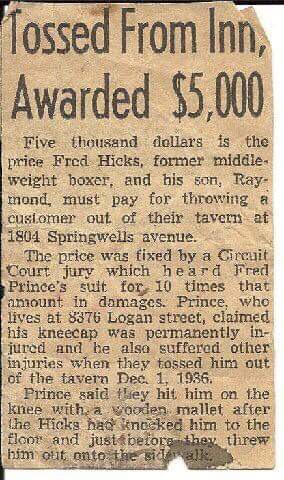
When I first became a Church of the Nazarene pastor, people would frequently ask if General Superintendent William Prince was my grandfather. Um…. no. Not by a long shot. This became more evident this week, when a cousin shared a 1937 Detroit newspaper article about my grandfather. The article doesn’t tell how my grandfather rescued a child from a burning building in heroic fashion. My grandfather did not lead a food drive to help the hungry in the Great Depression. I wish that were the case.IMG_6682.JPG

Apparently, a jury awarded my grandfather $5,000 (that’s over $92,000 in today’s dollars). This windfall came to the namesake of my brother and cousin because two men, the owner of a tavern, Fred Hicks and his son Raymond, tossed my grandfather out of their bar and beat him with a wooden mallet. Grandpa Fred claimed his knee was permanently damaged. The jury agreed.

It’s a brief article, but it gives a peek into my family history.

Princes have had a problem with alcohol. I’m not sure what prompted my grandfather’s hasty exit from the drinking establishment, but it’s not a stretch to say alcohol played a role. Of course, this incident happened approximately seven years after my grandmother (Fred’s wife) died of alcohol poisoning. Did I mention we had a problem with alcohol?

Princes haven’t always been good with money. $5000 was a lot of money during the Great Depression. When my grandfather died no one in the family worried about how they were going to spend their inheritance. There was no inheritance.

The article stated that the tavern owner was a middleweight boxer. My ancestors hit the bottle hard, but apparently did not hit the gym hard. Moreover, my grandfather must not have taken the advice that he gave his son (and my dad taught me): “When in trouble– do a lot of ‘cutting’ and ‘shooting.’ Cutting around corners and shooting for home.” Apparently, even before my grandfather’s kneecap was smashed by a wooden mallet, he was not the fleetest of foot.

It’s not a story that produces family reunion pride. We had substance abuse, money problems and we weren’t particularly smart or athletic All this to say, we were a mess.

Can anything good come out of 8376 Logan Street? Others may have given up on our motley crew. God did not. I’m not sure of where my grandfather stood with the Lord—he died before my dad met my mom. But in spite of all the dysfunction, all of Fred’s children came to faith. Many of Fred’s grandchildren and great grandchildren are serving the Lord. There are lawyers, teachers, nurses, counselors, and business people in the family. The two namesake grandsons (my cousin Fred and my brother Fred) both became pastors, so did three others. God never gave up on my family.

Your family story may include a drunk with a gimpy leg, like mine, but that doesn’t have to be the final word. God can redeem even the worst family’s story by making us part of His family and His story! Paul said this about himself, but it applies to me and my family: Here is a trustworthy saying that deserves full acceptance: Christ Jesus came into the world to save sinners—of whom I am the worst. (1 Timothy 1:15) Thanks be to God!


Future Church > Present Church. Here’s Why…

Future Church is going to look a lot different than Present Church and that’s a good thing.

Present Church:
Aging clergy
Declining attendance
Decreased giving
Partisan politics dividing the church
Young adults leaving church in record numbers.
Commitment level (even among the most devout) at an all-time low.

Future Church:
Bi-vocational ministers (like the early church*)
More house churches (like the early church*)
Less reliance on money and buildings (like the early church*)
Less politics, more Jesus (like the early church*)
An all-in, whatever-it-takes mentality of the faithful (like the early church*)

Present Church has taught Future Church what NOT to do. Present Church has gotten off track in our Americanized version of Christianity. Our voice is being convoluted by things that are not the Gospel. There’s too much carnality within our ranks. We are too political. We have too much angst and not enough Jesus. We are quick to point out the slivers in other’s eyes, while winking at the log in our own. Hypocrisy is rampant. It’s no wonder our young people are saying, “if that’s the church, thanks but no thanks.”

The Church was Jesus’ idea. He builds it, not us. If Present Church has failed Him (the previous paragraph implies that we have), then Jesus will raise up a new generation with new methods to proclaim His never changing message of hope. A new generation will look at what our efforts have gotten us (low numbers, feeble faith, anemic commitment and fearful and silent leaders) and determine that they will not be like us. They will have learned from our silence in the face of sin and our boisterous condemnations of those not like us. The next generation will not make the same mistakes.

How can I be so sure? Jesus! Jesus is the head! Jesus is our Teacher. Jesus is our strength. He is before all things, and in him all things hold together. And he is the head of the body, the church; he is the beginning and the firstborn from among the dead, so that in everything he might have the supremacy. For God was pleased to have all his fullness dwell in him (Colossians 1:17-19). Jesus will overcome! If death could not defeat Him, then neither will our generation’s watered down, powerless, politicized, teetering, non-Biblical ways. I will build my church, and the gates of Hades will not overcome it. –Jesus (in Matthew 16:18).

*The Early Church had its troubles. Future Church will too. Our Enemy was, is and will be on the prowl. But Future Church like the Early Church will rely on Jesus more, because Jesus is all they will have and that will be enough.

Bring back the Covered Dish as a symbol of our church

On Tuesday night, the Central Church Board and some of the pastors joined Karla and me for a cookout at our house. (I say some of the pastors because some were out of town or had other commitments). I grilled chicken, pork, beef and hot dogs (who knows what’s in the dogs… I’d like to think it was only chicken, beef or pork). Everyone brought a dish to pass. The potluck proved to be lucky as every pot (or dish) was yummy. The conversations were even better. The rain held off for most of the night and all was good. (Tangent Alert: Let me take this space to say we have a great church board! They love Jesus and Central Church. They are leaders you can be proud of and it is a pleasure to serve alongside of them. The pastors are awesome too!).

Tonight, it’s Cookout Part II, as our home group is coming over. It’s the same drill as Tuesday only no beef (except for what may or may not be in the hotdogs). We will eat, talk, pray for one another and look a bit into God’s Word. Many times, my home group helps hash out my thoughts for the upcoming sermon. (Let’s pray they help me tonight… or we could all be in trouble Sunday morning). I love our group—they are a huge blessing!

Christians have been doing this sort of thing since before we were called Christians. In Acts 2, Luke writes about those early believers: They devoted themselves to the apostles’ teaching and to fellowship, to the breaking of bread and to prayer (Acts 2:42).

Back in the NO NO Days (no movies and no dancing), we used to say that the only thing Nazarenes could do was have pot-lucks. We’d say in jest that we needed to replace the dove on our logo with a covered dish as it was the best symbol of the denomination. While we were mostly joking, I think something important was happening in those church potlucks.

When folks gather in Jesus’ name for the simple purpose of eating, fellowshipping, praying and Bible study, the Lord is present. When Jesus is near, we grow together. We learn from one another. We cry with one another’s sorrows and rejoice in our victories. It’s not complicated. It’s the church at its best. It’s also not shocking that Luke further wrote: And the Lord added to their number daily those who were being saved (Acts 2:47). When the church is at its best, the world notices and wants to be a part of what God is doing!

Bottom Line: If you want to grow in the Lord, then do what the early believers did. Get with a group in Jesus name and eat, fellowship, pray and get into the Word. You’ll be amazed at what God will do!

Where have all the prophet’s gone? Has modern preaching failed us?

Few would argue that we are living in a post-Christian America. There is anger, envy, lust, pride, and greed on all sides. Like most previous generations, we look around at the dismal state of affairs in and out of the church and say, “Come, Lord Jesus, Come.” Unlike most previous generations, very few prophets are emerging calling out our sin, directing us back to Jesus and toward the way of holiness.

Where are all the prophets?

My cynical view:
Truth telling is costly. Prophets and their families like to eat. Isaiah may have been an aristocrat. Amos wasn’t a prophet or the son of a prophet, his income probably came from sheep and figs. The Apostle Paul was a tent maker. Are modern would-be prophets silenced because they know where their paychecks are coming from and speaking out could jeopardize their livelihood? Have prophets been influenced by profits and loss?

Churches have enough trouble these days keeping members even without the preacher/prophet upsetting half the crowd. With less people attending, pastors feel pressured to keep all the folks they can. Has fear of emptying pews toned down the prophetic or controversial (yet Biblical) topics? There is no need for the devil’s temptations to be silent in the face of blatant sin when the prophetic voices are silenced by fear.

Do our preachers/prophets lack backbone?

It seems the few modern-day prophets (who are not afraid to speak truth) fall into one of these categories:

1) Retired Leaders. New-found boldness comes in direct proportion to their retirement from Big Wig status. With a secure retirement and no longer the subject of church votes, the formerly silent leaders can now utter all sorts of platitudes. Maybe the point is: Better late than never.

2) Pastors who are no longer pastoring. Disillusioned by the state of the politicized church, they have left the pulpit for another gig or have a spouse that makes a living wage. This newly voiced prophet (again unhindered by salary) will occasionally tweet or blog prophetic-like truths, but they have lost their pulpit, platform and much of their voice.

3) Pastors (usually from smaller churches) whose congregants have determined no matter what is said or written by the pulpit resident– they aren’t going anywhere. It was their church before the pot stirring pastor arrived and it will be their church after the pot stirring pastor leaves. Agree or disagree, they will wait him/her out. They’ll keep coming to church when the doors are open because that’s what they do. Of course, these small church truth tellers have a limited crowd.

That’s your list of modern day prophets. Prophets who need no money or prophets who have no audience.

Your cynical view:
“I don’t see you speaking up. I don’t see you calling out hypocrisy in the church, in politics and in our lives. I don’t hear your prophetic utterances that shake the rafters and cause a stir. You, sir, are the proverbial pot calling the kettle black.”

 My Confession:
I know. God help me, I know. I want to think that I am not afraid of half the congregation walking out following a biblical but unpopular message, but I’d be lying if I said it wasn’t a concern. Pastors and would-be prophets (myself included) remember the words from Joshua: Be strong and courageous. Do not be afraid; do not be discouraged, for the Lord your God will be with you wherever you go. Joshua 1:9

My Hope:
My fellow boomer and X-gen pastors, let’s not wait for someone else to pick up the prophetic torch in the days ahead (I’m looking at you, millennial pastors, and I believe in you!). Today. all pastors/prophets must follow Jesus’ example and boldly speak full of grace and truth (see John 1:14)! Pray for wisdom, strength and courage and go forth proclaiming the Gospel! This generation desperately needs us to regain our prophetic voice and proclaim the powerful message of Jesus. Don’t be quiet. Be brave! Be bold… and God will be with you wherever you go!

How to Disarm Enemies and Disperse Haters in One Easy Step

We all know Jesus said, “Love your enemies,” but did he mean it? That’s the big question. If you say, “Yes, of course, Jesus meant it,” then it makes sense that the followers of Jesus would (I’m stepping out on a limb here) love our enemies.  Moreover, if followers of Jesus loved their enemies then those enemies wouldn’t be enemies, at least not for long. Love disarms hate. If I love them; work for their good; pray for their well-being, then I’m not behaving like an enemy but a friend.

I’m not totally naïve (just in case you are about to make such an accusation). Our former enemies might still consider us enemies. In fact, they might hate us; say and post hurtful things; and be divisive. But Jesus didn’t say, “Love your enemies as long as they reciprocate.” If our haters see us continue to love while they are still hating, then eventually they might conclude that we aren’t their enemy. Or maybe they will still hate. I can’t control them, only me.  But as I refuse to hate (you can’t spew hate and love someone too); stop lobbing mud (you can’t throw mud at someone you love); and am kind (love is kind, 1 Corinthians 13:4); then something changes. That something is me. I can’t view them as the enemy any longer.

In case you are wondering, “loving” does not equal “agreeing with.” I can love someone and not agree with their life choices. But in our disagreement, we don’t have to be disagreeable. Disagreeing does not mean disrespecting. Love does not dishonor others (1 Corinthians 13:5).

How this plays out in the real world goes against the mistaken notion that everything in life has to be “Us vs. Them.”  When social media blows up between Christians and others engaging in back and forth yapping, then the hate continues and enemies are still enemies.  Following the “Love your enemy” command means you can’t participate in a conversation like this:

“I hate you.”
“No, I hate you.”
“You are bad.”
“You are worse.”
“Blah, blah, blah…”

If you don’t think such banter exists (on a much more complicated and wordy level) then you haven’t spent much time on social media lately (congratulations for that, by the way). Malicious speech among all sides happens all the time. ALL. THE. TIME.

If love disarms hate, and If I am loving then…

LBGTQ people aren’t my enemy.
Immigrants aren’t my enemy.
Liberals aren’t my enemy.
Conservatives aren’t my enemy.
Other religion adherents aren’t my enemies.
Atheists aren’t my enemies.
Abortion rights advocates are not my enemy.
Pro-Life picket sign holders are not my enemy.
Democrats are not my enemy.
Republicans are not my enemy.

But Ohio State Buckeyes are still my enemy! Just kidding, even Buckeyes are not my enemy. Our Enemy is the Evil one. That’s it. When we engage in hate toward our enemies, he wins.  When we love our enemies, he loses. Simple. Let’s not let our true Enemy win. Instead, let’s do what Jesus said to do: In both our actions and attitudes, love our enemies (He really said it and he really means it).


Are We More United Than You Are Led to Believe?

July 4th is the day we celebrate the United States of America. At times, you might get the impression that our nation’s name is the Divided States of America. I’m not naive. We aren’t perfect. We have our differences in the land that we love. What country doesn’t have problems? Our streets aren’t paved with gold and our gates aren’t made of pearls. As much as we pray that God’s kingdom would come and his will done on earth as it is in heaven, we aren’t there yet. But I’m an optimist. The squeaky wheels seem to get the media’s grease—but I like to think that most people aren’t like those squeaky wheels. Most people are good, honest and hard working. Most people have common sense. I want to side with most folks.

Most Americans like our diversity. Most folks know that God uniquely created us and gave us different gifts, ideas, abilities, talents, desires, and aptitudes. We don’t all look alike, think alike, dress alike, or like the same music or sports teams. That helps make life full and exciting instead of boring and stale.

Most churches are trying their best to serve God. Are there mean spirited churches or churches that have gotten off mission? Ugh…yes. But most love Jesus and love their neighbors.

Most folks understand that the content of one’s character not the color of one’s skin is what matters. Are there racists out there? Unfortunately. But let’s keep educating, working and singing until everyone believes: Red and Yellow, Black and White they are precious in his sight. Jesus loves the children of the world.

Most police are doing a great job. Are there some bad apples?  Sure. There are bad preachers too and bad teachers and bad burger flippers and bad you name it.

Most people on-line like to share their joys, delights and maybe prayer requests. Are there cyber bullies? Not only cyber bullies, there are cyber goofballs, cyber knuckleheads and cyber what-were-you-thinking-for-posting-that. But most folks use social media to share victories not dance on other’s defeats.

Most people recognize that politics is necessary in a democracy (refer to the above statement on how we don’t all have the same ideas). For Christians, we put our hope in the Lamb, not the elephants or donkeys, but we also understand that those on the other side of the aisle don’t hate you or hate America. We just see things differently. If we look for it, we will see we have more in common than not.

Most people want everyone to be healthy. Do we all agree on how this can happen? Nope. But if we don’t dream of a better healthier tomorrow, we won’t get a better healthier tomorrow.

Most folks recognize that’s what is happening at the southern border is terribly sad and disturbing. Do we all agree on how to move forward? No, but most people agree with Jesus who said we need to love our neighbor and to care for the least of these.

Most Americans love our veterans and want them to have the absolute best care— for their physical, emotional and spiritual well-being. Most people are rightly shaken that 23 vets take their own life every single day and we must end to this disturbing trend.

There’s more circumstances that seem divisive but don’t necessarily have to be, but you get the idea.

Most folks can’t quote Mark 8:25, but we all know its truth that says: If a house is divided against itself, that house cannot stand. Most individuals want our country to stand strong and united for generations to come.

The divisive words and actions of others might make the news, but let us work with most Americans who long for us to be the United States of America. That is all.

Don’t know what to do regarding some of our real-world problems? Let’s start by doing what Jesus said to do.

There are a lot of topics that Jesus either didn’t address of wasn’t able to speak to because the situations were not present in the first century of Palestine. We can’t expect Jesus to talk about the proliferation of nuclear weapons when the capability of destroying the whole earth with a push of a button wouldn’t exist for 1900 years. Global warming wasn’t one of Jesus’ talking points. So I get it that there may be room for interpretation, when it comes to things that Jesus didn’t directly address.  We can assume and imagine, but we can’t know exactly what Jesus would have said about such eventualities. But there are plenty of others things to which Jesus spoke directly and clearly. For instance,

I don’t know all the intricacies of the crisis along the southern border of the United States, but I know Jesus said, “Let the little children come to me, and do not hinder them, for the kingdom of heaven belongs to such as these” (Matthew 19:14).

I don’t know all of the heartache that goes along with being incarcerated or having a family member incarcerated, but I know Jesus said, “I was in prison and you came to visit me” (Matthew 25:36).

I don’t know how to answer folks who ask about the Flint Water Crisis but I know that Jesus said, “I was thirsty and you gave me something to drink” (Matthew 25:35).

I don’t always know how to proceed with conversations within the LBGTQ community, but I know that Jesus said, “If you love those who love you, what reward will you get? Are not even the tax collectors doing that?  And if you greet only your own people, what are you doing more than others? Do not even pagans do that?” (Matthew 5:46-47).

I don’t always know the best approach regarding the benefits afforded to me by living in a terribly blessed country, but I know Jesus said, “What good is it for someone to gain the whole world, yet forfeit their soul?” (Mark 8:36) and “Life does not consist in an abundance of possessions” (Luke 12:15).

I don’t know all the geo-political aspects of war and rumors of war, but I know Jesus said, “Blessed are the peacemakers, for they will be called children of God” (Matthew 5:9) and he also said, “love your enemies” (Matthew 5:44).

I don’t know why denominations are pitted against each other (as if they were the Enemy), but I know that Jesus said, “I pray also for those who will believe… that all of them may be one” (John 17:20-21).

I could go on and on, but you get the idea. Maybe instead of guessing or pontificating about what Jesus might have said in some hypothetical world, we should start to listen, obey and do what Jesus DID SAY regarding many of our real-life dilemmas. It seems that if we just do what Jesus directly said to do we (and our world) would be much better off.

Has the death of Sunday Night Services led to Sunday Morning Worship decline?

Fact #1: Sunday Night services in the Church of the Nazarene have gone (or have mostly gone) the way of the dodo bird.

Fact 2: Sunday Morning church attendance in the Church of the Nazarene (USA) is in decline. In some places, it is gradual; in others, it’s a free fall. In very few pockets is there growth.

Fact #1 (the non-existence of Sunday Night services) is NOT the cause for Fact #2 (Sunday morning decline), but it’s a symptom that has led to overall demise of the church.

Not trying to sound like a church curmudgeon (I remember the good old days…), Sunday nights were preceded in my early years with a NYPS (current NYI or a youth service) and then the Sunday Night service ensued. On Sunday Nights, we had youth bands playing, young people singing “specials” (sometimes they were not very “special”) and frequently those called into ministry would preach. Always there were testimonies of how God had worked in the individual’s life that week (in one church, a lady with dementia would recount that week’s soap opera details as if they were in her own family; in another, a man would tell wild tales of life with his drug addicted son and conclude by saying “where He leads me I will follow.” I am not sure it was God leading to the crack houses, but I digress). Often following the service a big group would end up at a local restaurant and tell the same funny stories over and over again.

If the above description sounds too idyllic, in a moment of full disclosure, please note:  It wasn’t uncommon for Sunday night services to feel like a train wreck or the ugly step sister of Sunday morning. There are reasons why gathering back at the church for an evening service has died.

The problem is that the essential aspects of the Sunday night service aren’t happening in our Sunday morning gatherings.

Again, I am not saying we need to revive Sunday Night services (for the record, in my current assignment we still have Sunday Night services. Last night we had a youth service going on, a VBS meeting for volunteers and a Pentecost prayer service in an upper room in the church). But we need to regain what was lost in our Sunday night services. A place where our youth can learn and use their gifts. A place to hear the stories of victories of God in individual lives. A place that makes fellowship with one another easier. In other words, a place that makes the church family seems like family.  In some churches this takes place in small groups, but in many churches these aspects of Christian fellowship have been lost.

Maybe one of the causations for our Sunday morning decline is that the church no longer feels like family. The Sunday Morning service is more like a show, a place to be entertained. There’s little connection or interaction with others. Little investment is made by the attender. They come. They listen (maybe sing). Then they leave. With little “skin in the game,” there is also little commitment and little reason to keep coming. When a better Sunday morning “show” comes to town, it’s easy to jump ship for the newer, hipper, better “worship-tainment.”

Without the communal aspects of Sunday night services, churches must be diligent to create a warm family-like experience that will keep both old and young tied to one another.  Intergenerational empathy for each other is crucial for the long-term health of the church. A commitment to making Sunday mornings less showy (not necessarily a lesser quality) and more communal, more familial is what is needed.

Can we reverse the downward trajectory in the USA Sunday morning attendance? Making the church a family again will be a good first step in that direction.

Is your church like a Country Club or a City Park? Here’s how to tell the difference

Not everyone likes being a part of a church that deeply cares about its community (They’d never say it that way. It’s kind of like saying, “I don’t care about people.” That sounds bad. So they’d never say it, but if the Gucci loafer fits…). There are plenty of church goers who’d rather their house of worship was more like a country club than a city park. There are big differences between a church that’s like a country club and a church that’s like a city park.

A country club-like church is exclusive—only a select few are welcome. It’s for “us.”
A city park-like church is open for all. It’s for “us,” “them” and “them” too. Everyone’s welcome.

A county club church keeps “those people” out.
A city park church is full of “those people” (whoever “those people” happen to be).

A country club church’s members like being with people just like themselves. Diversity is bad.
A city park church’s attenders love that everyone is not alike. Different is good.

A country club church’s members show up to be seen.
A city park church show up to celebrate life.

A country club church only values those who contribute.
A city park church values everyone.

A country club church proudly boasts of their once-in-a-blue-moon pittance for the needy.
A city park church regularly cries with those who have been beaten down by life.

A country club church is nice and neat.
A city park church is sometimes messy. The playground equipment isn’t the best or newest… and that’s ok.

A country club church would rather have kids seen than heard. The quieter the better.
A city park church loves it when kids are squealing and having fun. The louder the better.

A country club church is best summarized by the words, “Hey you kids! Get off my lawn.”
A city park church is best summarized by the words, “Have fun kids! You are loved!”

A country club church exudes snootiness (snotty-ness?).
A city park church exudes Jesus (just Jesus!).

But most of all…

A country club-like church teaches you’re better than your neighbor.
A city park-like church teaches one to love their neighbor.

Would Jesus be at the city park or the country club? We all know the answer to that question.

A Pastoral Perspective on the Abortion Discussion: Pro-Women, Pro-Baby, Pro-Both.

A week or so ago, a Nebraska farmer, Kurt Kaser, amputated his own leg with a pocketknife after his leg was caught in some farm machinery. With his leg stuck in an auger, he was being drawn into the apparatus which would mean certain death. No one was around. His cell phone was out of reach. Mr. Kaser realized his only hope for survival was to cut off his leg. (You can read his story here.)

No one in their right mind, under normal circumstances, would cut off a limb with a pocket knife. One would only resort to such measures if it was life or death. Extreme circumstances caused him to do the unthinkable.

As the abortion debate has heated up in recent days, Mr. Kaser’s dilemma seems eerily similar to what many women face with an unwanted pregnancy. The notion of ending a pregnancy goes against every maternal instinct we humans have.  Yet extreme circumstances cause many women to do the unthinkable.  (Tara Beth Leech’s article from a few years ago helped me understand this issue better).

I don’t believe that most women (at least not the ones I’ve talked to) choose to have an abortion like one chooses hair color or an item from the menu at Applebee’s. The decision is more like Mr. Kaser’s: amputate or die. When faced with an unwanted pregnancy, often women, like Mr. Kaser, feel trapped, alone and afraid. It might seem at that moment to bring a child into her dysfunctional world would only cause more grief, hopelessness and despair. Extreme circumstances lead to the unthinkable.

As a male, pro-life pastor, I understand some people view those three descriptors as disqualifiers from having any meaningful input into the abortion debate. It’s true, I can’t imagine being trapped like Mr. Kaser where my only option was to amputate my leg with a pocketknife. Just as I do not pretend to know the horrific trap that many women feel when trying to navigate the decision of having a child while their world is caving in all around them. My contribution to the abortion discussion is not more pontificating, but is the work of a pastor. I want to following Jesus lead in John 1:14. I want to be full of grace and truth. I want to help build a hope-filled and loving Christian community that comes alongside women and their babies. It’s advocating and working for a better story for women who feel trapped in their pregnancy.

Surveys show that the church is not the first-place women turn to when in the midst of an unwanted pregnancy. For some it’s the last place. That’s part of our problem.  But what if we could change that story?  What if we aren’t seen as dishing out condemnations for their present circumstances, but seen as a Jesus-reflecting, helpful place that leads women and children toward a better future? What if churches offered real concern, love and resources to women who feel stuck in an uncertain future? What if women came to our churches because we offered the most empathy and support?

The work of the church and the pro-life movement cannot stop caring at the baby’s birth, but must continue to provide a loving and nurturing community for moms and babies (and for everyone else, for that matter) throughout their lifetime. Let’s work for everyone’s well-being both in the present tense and in the future. Let’s fight for better present circumstances of women who feel their only option is an abortion and fight for a better life for moms and their babies in the days ahead. Maybe if the church demonstrates that both women and their unborn children are created in the image of God and their well-being matters to God, then women wouldn’t view abortion as their only option. Let’s be pro-woman, pro-baby, pro-both.


Will the Church of the Nazarene Split over Social Drinking?

Please read the following disclaimer/facts before reading the article below:

Fact 1: My dad was an alcoholic before becoming a Christian. Had he come to Christ in a church that allowed social drinking, I believe my dad would have died an alcoholic.

Fact 2: Medical professionals are now admitting that even small amounts of alcohol can have a negative effect on a person’s well-being. See the August 23, 2018 study here.

Fact 3: The Church of the Nazarene has historically taken the stance of prohibition in part to side with those who struggle with issues of alcohol and chemical dependency.

Fact 4: Many Nazarenes are already drinking (I have had plenty of attenders, members, and leaders admit to social drinking and voice disagreement with our current policy).

Fact 5: Other historically “dry” denominations have allowed social drinking in recent years.

Fact 6: The Bible argues against drunkenness. It does not mandate abstinence or prohibit the consumption of alcohol. (Note: a case could be made that clean drinking water was not readily available for the Biblical writers and the medicinal purposes of wine in ancient times outweighed the dangers of moderate alcohol consumption.),

Fact 7: The Social Action Committee at the 2017 General Assembly passed a resolution that would have permitted social drinking. There was not a vote on the General Assembly floor because the proposal was sent to committee for further study (I do not know if a committee has been formed nor do I know what is/was the outcome or recommendations from that committee).


Given these facts, will the Church of the Nazarene split over the issue of Social Drinking?

I have heard from people that if the church changes its stance regarding social drinking they will leave. I liken this to their parents who made similar statements regarding the cinema 30+ years ago. They didn’t leave then, and most won’t leave now. Members won’t leave in droves should the alcohol position change. There won’t be a split. Where would the teetotaler members go?  As already stated, most once dry denominations have already allowed for (or turned a blind eye to) social drinking among its membership. Moreover, for many of the younger members in the Church of the Nazarene, drinking is a nonissue. They already socially drink.

The great likelihood is that the General Assembly delegates will pass legislation that opens the door for moderate social drinking (if not in 2021 then surely in 2025), Given my family history (see Fact 1), I will not be happy with the change. Given modern research (see Fact 2) we may regret the decision. Given our historic stance of siding with those who struggle with alcohol (See Fact 3) we may lose some of our voice with the victims of alcoholism and its effect upon individuals and families.

Ultimately, the reasoning to move away from our historical stance regarding alcohol is less about righteousness or coming alongside a struggling believer and more about pragmatism:

1) The ship has sailed. Many are already drinking (see Fact 4);

2) “Peer pressure.” Other once dry denominations now allow social drinking (see fact 5); and

3) Making a Biblical argument is difficult as the Bible doesn’t expressly forbid it (see Fact 6).

For these reasons, the prohibition against alcohol consumption seems likely to be lifted once the debate reaches the General Assembly floor. I will not leave the Church of the Nazarene over this issue, nor do I think that many others will. But I will be saddened for the children of alcoholics like myself whose family was salvaged because of the grace of God and the historic stance of a church that stood with those who struggle with alcohol.


A Better Mother’s Day Gift than Burnt Toast and Cheerios

On Mother’s Day, I would make my mom breakfast-in-bed. By “breakfast-in-bed,” I mean: burnt toast, orange juice and cheerios. I would have a jelly jar with hand-picked dandelions and a homemade card to garnish the cookie sheet that would hold the items listed. My mom always seemed thankful for the less than appetizing meal and not quite made-by-Hallmark Mother’s Day card. She conveyed an appreciated for the effort. She probably would have appreciated more my completion of any number of household chores that generally slipped my mind without parental reminders and threats of no allowance. But breakfast-in-bed was what she got.

At church on Mother’s Day, there were generally prizes for the oldest, youngest and mom with the most kids. I can’t remember my mom ever winning any of those awards. Often the ladies of the church were paraded to the front where they would sing the third verse of Such Love or some hymn.  Was this “special recognition” a prize or punishment? Once home from church, I don’t remember my mom ever sitting in the living room while the kids prepared Sunday dinner. The kitchen was her domain (Mother’s Day or not).

Mother’s Day consisted of a lousy breakfast, an introvert’s nightmare at church and making her own Mother’s Day meal. Lot-te-da!

Truth-be-told, I’m not sure any mom becomes one because of a Mother’s Day gift. Enduring childbirth and the hassles of raising a bunch of yahoos for a box of chocolates or a dozen roses hardly seems like a good deal. Most moms (sadly not all) are glad for this special, unique role and would do it all over again even without the dandelion bouquet.

To all ladies (mothers or not), no Cheerios or burnt toast, instead I offer the following:

  • If you are exhausted with all the duties that come with being a mom, I’m praying for your strength and cheering you on!
  • If you adopted a child or are a foster parent, thank you for your commitment to the lives of children.
  • If you are struggling with infertility, I am hoping with you and holding you in prayer.
  • If you are single, remember the Lord has made you completely whole!
  • If you are a single mom, I pray that the Lord provides all of your needs!
  • If you lost a child this year to death or miscarriage, I weep with you.
  • If your child is hindered by addiction or struggling with life, then I will take you to the One that specializes in bringing home prodigals.
  • If you are alone on Mother’s Day, the Lord is your companion.
  • If you are surrounded by loved ones on Mother’s Day, the Lord enjoys your delight!
  • If you grieve this Mother’s Day, the Lord mourns with you.
  • If you celebrate Mother’s Day, the Lord rejoices with you.

If Mother’s Day brings a smile or a tear, know that the Lord is forever on your side in all of the circumstances of life.

For Pastors, the Monday after Easter Means…

For Pastors, the Monday After Easter means…

  • Sleeping in. Hello pillow my old friend.
  • Two Words: Binge NetFlix
  • Queasy stomachs. Now you know why they are called “devilled eggs.”
  • Dress/Suit back into a closet until a funeral or next Easter whichever comes first.
  • Sugar high. For the No Candy during Lent crowd.
  • Caffeine rush. For the faithfully deprived coffee drinkers.
  • Back on Facebook following the Lenten fast. Scroll timeline for two minutes, realize it’s still a cesspool and life drain and decide to delete account.
  • Hangovers. Hey, Episcopalians recognize Lent too. (I’m joking, my Episcopalian friends)
  • Empty plastic eggs. Mostly under your bare foot at 2AM.
  • Ham leftovers. Ham and eggs for breakfast. Ham sandwiches for lunch. Fried ham and scalloped potatoes for dinner. Bean soup tomorrow.
  • Second thoughts. Wishing there was a little more Umpff in that “He is Risen!” line.
  • Calculating. How to get yesterday’s crowd to come back before Christmas?
  • Wal-Mart Trips. Easter candy 50% off.
  • Fake Easter Grass in the dog’s food dish, in between the couch cushions and in the ice maker. How did it get in there?
  • “Hello Pastor. This is Ima Grumbler. I hate to bother you on a Monday, but how come we didn’t sing all four verses of Up from the Grave He Arose. It ain’t Easter if we don’t sing all four verses of Up from the Grave He Arose. I’m sure the Baptists sang all four verses of Up from The Grave He Arose. I hope next year we sing all four verses of Up from the Grave He Arose.”There are only three verses in the hymn and its name is Christ Arose not Up from the Grave He Arose.“Oh. Nevermind. Good-bye.”
  • Free lilies! Anyone? Anyone?
  • Maybe the Easter Egg dye will come off my fingers by Mother’s Day.
  • Forget something at church? Sorry, no one answers the church’s phone on Monday.
  • 354 days until Good Friday (April 10, 2020).
  • He is still risen! He is still risen indeed.

An Easter Egg (and Chicken) Hunt — an Easter Invitation Story

Once upon a time there was a boy named Johnny Pullet but his friends called him Ducky. He was the youngest child, lowest on the pecking order you could say, in his family and he loved Jesus.  His older brother, on the other hand, put on a tough outer shell, a real rotten egg, and acted as if he’d never go to church. He scrambled like a wild chicken whenever Johnny would come over. Easy invitations to attend Easter services weren’t to be for Ducky. In fact, it was hard. Boiled by his brother’s refusal to even consider attending Easter service Ducky decided to pray that the brothers would not be unequally yoked but would one day be a big happy Christian family.

One morning, as he was walking around his house (he was on the sunny side) up ahead he spied his brother who seemingly had poached an out-of-season female pheasant, a hen.  His brother also saw Ducky and laid into Johnny as his eyes grew the size of ostrich eggs. “Benedict Arnold you will be, if you tell anyone what I did,” his brother in a Yoda-like manner said, while also thinking he had done a dastardly deed.

Not wanting to get his brother in trouble, but also not wanting him to be devilled by his ways, Ducky, again, decided to pray. In a moment of inspiration, Ducky hatched a plan. He got cracking, combed his hair and ran to his brother’s house. A small place, Johnny felt cooped up in it, but he boldly asked his brother, “If you aren’t in trouble with the game warden, will you come to Easter Services with me?”

“If I am not in fowl (sic) with the law, “omeletting” you know, I will give you a carton of my finest treasures AND go to church with you.”  Ducky quickly showed him that the “pheasant” wasn’t a pheasant but just a heap of feathers from a previous hunting expedition. His brother took a gander at the feathery mess and said, “Well, I’ll be a Gizzard’s uncle, you’re right! Let’s whisk off to church!”

Proud as a rooster, Ducky walked into the church with his brother by his side that Easter.  His brother loved it and has been coming ever since. He even met a nice chick and the two planned to get married as soon as they find a fryer (friar) willing to officiate their happy nuptials.

The end.

Moral of the story: Don’t keep your eggs in one basket. Keep praying and inviting people to Easter Services in as many ways as you can. The services will be Egg-citing and Egg-cellent and your friends will be glad you invited them!

The following 29 chicken and egg (which came first?) words were hidden in the story above: Carton, Chick, Chicken, Comb, Coop, Cracking, Devilled, Duck, Eggs Benedict, Fowl, Friar, Gander, Gizzard, Hard Boiled, Hatch, Hen, Laid, Omelet, Over Easy, Pecking Order, Poached, Pullet, Rooster, Rotten Egg, Scrambled, Shell, Sunny Side Up, Whisk and Yoke

How the Notre Dame fire and the Church of Jesus Christ will be remembered

It is Holy week and the Notre Dame Cathedral in Paris was on fire. You no doubt saw the video of the iconic church burn. All the world is heartbroken. The damage is in the millions. One billionaire pledged $339 million to help its rebuilding (even that will not be enough).

As I was watching the images of the fire, I wondered how historians will view this week’s events. Will they say the fire at one of the world’s oldest and most known places of worship during Holy Week is a symbol of the destruction of Christianity in the 21st century? It’s no secret that Christianity in Europe has been on the decline for decades. It is devoid of power and effectiveness. America’s Christianity isn’t far behind. So I wonder if some scholar in two hundred years will write on the “Rise and Fall of the Church of Jesus Christ,” and cite the destruction of Notre Dame to say “the best efforts of the firemen like the best efforts of a few true believers could not stop the destruction of the church. The church died in the 21st century.”

Most watchers of religious trends know that the “nones” (those people affiliated with no church and no religion) are the fastest growing group in America. They have passed the Roman Catholic adherents and every evangelical denominational membership in the last ten years. If not dead, many would say the church is dying. That’s the bad news.

Here’s the Good News: Jesus is still the head of the church. Paul wrote this:
The Son is the image of the invisible God, the firstborn over all creation. For in him all things were created: things in heaven and on earth, visible and invisible, whether thrones or powers or rulers or authorities; all things have been created through him and for him. He is before all things, and in him all things hold together. And he is the head of the body, the church; he is the beginning and the firstborn from among the dead, so that in everything he might have the supremacy. (Colossians 1:15-18). In other words, the truth that should be most evident during Holy Week, Jesus specializes in resurrection.

In light of the Notre Dame fire and the fate of Christianity, what can we do? Like the French firemen dosing the flames of Notre Dame, we need to get to work. We can’t simply shake our heads and say to the church, “Rest in Peace.” Everyone who calls themselves a follower of Jesus must to be about the urgent business of Jesus. We need to be people of prayer. Committed to living and sharing the life of Jesus. We need to love our neighbors and our communities with our presence and with our mouths sharing Christ’s love and hope.

Begin today. This Sunday is Easter. Pray for your neighbors, friends and family members who might be likely to mark “none” on a questionnaire about their religious leanings. But don’t stop at praying, invite them to Easter Sunday services. Make the appeal of Jesus evident in your life. Determine that Christianity isn’t going to come crashing down on our watch. Let us live and embody Jesus’ words so much that the evidence of His resurrection is overwhelming.

Let’s proclaim the Good News so when our imaginary historian writes in 200 years of the fire at Notre Dame it will not be of the Rise and Fall of Christianity but instead it will reflect the “Rise and Fall and Resurrection of the Church of Jesus Christ!”

Your Pre-Easter MUST Do List (with appropriate hashtags provided)

  1.  Make sure the family has coordinated outfits for the Easter Photo Booth at Central Church. #SayCheese #easteratcentral2019
  2. Invite a Friend to Central Church’s Easter Celebration Services. #JoinMeAtCentralChurch
  3. Taste the jelly beans, peeps, chocolate bunnies, Cadbury eggs, Lindt chocolate carrots, Nerds’ bumpy jelly beans, Whoppers’ robin eggs, Reese’s peanut butter eggs, and Russel Stover’s marshmallow eggs just to make sure that they haven’t gone bad.Remind yourself you are making this “sacrifice” for the children. #BetterSafeThanSorry
  4. Hide eggs. Hint: Do not put them where curious dogs, cats, raccoons, mice or any other creatures in God’s Kingdom (including candy-starved dads) might find them. If the kiddos open up the plastic eggs and like the Easter tomb find nothing, there could be a riot. #HideThemInAnEggCarton #ThePerfectHidingSpot
  5. Invite a family member to Easter Services. If family members experience the Resurrected Jesus then you can stop the not-so-effective rhyming evangelism strategy. #TurnOrBurn #ShakeOrBake #ComplyOrFry
  6. Practice saying, “He is risen, indeed!” There is nothing more embarrassing than following the pastor’s declaration on Easter morning that “He is risen,” for someone to loudly asks, “He’s a raisin?” #HeIsRisenIndeed #EasterTradition
  7. Lilly allergy? Take your meds. (There will be a few lilies in the sanctuary, because everyone knows that Easter and Lilies go together like deviled and eggs) #AhhChoo
  8. Invite a stranger to Easter Services. Didn’t Jesus say, “I was a stranger and you invited me in (to Central Church)”?  Maybe not those last three words, but he did say the first part. #Matthew2535 #DoingWhatJesusSaysToDo
  9. Find your Easter Bonnet in the old trunk in the basement, put it on, get your kids and tell them a story beginning with this line (they love it when you say this, by the way): “When I was your age…” #WalkedToChurchUpHillBothWaysInWaistHighSnowWearingMyEasterHat
  10. Invite an enemy to Central Church for our Easter Celebration.#EnemiesNeedJesusToo

Here’s the Shorter version of your Pre-Easter Checklist: INVITE, INVITE, INVITE, INVITE!!!

You haven’t “arrived.” Here’s why

Here are some indicators that you might not have travelled as far down the highway of holiness as you would like to admit:

When you point out your wins and ignore your losses. When pride comes, then comes disgrace, but with humility comes wisdom. Proverbs 11:2

When there’s a pit in your stomach from scrolling through Facebook and seeing a post from someone who has wronged you. The post has nothing to do with you, but you get out-of-sorts just by seeing the profile picture of your accuser. But if you do not forgive others their sins, your Father will not forgive your sins. Matthew 6:15

When a co-worker gets recognized for something you’ve been doing all along. A heart at peace gives life to the body, but envy rots the bones. Proverbs 14:30

When you linger too long on an Instagram post of a voluptuous woman (or handsome man, whatever the case may be). But I tell you that anyone who looks at a woman lustfully has already committed adultery with her in his heart. Matthew 5:28

When the driver in the car in front of you is reckless, cuts you off and your response is a four-letter expletive or a one finger wave. Do not be quickly provoked in your spirit, for anger resides in the lap of fools. Ecclesiastes 7:9

When the opportunity to give to a worthy cause comes and goes because no one will know whether you gave or not. Be on your guard against all kinds of greed; life does not consist in an abundance of possessions. Luke 12:15

When you secretly wish that a church leader who slighted you might fail. Do not seek revenge or bear a grudge against anyone among your people, but love your neighbor as yourself. Leviticus 19:18

When a fellow Christian confesses a struggle and you make a mental note to never allow him/her serve in a meaningful way. Do not judge, or you too will be judged. Matthew 7:1

When you spend more time on social media than you spend in devotion to the Lord. We do not want you to become lazy, but to imitate those who through faith and patience inherit what has been promised. Hebrews 6:2

When you think none of these aforementioned scenarios apply to you. Jesus said, I am he who searches hearts and minds, and I will repay each of you according to your deeds.(Revelation 2:23). In other words, you might want to think again about your actions and attitudes.

 An important characteristic of holy living is confession and being open to the Lord’s correction. Let us always strive to live a life open to God’s examination and receptive to His fine tuning of our hearts and minds.

How the Holy Spirit and Fire Overcome the Negative Winds in Your Life

This Little Light of Mine is a beloved children’s song that is known around the world. The anonymous song is an old negro spiritual that has been sung in Sunday schools and in cathedrals. The lyrics simply sing the truth that while we may only have a little candle light, when we don’t hide it, letting it shine and not allowing Satan blow it out, then the darkness flees!  I can appreciate that truth. Let it shine. Let it shine. Let it shine.

Don’t throw stones at me (or hide me under a bushel? No!), but there’s a problem with little lights. The little candle’s flickering flame is easily blown out. It doesn’t take Satan to “poof” it out.  Any nasty wind will do. I’ve seen enough funniest home videos to know that everyone from grandmas losing their dentures to babies covered in frosting can blow out the little candle lights on a birthday cake. Little candle lights are fragile. They blow out easily.

A booming campfire, on the other hand, the type of campfire that has lots of wood, lots of flames and perfect for s’mores can’t be blown out by grandmas, babies or any other windy happening. In fact, wildfire experts know that forest fires are not reduced by the wind, they actually grow stronger by wind. Wind extinguishes a candle but it energizes a fire.

Throughout the Bible, fire represents the power and presence of God. Moses encountered God at the burning bush, and later God appeared in a pillar of fire to lead his people in the wilderness (Exodus 3:2; 13:21). On Pentecost, following the sound of rushing wind, Luke tells that something like tongues of flame rested on each of the disciples gathered. They were immediately filled with the Holy Spirit, and their lives and the world was changed forever. All of this fulfilled John the Baptist’s prophecy that the Messiah would baptize “with the Holy Spirit and fire” (Matthew 3:11-12). That’s what we need too—to be baptized with the Holy Spirit and fire.

When we are empowered by the Holy Spirit and fire, even the hardiest winds can’t blow us out. Winds are going to come to everyone. Winds of discouragement. Winds of negativity. Winds of temptation. Winds of heartbreak. Winds of grief. Those winds are generated in some cases by the stuff of life, but other times those cold gusts come via the blowhards in our way. Difficult circumstances and negative, carnal people can try to extinguish your little light. But people who are consumed with the Holy Spirit and fire aren’t frail and failing like a little candle when the winds are blowing.  Instead blazing Holy Spirit filled believers look at the wind and those people in our life who are full of hot air and quote Paul,“We will no longer be infants, tossed back and forth by the waves, and blown here and there by every wind of teaching and by the cunning and craftiness of people in their deceitful scheming. 15 Instead, speaking the truth in love, we will grow to become in every respect the mature body of him who is the head, that is, Christ.” (Ephesians 4:14-15).

Don’t simply be a fragile little light in a dark, dark world, instead be empowered by the all-consuming Holy Spirit and fire! Even tornadoes are no match for the Spirit’s fire. Maybe a change of lyrics is in order. “This BIG light of mine is Jesus and “even the wind and waves obey him.” (Matthew 8:27). It’s not a catchy tune, but it’s true!


Killing the Power of the Pulpit in Six Easy Steps

The age old philosophical debate about a tree falling in the woods with no one around, could apply to many church sanctuaries these days. If a sermon is preached to empty pews or to folks who are half asleep or half dead, is it really heard? If preaching is falling on deaf ears in the best of circumstances, these steps will ensure the death of the pulpit in short order:

  1. Don’t Preach Evangelistically

Jesus talked about Heaven and Hell. You can too. In the last illustration from Jesus’ last sermon (see Matthew 25), he made it clear that there is a heaven to gain and a hell to shun. When preachers refuse to preach that heart change is needed and necessary, don’t be shocked when hearts aren’t changed.

  1. Preach Non-offensive messages.

In an effort to not offend anyone, preach weak, anemic sermons. No one will be offended and no one will be changed by the power of the Holy Spirit either. Paul said it best:Don’t become so well-adjusted to your culture that you fit into it without even thinking. Romans 12:1 (The Message)

  1. Preach Politics instead of Jesus

Against what some church goers might think, Jesus was not a democrat or a republican. If you must align yourself with a political party, let it not be with the donkeys or the elephants, march to the beat of the Lamb!  In a loud voice they were saying: “Worthy is the Lamb, who was slain, to receive power and wealth and wisdom and strength and honor and glory and praise!” (Revelation 5:12)

  1. Reject Biblical Authority

Many of the current debates in church circles really revolve around Biblical interpretation. What does the Bible really mean? The question is not even “Does the Bible speak against certain behaviors?” Rather are the behaviors that the Bible prohibits culturally and/or time sensitive or are the behaviors to be universally rejected. If I am going to err on either side of that debate, I want to err on the side of preaching what the Bible says. Many will reject such simplicity, but the preacher’s authority is not based on his/her words but the Word of God. Without the authority of the Word, the sermon is nothing more than a nice talk.

  1. Pray Little

Spend less time on social media and pray more. Complain less about uncommitted church folks and the gossips in your midst and pray more. Concern yourself less with politics and pray more, If you think you AREN’T PRAYING ENOUGH, pray more. If you think you are PRAYING ENOUGH, pray more. Just pray more! A sermon that is not prayed over might as well not be preached.

  1. Don’t Practice what you Preach.

Practically this calls the preacher to being a good neighbor (if you are going to preach about the Good Samaritan); it means loving your enemies (if you are going to preach from the Sermon on the Mount); and it means living in such a manner that your neighbors and even enemies recognize the power of the gospel at work in you. Your best sermons are the ones lived before your family, neighbors and church folks.

Follow these six easy steps and no more worrying about any annoying overcrowding in the sanctuary and no need to set aside an evening to disciple non-existent new believers. Soon parking will be a breeze in an empty church lot. Gathering a crowd to hear a sermon is tough enough these days, follow these steps and you won’t have to worry about it.

Interchangeable Baseball and Church Life Lingo

In honor of the starting of the baseball season (Go Tigers!!), I give you the interchangeable baseball and church life lingo.

Sacrifice Fly: A bug in the communion juice

Double play: Both guitar players are strumming during what was supposed to be a solo

Squeeze Play: Nine people sitting in an eight-person pew

Grand Slam: The pew (from the above definition) breaks

Triple Crown: The three kings in the Christmas Pageant

Closer: The last song of the worship hour

Change Up: When the band has practiced a “closer” but the pastor announces a different song is to be sung to end the service.

Home Run: A teenager’s mode of transportation to his/her domicile following a forgetful parent’s leaving church without said teenager.

Walk Off: If the teenager from the above definition is not fleet of foot.

Full count: The head usher’s attendance tally on Easter Sunday

Hit and Run: What happens just prior to a toddler’s parent being paged to come to the nursery

Pinch hitter: When the toddler in the above definition has more than one bad habit.

Home Plate: The dish a parishioner brings to a pot luck

Long Relief: The hour and a half sermon by the guest preacher

Caught Looking: What happens to the senior high boys checking out the incoming class of freshmen girls into the youth group by the youth pastor

Pick Off: What the facility crew has to do with chewing gum stuck under the pews

Tagging Up: The nursery worker’s task of placing the security/information sticker on a toddler’s back.

In the hole: Where the preacher finds him/herself when using an unapproved sermon illustration of his/her spouse

Dugout: How the preacher from the above definition exits “the hole” using flattery and extra chores around the parsonage.

Wild Pitch: A Gideon’s plea to pass out bibles at the local zoo

Fielder’s Choice: If former Detroit Tiger players Cecil or Prince had to decide between regular or gluten free communion wafers

Slide:  What old time missionaries would bring to show a picture of their work in a far-off country before Power Point

Shutout: The experience of not getting into the church before the security team locks the doors

On deck: The happening at the Senior Game Day when someone is accidentally sits on the Skipbo cards.

Warning Track (sic):A brochure telling the reader the dangers of eternity without God.

Strike Zone: The area around the preacher’s flailing arms during a heated illustration.

Spit ball: What leaves the preacher’s mouth during the above definition’s heated illustration.

Stopper: What the security team does when a deranged lady is trying to rush the platform

Cut Off Man: The sound man’s nickname following his muting the worship leader’s microphone during an extra-long chorus introduction

Foul Tip: When a jokester parishioner gives a naive pastor an off-color sermon illustration

Whiff: The brief, pleasant aroma during the eulogy when the funeral dinner crew are making cinnamon rolls

Dinger: A parking lot infraction when the church bus slightly brushes the pastor’s wife’s car

Save: What Jesus does


Yes, the World has Changed, Here’s What Hasn’t Changed

Old preacher types like me often bemoan how our world is different from when we entered the ministry as bright-eyed, wet-behind-our-ears seminary or Bible college graduates.  After 30+ years of pastoring, trying not sound disgruntled (“Get off my lawn, you kids!) but still say, “it’s true.” Things are different now. Here’s a not exhaustive list:

  • People attend church less. Give less. Serve less. Seem to pray less. But expect more.
  • The Bible is not seen as authoritative anymore. Member’s preferred cable news seems to carry as much weight (if not more) as the Bible these days.
  • Sunday mornings are not off limits to sports, camping trips or any other activity.
  • Wednesday Nights are not considered “church night” by public schools. Concerts and sporting activities take place on Wednesdays just like any other night.
  • Young adults don’t “sow their wild oats” and later return to the church; now too often they “sow their oats” (wild or otherwise) but don’t return.
  • Social media has given a voice to every disgruntled and carnal member who cowardly spews hate, lies and gossip. (Mark Zuckerberg might think he created Facebook, but after seeing the carnage caused by social media, it sure looks like the Enemy was involved. If not at the beginning, he jumped on board quick.)
  • Political angst has splashed into the church creating more friction than a sandpaper factory.

Enough examples, you get it — pastoring is different in today’s world.

But it’s not all bad, here’s what hasn’t changed:

  • The Bible is still true. For the word of God is alive and active. Sharper than any double-edged sword, it penetrates even to dividing soul and spirit, joints and marrow; it judges the thoughts and attitudes of the heart.(Hebrews 4:12). The Bible still forms a firm foundation in its “alive and active” pages. It still convicts and convinces people that God loves them and has a better, deeper, richer, fuller, more abundant life for them.
  • Broken and hurting people are still everywhere. We all, like sheep, have gone astray, each of us has turned to our own way (Isaiah 53:6).  The world is broken and full of broken people. It was true when Jesus walked this earth. It’s still true today. We have no shortage of people who have yet to experience the love and grace of Jesus. Sometimes these folks are in our pews week after week. Sometimes not. But all of us have “gone astray” and need Jesus!
  • Jesus is still Lord. Jesus Christ is the same yesterday and today and forever.(Hebrews 13:8). Jesus still repairs and restores broken and hurting people. Jesus still conquers every foe. Jesus is still the victor. Jesus is still the answer for our hurting, broken, troubled, lonely planet. Jesus’ message never grows old and His love never wanes.

 All this to say, the world is different, but God is still on the throne!  Praise the Lord!

Robert Prince is a Football Coach for the Detroit Lions. Wait… Who?

The Detroit Lions released the names of their coaching staff for the upcoming season.  For fans of the Motor City Kitties reviewing the coaches list, there is one name that might come as a surprise to you.  The wide receiver coach is none other than Robert Prince. Not yours truly, another Robert Prince.  I probably couldn’t help the Lions wide receivers much other than say things like “Run faster” and “Catch the Ball.” After watching 55 years of Lions futility, it’s my observation that the past wide receiver coaches failed to give those two important instructions. Maybe I could coach them after all. How much worse could I do?

I hope the other Robert Prince is a good coach, because I’d love to see the Lions win something before I die.  The Lions have won exactly one playoff game in my lifetime.  To put that in perspective, the New England Patriots have 36 playoff wins (in less years). So good luck to you, Robert Prince! Coach them well!

Could you imagine if somehow, I went to Ford Field and passed myself off to the security guards as the other Robert Prince. I have learned the other Robert Prince coached at Boise State (I’ve never been to Idaho), coached in the Japanese X-League (Japan has a football league?) and is African American (this might pose a challenge to pass myself off as him). I seriously doubt I could fool anyone that I am the other Robert Prince. But if I could sneak by a guard, and make it to the field as soon as it came time to call real football plays to real players in real helmets and uniforms, my lack of football knowledge would become abundantly clear. No matter what name we share, it wouldn’t take long for people to know I wasn’t that Robert Prince.

In the same way, people can call themselves “Christian,” but it doesn’t take much observation to discover if their “Christianity” is in name only. Jesus said, “By their fruit you will recognize them” (Matthew 7:16). Not by their words or calling themselves a “Christian” or occasionally sitting in a pew at church, but their fruit determines whose they are. If a person is stirring up trouble, spreading lies, causing dissention, never tithing, bitter, and not building up the body of Christ but tearing it apart, then his or her “fruit” will be sour and unappealing. Conversely, for the true followers of Jesus, “the fruit of the Spirit is love, joy, peace, forbearance, kindness, goodness, faithfulness, gentleness and self-control”(Galatians 5:22-23). No matter what name people may call themselves their fruit (or lack thereof) gives away their true self.

I will never be confused with the Detroit Lions wide receivers coach, but I hope the fruit of the Spirit is evident in my life.  By the way, years ago the service manager at a local car dealer was also named Robert Prince.  Guess what? Just as I can’t coach football, I can’t fix cars. But I can tell you what Jesus has done in my life, how He can work in yours and share as much godly fruit with as many people as I can. You can too. Be a fruitful Christian!

Thoughts on Lenten Fasting

The Lenten Season begins today and will go until Easter. Christians have been observing Lent for a long time– since about the mid to late 4th century.  During this season, many Christians will give up something (or fast) as a means to draw closer to God and intensify their spiritual awareness. I’ve known people to give up chocolate, coffee, television, social media or any number of other things for these forty days. The idea is to temporarily give up something we like (i.e. candy or coffee) in order to draw near to Someone we eternally love (Jesus).

Deciding on what or if one should fast is a deeply personal choice, and I would never suggest what you should or should not fast. Keeping in mind that fasting should be something good that you miss temporarily as you abstain from it, the following items were NOT among my Lent fasting options (since I already don’t like them and am on a permanent “fast” from them):

Flint Coney Dogs (I’m a Detroit Coney guy…sorry)

Sweet pickles (barf)

Snow and cold (it’s above my pay grade to eliminate snow and cold for Lent, but if I could…)

The Bachelor (No TV program since The Jerry Springer Show has made me consider poking my eyes out on a more frequent basis).

Political posts on Facebook (Politics and Facebook are a deadly combo, I avoid it like some politicians avoid the truth…. Oops I just got political).


Moreover, speaking of permanent fasts, I wish that…

The Detroit Lions would stop their fast of Super Bowl Appearances

Church folks would permanently fast from the following phrases:

“That’s not the way we’ve always done it…”

“I just need to be fed….”

“It’s the youth pastor’s fault…”

“It’s not my spiritual gift…”

“I’d like to give but….”

“My kid’s soccer game is this Sunday morning….”

“I probably shouldn’t mention this to you, pastor, just before you preach but….”

If you haven’t decided to fast during Lent, consider doing so. Take time to think about what you would temporarily miss, as you draw your thoughts to Jesus during these next 40 days. Remember James 4:8 is true during the Lenten season and all year: Come near to God and he will come near to you.

Read This Before Lent

Christians have always fasted during the season of Lent. The season that begins Ash Wednesday lasts forty days, not counting Sundays, and ends on the day before Easter. These forty days represent the time Jesus spent in the wilderness, when he was tempted by Satan before beginning his earthly ministry. It’s a season of self-examination when we assess our life and priorities. In this season, we repent where needed and we fast. We repent to get right with Jesus. We fast to get to know Jesus more and more. In fasting we temporarily remind ourselves that in giving up something good, like food, we see our need for something greater — namely, Jesus and his power and love in our lives.  I love this season.

As you probably know, Christians aren’t the only ones who fast. In fact, in Acts 23, Paul is testifying before the Sanhedrin and a brouhaha breaks out among the Sadducees and the Pharisees over what Paul is saying.  Then verses 12-13, tell this bizarre account:  The next morning the Jews formed a conspiracy and bound themselves with an oath not to eat or drink until they had killed Paul. More than forty men were involved in this plot.”

What’s crazy in Acts 23 is not that forty people agree to murder Paul (remember these same guys were instrumental in Jesus’ crucifixion). It’s crazy that these men decided to fast food and drink until they were able to commit their evil deed. They were fasting to do something very, very wrong. What’s sad about this messy affair is that these conspirators had a greater level of commitment to do something wrong, than a lot of Christians have for doing something holy and right.

Maybe it shouldn’t shock us. You know cowardly people who expend more energy to gossip, spread lies and tear people down in person or on the internet, than true believers spend in lifting others up. I know people who give generously to causes like Planned Parenthood and animal rights, when Christians struggle to obey God in tithing. I have a writer friend who writes and re-writes his prose wanting each word to be perfect, while some pastor friends throw a few words together with little thought and call it a sermon (I assume they hope that God will somehow transform their lack of preparation into something worth hearing. Rarely does God, to the sorrow of their yawning congregations, work such a miracle). To the shame of all believers, too often non-believers are more committed to their ungodly causes than followers of Jesus are to the Gospel.

Here’s my big question as we embark on another Lenten season: Could you be inspired by the commitment level of would be murderers in Acts 23 to motivate you to raise your commitment level to Jesus today? Consider how you might draw closer to Jesus in this upcoming season of Lent. Is there anything between you and Jesus? Confess it and move on. What might you fast as you earnestly seek the Lord with all your heart? Lent is almost here. Let’s get ready!


What Flint will look like when God’s will is “done in Flint as it is in Heaven”?

I’m not a heaven expert. I won’t be able to sell a million books because of an out-of-body experience in Glory. I really can’t describe the place to you. That’s OK, because the Bible says, “No eye has seen, no ear has heard, and no mind has imagined what God has prepared for those who love him” (1 Corinthians 2:9). That pretty much rules out any accurate descriptions of Paradise while we remain on this side of it.  The Bible tries. You’ve heard that there will be streets of gold, pearly gates and mansions. Now all of that may be exactly the way it sounds (did I mention I’ve never been there?) but it might also be the Bible writer’s attempt to describe the indescribable. For a guy (all the Bible writers were male) who walked on streets of mud, lived in shacks and entered cities through rickety gates, those other descriptors of heaven sounded pretty good. Being safe and secure, living well with no mud on one’s feet was maybe the best thing imaginable (in their minds), and concluded that must be what heaven will be like.

Around our church, we have been known to pray a version of the Lord’s Prayer that goes like this: “May your kingdom come and your will be done IN FLINT as it is in heaven.”  We pray that prayer all the time.  What would happen if God answered that prayer? Would Flint’s “Back to the Bricks” event be changed to “Back to the Golden Bricks”?  Would everyone’s house look like the Mott’s Applewood Estate? Would our Vehicle City signs on Saginaw street be made out of pearls instead of steel?

Here’s my two cents. I honestly don’t care much about mansions and golden streets. If heaven has all that then great, but I’ll be ok with a one room cottage as long as Jesus is there too. Given the life and teachings of Jesus described in the Gospels, Jesus cared for the poor, the needy, the sick and the troubled. With that in mind, here are a few things that we can agree on about heaven:

1) Everyone will love Jesus.

2) No one will be hungry.

3) No one will be sick.

4) No poverty.

5) No drugs.

6) No human trafficking.

7) No liars, braggarts, and bullies (I think that means No Facebook)

I could go on, but you get the idea. Heaven’s going to be awesome! And if we really want God’s will to be done in Flint as it is in heaven, then it makes sense that we will work to see Flint become a little more heavenly. To that end, we must get as many people as possible to love Jesus too. It means fighting with all our might to put an end to hunger, sickness, disease, poverty, racism, and all the other bad “isms.” It means loving God and loving others. It’s showing kindness to all (even our enemies). It’s bringing hope to the hopeless and being present for the lonely.

Heaven will be awesome with or without mansions. But in the meantime, let’s make Flint more awesome too as we act, love, speak and serve in a heavenly manner!

A Friendly Reminder about Pastors

Last week Karla and I were with a group of pastors that we meet with every year for encouragement and discussions.  This week, I’ve been in Kansas City for an every-four-year evangelism conference attended mostly by pastors. In other words, I’ve been with a lot of pastors lately.

I like pastors. They are usually nice people. For the most part, they have committed themselves to work of the Lord.  They love Jesus and people and that is always a good combo. Having said that, here are a few other things about pastors that you should know:

1) Pastors aren’t perfect. I know you know this (theoretically) but you may need to know it practically too.  For example, since pastors aren’t perfect they will make mistakes (just like you). They may have good motives and still make a decision they later regret. This doesn’t make them evil or horrible, it makes them human. Just like you.

2) Pastors aren’t robots. They have feelings. Pastors take it personally when folks leave their church. Rejection is never easy and when people leave, it hurts. When church people gossip or worse, it’s upsetting. One pastor friend described how he received death threats over a decision he made (I’m serious). He turned a stack of threatening anonymous letters into the police. They never determined who was sending the letters. He left the church. The letters kept coming. Weird. Another pastor (and church) hired a body guard because of threats from a church attender. Crazy. Frightening. The Bible says to trust in the Lord in the face of such circumstances, but that’s easier said than done. Pastors are human too.

3) Pastors aren’t islands. They have family issues too.  One pastor friend returned from our meetings to a death in the family; another one’s father wandered off this week and tough decisions need to be made about his dad’s care; some pastors admitted to marriage troubles; others have prodigal kids who are making horrible decisions; and still others have major health issues going on that will affect their ministry going forward. They are worried. They probably shouldn’t worry but pastors (there is a common thread working here) are human too.

When everything is humming along nicely: The Spirit is moving; congregants are loving Jesus and loving others; life is good and everything is going great, then pastoring is a great gig. But when the Enemy attacks, when life happens, when people aren’t kind, then pastoring can be tough and lonely.

I write this not to make you feel sorry for me or any other pastor you know, but to remind you to pray for your pastors. Encourage them. Be part of the solution not a problem. In my son’s house, there is a message board on the wall that applies here. It says: Be a fountain, not a drain.  It’s the same message of Hebrews 13:12 that says: Have confidence in your leaders and submit to their authority… so that their work will be a joy, not a burden, for that would be of no benefit to you.

The best pastors benefit everyone. The best pastors are the ones who joyfully know that his/her congregation is seeking Jesus, that they are lifting him/her up to the Lord on a regular basis, and their church is becoming more and more the holy people of God.

How cold is it in Michigan? It’s so cold that…

It’s cold in Michigan. Really cold.  How cold is it?

It is so cold that….

  • I stepped outside and my whole body had a Slurpee Brain Freeze
  • When the Starbucks barista handed me a steaming Venti Pike Place at the drive thru window, I instantly had iced coffee
  • After shoveling my driveway I thought about jumping in the freezer to warm up
  • No matter what movie I choose on Netflix I get “Frozen”
  • Even your friends give you the cold shoulder
  • Folks at the First Baptist Church changed their name to Zero Degrees Calvin (Kelvin)
  • The Jehovah’s Witnesses are calling themselves the “frozen chosen.”
  • Streakers are known as “Polar Bares”

Baby, it’s cold outside!

But there is another type of coldness that is far worse than anything happening outside today.  Jesus warned us about the last days with these words:

At that time many will turn away from the faith and will betray and hate each other, and many false prophets will appear and deceive many people.  Because of the increase of wickedness, the love of most will grow cold, but the one who stands firm to the end will be saved.  (underlining mine. Matthew 24:10-13)

Are these the last days? I can’t say with absolute certainty. I don’t know when our Lord will return. But I know that many folks have “turned away from the faith” like Jesus said they would. There are plenty of folks spewing all kinds of hate these days. False Bible quoting prophets are not hard to find. There is an undeniable increase of wickedness in the land. Finally, I know plenty of folks whose love has grown cold—which has nothing to do with the subzero temperatures.

It’s easy to spot a cold heart. Cold hearts are selfish hearts, angry hearts, and gossip spreading hearts. A cold heart is a blaming, shaming and judgmental heart. A cold heart thinks they have been the one wronged, all the while they are harming others. A cold heart doesn’t see the hurting neighbor, the troubled child, or the sick saint. A cold heart finds fault with the church and God’s people. A cold heart may talk about Jesus, but hasn’t known Jesus for quite some time. A cold heart, in other words, is a carnal heart that will be in deep trouble on Judgment Day.

How can we insure that our heart doesn’t grow cold?  Simple. Stay close to the flame. Stay close to Jesus. Peter got it right.  He knew in the middle of the storm (polar vortex or otherwise), the safest place isn’t in the boat, but next to Jesus. The key, Jesus said, is standing firmly next to Him. Someone who’s staying close to the heartwarming love of Jesus will never grow cold no matter what the weatherperson says is happening outdoors.

Stay warm, my friends! Stay warm!

The Day America Should have Cried Instead of Cheered.

From my vantage point, yesterday was not a good day for America.

Not a News Flash: Vulgar rhetoric has been increasing in recent years. Specifically, the use of the F-word seemingly has become acceptable language. Not just from a shock inducing comedian doing his routine in a darkened comedy club but from politicians, students, everyone. I received a business form letter yesterday from a lady wanting to sell the church some sort of photo software. In one of the opening sentences she wrote, “Your work in the world is so f–ing important, and I am so passionate about it that I am offering my gifts to help YOU reach more people…”  I wrote her back, “Dear Heather, here’s a tip for you:  Don’t use the F-Word in an e-mail to a pastor if you are trying to sell him some kind of service.  He will think that you are not professional and will automatically unsubscribe from your email list.”  What is happening to our language when this is an acceptable business practice? The de-evolution of our language hit the accelerator in the last election when both the Elephants and the Donkeys seemed to think crass talk was standard election verbiage.

Respect and love for our fellow humans has taken a hit yesterday too. We have seen the stories on the confrontation that took place with earshot of the Lincoln Memorial in Washington DC between a group of Catholic high school students and a native Americans and other protesters.  Honestly, I don’t know who was “right” and who was “wrong” but I know this, we are far from the dream of Dr. King when he concluded his famous speech with these words: all of God’s children, black men and white men, Jews and Gentiles, Protestants and Catholics, will be able to join hands and sing in the words of the old Negro spiritual: “Free at last! Free at last! Thank God Almighty, we are free at last!” (Martin Luther King, Jr., I have a dream).  Clearly, we are not free at last from harsh and vulgar rhetoric, misunderstanding, blaming, shaming and demonizing those who have a different view from ours.

Then in what could only be described as the low point in our Republic’s history took place yesterday. Governor Andrew Cuomo signed into law a bill that allows late term abortions up to the point of birth in the State of New York. This infamous moment was met with cheers from the people assembled when the bill passed the state senate. Cheers as if the New York Yankees had just won the World Series. Cheers? The soul of our nation was being ripped out and there was applause and revelry. Praying, weeping, not cheering should have been the response. We have devalued life so much that we cheer when the potentiality of the most innocent ones in our society are allowed to be exterminated. Dear God, this was not a day to cheer, but to confess and weep for our Nestea plunge into the abyss of darkness.

Ironically, at a Florida bank yesterday, five people were murdered in the latest mass shooting when a 21-year-old gunman entered the bank and started shooting. It’s barely a blip on anyone’s radar this morning.  We’ve grown accustomed to these stories and tragedies. Life has taken on such little value that the horrific is cheered and the tragic is ignored.

What is wrong with us? Our moral compass is not simply veering us off course. It has been shattered and we are wandering aimlessly and directionless. Isaiah’s warning is as true for 21stcentury America as it was for Judah in the 8thcentury BC when he wrote, “Woe to those who call evil good and good evil.” (Isaiah 5:20).

More than ever, we need “God’s Kingdom to come and His will to be done in America as it is in heaven.” Yesterday was not that day. Let’s pray that today and tomorrow can be.

The Enemy HATES what’s happening at Central Church

(The following is what I wrote to our leaders this week in my weekly weekend recap. I thought all Central folks might want to read it too):

Let’s be clear on this one: The Enemy HATES what is happening at Central Church!

He HATES it.

He HATES that people are seeking Jesus.

He HATES that we are focusing more and more on our community (He’s no dummy. He knows that when the lonely and lost in our community find Jesus they will tell others… who will find Jesus and then tell others… and so on and so on and so on).

He HATES that the Peak Building is now in constant use.

He HATES that our Age-Level team is working together better than ever.

He HATES that we have over 300 people involved in the Community Bible Experience.

He HATES how so many people are being helped in ministries like Divorce Care, Grief Share and Celebrate Recovery.

He HATES that we are involved in the GROWING YOUNG initiative and that we are committed to seeing Central Church make a difference to today’s and tomorrow’s generation.

He HATES reports like I heard this week how an alcoholic daughter of a member of Central is tuning into the Livestreamed Services every week and that she is making life changes as a result.

He HATES that we are going on the offensive and that the Gates of Hell are being stormed as we are rescuing the perishing!

He HATES all of it. So…

Don’t be surprised if petty arguments begin to pop up.

Don’t be surprised if some folks get their eyes off the prize.

Don’t be surprised if the enemy attacks.

Did I mention HE HATES WHAT’S HAPPENING at Central Church?!

Do your best to avoid getting caught up in petty arguments or discussions. Stay away from them. Run away if need be.  Keep your focus on Jesus. In everything we do– in everything we are about—we must be ALL about Jesus.

Paul wrote Timothy good words for us to remember:

Don’t have anything to do with foolish and stupid arguments, because you know they produce quarrels. (2 Timothy 2:23).

Keep praying that God’s will is done and His Kingdom comes in Flint as it is in heaven!

Will the 2020’s Be Known as the “Decade of Death” for Your Church?

A pastor friend, who serves on his district’s advisory board, recently indicated that his district needs to close 40 (you read that right… forty) churches! That’s a lot of dying and already dead churches.  If you look close at his district’s office building there may be a sign in the lawn that reads: FIRE SALE!  If there’s not a sign, there should be.

It’s not just my friend’s district. The 2020’s is going to be known as “The Decade of Death” for many churches.  Members (and givers) are getting older or dying off. Stories of sacrifice where lay leaders put a second mortgage on their farm to keep the church doors open don’t happen anymore. Pastors will be retiring. Providing the pastor a living wage and health benefits is becoming more and more of a challenge. Aging buildings and the resulting bills will make operating a brick and mortar church very cost prohibitive. Moreover, our culture is less engaged with the things of God than ever before. All of these factors and more will force many churches across the country and across denominational identities to close in record numbers in the next decade.

Fear Not!  Your church need not succumb to the Decade of Death. The churches that not only survive but thrive in the 2020’s will be the churches that learn to quit playing catch up with the culture, and instead go on the offensive. That means: Preaching Jesus. Caring for the needy. Being the best neighbors. Engaging the younger generation. Prioritizing families. Refusing to be defined by what they are against. And not allowing the message to be co-opted by politics (from either side of the aisle), power or petty arguments.  Those churches will not need to plan their funeral.

The truth is that no church (whatever the cultural realities exist) that allows Jesus to build it and keeps their eyes fixed on Jesus will be dying anytime soon.  Jesus words in Matthew 16 are still true in these contentious days: I will build my church, and the gates of Hades will not overcome it. (Matthew 16:18).


Does the Church of the Nazarene (USA/Canada) have too many preachers?

There is no shortage of opinions on why the Church of the Nazarene (and most other churches) in the USA/Canada is in decline. The downward trajectory has been at work for a while. I wrote about the disturbing trend nearly a year ago and submitted my own two cents into the debate that we need to get back to good old fashioned evangelism (you can read it here). I still think that is true.

Too many have read this opinion and concluded: If the clergy were more evangelistic then the church would be growing again. Preachers need to preach more evangelistically. Pastors need to spearhead new and better evangelistic efforts. Send our ministers to conferences on reaching the millennials, train them what to do and all will be well. But is that the answer?

Here are a few interesting statistics:

Over the last decade, the Church of the Nazarene grew in five of the six regions. Only the USA/Canada region saw a decline. The most impressive growth came in these three regions:

Africa                         83.93%

Eurasia                       112.53%

South America          55.98%

And just so you know, the USA/Canada region dropped 4.57% over the same period.

Now check out this statistic that compares Organized churches and Not Yet Organized churches with the number of elders and the number of churches per elder on the region:

Region             Org     Not yet Elders      Elders per church

Africa              4656    3973     1569                5.53

Eurasia           3973    1728      858                  9.93

South Am        2419    372       1645                1.7

USA/Can         4602     734       11,104             .48

The fastest growing areas of the church have more churches than elders. In the case of Eurasia there are nearly 10 churches per elder. But in the USA/Canada, the numbers are reversed with over 2 elders per church.

What does this mean?

The short answer: We have too many preachers.

The long answer: When the churches did their best in the USA there were fewer ordained elders. Lay people took on leading children and youth ministries. Lay people were involved in evangelism (anyone remember Evangelism Explosionor The Master’s Plan of Evangelism?). The ministries of the church were driven by the members of the church. People had more time and they used their time for the work of the Lord. Churches also had less money and needed the free labor of the ministry volunteers to carry on the mission.

Then the church became more affluent. Paid clergy replaced free lay people. People became busy with their lives. So much so, that we now count ourselves happy if “regular attenders” show up 1.7 timers a month for a one hour worship service. When people are less involved, they have less ownership, less commitment and tend to be more critical of the work that is being done.

Maybe the answer to our lack of growth and lack of commitment is less preachers, not more.  The key to growth is discovering how to involve our people and get them to take more ownership in the ministries of the church. Fulfilling the Great Commission to make disciples is not simply the task of clergy but of all believers. We Protestants need to reclaim the belief in the Priesthood of all believers and re-engage the laity in the work of the church.

Seminaries and church leaders see the writing on the wall that in 15 years we will have a clergy crisis in the USA/Canada.  Today’s clergy are old and getting older. In 15 years, they will retire or die off. Moreover, many of the baby boomer members, who are paying much of today’s church bills, will be retired, on fixed incomes or have passed on.  In other words, in a decade and a half the church will have less preachers and less money to spend.

This soon-to-be-here storm may not be the end of the church as feared, but could actually be good news. With less money and less available clergy, lay people will be forced to take on more leadership and more of a role in the ministries of the church once more. Will they?  Well, that’s the big question, but the health, life and future of the church in USA/Canada will depend on an engaged laity making disciples and reclaiming their role in the Church of Jesus Christ.

New Year’s Resolutions Flint Central Church style

No one at Central Church shared with me their New Year’s Resolutions, so I took it upon myself to make New Year’s Resolutions for the them.

 Justin Hilliard (Our Lighting genius protégé). Resolves that when given the green light (figuratively speaking of course), he will make a Trans-Siberian Light show look like child’s play compared to our Sunday Morning services

 Deb LeVictoire (my terrific and talented assistant): Resolves to take a scribble reading lessons so she can read the memos that I give her.

Our Great Facilities Crew: Resolves to not pour hot wax on people who mishandled their candles on Christmas Eve and dripped wax on the pews, carpet and hymnals.

Jordan Loudermilk (Our tech hero): Resolves to not jump off the balcony when someone says “I need more monitor volume.”

Our Funeral Dinner Committee: Resolves to have even more fun as they prepare the meals for those who are grieving.  (This is impossible.  This team put the “fun” back in funeral and have been a blessing to countless people.  Thanks for all you do, Funeral Committee Friends!

Joey Wood and Tyler Sauer (Youth Pastors Extraordinaire). Resolve that should they decide to run the Detroit Marathon again, they will wear matching the shirts that say: Other Youth Pastors Eat my dust

 Karen Donaldson (The Facilities Manager and defacto manager of all-things Central Church): Resolves to pray for a little Sodom and Gomorrah action the next time someone tells her the sanctuary is too cold. That’ll heat them up!

Wendy Eaton (Early Childhood Pastor): Resolves to beat up anyone who says, “Toddlers can’t learn about Jesus.” Of course, she said the beat down will be given in a loving and Christ-like manner.

Deb Pruitt (Our Wednesday night chef and plenty of other things chef): Resolves to make a meal so scrumptious that Food Network decides to make a reality show on her life called, Pruitt Can Do it.

 Janet Benjamin (Children’s Pastor): Resolves to not sue rapper and movie star Ice Cube  for failing to mention her in his movie “All About the Benjamins.”  Clearly the movie was not all about the Benjamins as she and her family were left out completely.

The Central Church Security Crew: Resolves to arrest anyone for failure to tithe 10% (they really don’t arrest anyone, but they do keep us safe).

 Jon Gildner (Discipleship Pastor and a bit of a competitive guy): Resolves to beat every pastor in Pickleball this year.

Our Amazing Tech Crew: Resolve not to show a Joel Osteen sermon clip instead of our service during a boring sermon from yours truly.

Karla Prince (the lovely and talented one): Resolves to stand to her feet with her hands on her hips and shout out, “All right buster it’s my turn!” the next time her name is besmirched in a sermon.

Steve Antony (Senior Adult Pastor and current Snowbird in Florida): Resolves to not pitch a fit when Michael Phelps is selected over him as the greatest male swimmer of all time.

Todd and Roshanda Womack(Community Connections Pastors): Resolve to debate with anyone who says “Flint is done.” They know better and so will their soon-to-be-head-spinning and reduced to mumbling a defeated “I’m sorry” Flint hating debate opponent.

 Mark Routt (Drummer and all around great guy): Resolves to tell anyone who asks how he learned to play the drum, “Beat it.”

Jon Livengood (Young adult and Missions Pastor and Kentucky Basketball fan): Resolves to not breakdown into fits of uncontrollable sobbing when Michigan wins the NCAA Basketball National Championship

Enosh Fee (Worship Pastor and Superhero fan): Resolves to not lead worship while wearing a cape and a T-Shirt with a big “S”  following reaching his weight loss goal.

Nate Degner (Worship Pastor and Green Bay Packer fan): Resolves to not wear a bag overhead while leading worship this Sunday, even though the lowly Detroit Lions beat his team twice, the last one being Sunday’s 31-0 blowout.

Rob Prince (me):  Resolves to not make any New Year’s Resolution lists for exactly 365 days.

The End.

Not-So-Theologically-Deep Christmas Ponderings:

  1. If one knows more details about Han Gruber’s fall from the Nakatomi Plaza than Adam and Eve’s fall in the Garden Eden is remedial Sunday School attendance required for that person? (This question is for those readers who are convinced that Die Hard is a Christmas movie).
  2. Do Pentecostal snowmen ever pray for fiery Holy Ghost revival
  3. Is Home Alone a sequel to the Left Behind book series?
  4. Was the Apostle Paul thinking of mistletoe close encounters in the church vestibule, when he called people to greet one another with a ‘holy kiss”? (Central Church won’t have mistletoe in the foyer, but there will be a photo booth area for Christmas portraits starting this Sunday).
  5. If a certain pastor’s wife loves Christmas trees so much that she has placed twelve fake firs in the house; can that house be declared a National Forest by the Department of Natural Resources? (Asking for a “friend”?)
  6. Was “wee little man” Zaccheaus ever mistaken for an elf?
  7. Can Santa tell which stockings hung on the fireplace belong to Christians? Sure, they are the holy (holey) ones.
  8. Can a five point Calvinist “re-gift” an unwanted Christmas present or is their motto: “Once your gift… always your gift”?
  9. If shepherds can find a baby in a manger in crowded Bethlehem and Wisemen can travel from “afar” to find Jesus without the assistance of a GPS, why do so many folks have trouble locating a church on a day other than Christmas Eve?
  10. If wax is spilled on the pew cushion during the Christmas Eve Candlelight service by a careless worshipper, is that person automatically placed on Santa’s “Naughty list”?(Answer: No, but missing the Christmas Eve service places one dangerously close to making the list)
  11. Would old time Nazarenes have allowed Dancer and Prancer to become members?

On a much more serious note, in your theological musing moments this Christmas season I hope you reflect on the glorious words of John 1, when the apostle wrote: The Word became flesh and made his dwelling among us. We have seen his glory, the glory of the one and only Son, who came from the Father, full of grace and truth.  (John 1:14)!

Best. News. Ever!  No joke!

How much does it cost the Church of the Nazarene to Baptize a Person?

The Jesus Film ministry would (maybe they still do) market their efforts by stating that for every dollar given, “X” amount of people would hear the gospel and “X” amount of people would accept Christ through the showing of the Jesus film. I think it was a highly effective fund raising method. Many folks heard those stats and said, “if I give $100, “X” amount of people would come to know Jesus? Where’s my checkbook?” In a moment of complete honesty, it always made me feel a little uneasy to place a dollar value on conversions.  But I understand what they were trying to communicate and I certainly appreciated the evangelistic efforts of the Jesus Film/Harvest Partners.

So, in spite my admission of uneasiness of putting a monetary value on the Lord’s work, I am about to do the same.  We can all agree that Jesus called us to make disciples and baptize folks.  Most Christians can quote some (if not all) of the Great Commission. It is job #1. We must baptize people.

According to the latest numbers put out by the General Secretary, the Church of the Nazarene in 2018 baptized 97,566 people.  Not bad you say. In one year, nearly 100,000 converts were baptized. We are accomplishing the Great Commission. But at what cost?

Those same General Secretary stats show that the Church of the Nazarene raised for all purposes $935,131,440. That’s a lot of money. The following is the statistical break down for the cost of our effectiveness in carrying out the great commission of baptizing people according to region:


Region                         Baptisms         Money Raised             Cost per baptism

Africa                           33,065               $8,556,239                      $258.77

Asia/Pacific                    3,477             $34,234,857                  $9,846.09

Eurasia                       17,220             $11,697,241                       $679.28

MesoAmerica             14,273             $19,936,915                    $1,396.83

South America            12,235            $43,452,457                    $3,551.48

USA/Canada                17,296           $737,997,223                 $42,668.66

I’m not a mathematician nor the son of a mathematician, but when we spend over $42,500 per baptism in USA/Canada can we admit we are doing something wrong?  Probably we don’t want our USA/Canada Regional director to stand before our District Assemblies like the Jesus film people and implore our folks “Please give only $42,668.66 and we will baptize one person next year!  Give $85,337.32 and we can baptize two people! Get out your check books!” I’m not sure that approach will be quite as effective as the Jesus film plea.

Listen, we need to emphasize baptisms!  All 4,602 churches in USA/Canada need to be baptizing people.  Every one. If our pastors aren’t baptizing folks, what are we doing?  Just two paragraphs up, we stated that the Great Commission is our #1 priority. If it is costing us in excess of $42,000 per baptism it doesn’t seem that we are taking a very cost efficient approach in the USA/Canada region.

Dietrich Bonhoeffer’s famous work is the Cost of Discipleship.  He wasn’t referring to the actual dollar amount but rather our commitment and denial of self to be and make disciples. Well, the dollar amount of our discipleship seems to show that in the USA/Canada region we have given up our commitment to making disciples or we are doing it very poorly. It’s my prayer that we renew our efforts and recognize the cost of not doing discipleship and the cost of not baptizing people will be the death of the church.

There are plenty of good things that our churches are doing in USA/Canada. Even some of our smallest churches are shining lights in their communities (I would never suggest otherwise), but if we aren’t baptizing people, we are doing it wrong. We must get back to first things first—and renew our zeal to prioritize baptisms and making disciples.

Edited to add:  For full disclosure… in my current assignment, if we baptized folks at the cost of those baptized in Africa, we would have needed to baptize about 10,000 people. In case you are wondering, we did not baptize 10,000 people in 2018. Not even close.  In other words, I need to be more serious about the Great Commission too.


Five Life Lessons from a Christmas Tree Farm

Karla’s dad for several years owned and operated a Christmas Tree farm. Arling (that was his name, not the noise a Salvation Army Bell ringer makes) would take the customers to get the trees on a wagon hooked up to his tractor.  Once a family found the “perfect” tree he would either let them cut it down or he would do the timbering himself. Then he’d cart the happy and festive tree hunters and their Tannenbaum back to their car. He had a shaker that would shake the dead needles out of the tree and a bailer that would tie the tree up for easy handling.  Mary (my mother-in-law) would make wreathes from the misshaped or broken trees. There was usually hot chocolate and treats while the customer waited for their tree. It was a sweet operation.

They didn’t make much money on the Christmas tree farm. After paying for the land, taxes, spraying for diseases and all of his equipment, there wasn’t much cash leftover.  If he ever added up the hours spent mowing, trimming and getting the area ready, he probably made about fourteen cents an hour. Besides my father-in-law was a softy. If someone told him a sad story of not being able to afford a Christmas tree or if he learned of someone who didn’t have a Christmas tree, usually they got a freebie. It’s not a great way to run a business, but it was a great way to run a life.

This is our first Christmas without Arling (he was promoted to heaven on January 4, 2018) and the tree farm has been sold. Arling’s life and farm provided me with good memories and important life lessons. Such as:

  1. Like a Christmas tree farm, we should be mindful of Christmas all year long. There was always work to do on the farm, not just at Christmas time. Likewise, we should not think of the Christmas message, “Emmanuel, God with us” as only a Christmas truth. It is Good News of Great Joy for all seasons.
  2. There is no such thing as a “perfect” tree (hence the quotation marks) and there is also no such thing as a “perfect” person (unless your name is Jesus of Nazareth).
  3. Like the wreathes made from the broken and misshaped trees, everyone (no matter how broken) can be made into something beautiful if given the right opportunity.
  4. Like Arling’s bottom line, money isn’t the most important thing. Be generous. Not everyone has been blessed with a good job, health or life skills. It’s always important to remember, “But for the grace of God, there go I.”

And finally,

  1. A little hot chocolate on a bitterly cold day makes most things better. This world has its share of bitterness and sweetness. Enjoy the sweet things, but leave the bitterness behind.


I’m Going to the Nazarene Prom Tonight

Tonight is our district gathering that I have often referred to as the Nazarene Prom (aka the District Annual Ministers and Mates Christmas Dinner).  The over/under for Christmas ties worn is 14 (I’m taking the over) and Christmas socks is 24 (I’m taking the over on that too). The percentage of ladies wearing a red dress is approximately 94.3%.

Now that good Nazarene teens can go to the actual prom without causing a major breech in the manual, maybe future Ministers’ Christmas gatherings won’t seem prom-like.  But for those who grew up in the Nazarenes-don’t-go-to-movies-or-dances era like me, the Christmas gathering is as close to a prom as some of us have ever been. Of course, I have no idea what the real prom is like since in my day Nazarene churches offered a prom alternative called “A Night to remember.” Our fake prom was held on Mackinac Island. I don’t remember “A Night to Remember” because I never went to it either. Like a real prom, our fake prom’s attendance was expensive (not the reason I didn’t attend) and required the asking of a girl to attend too (that might have played a role in my lack of attendance). In any event, I stayed home from both the real prom and the Nazarene fake prom.

But tonight I’m going. I won’t buy my wife a corsage like for a prom. She won’t be wearing a formal gown (although I have seen some who have). I won’t break curfew in getting home (I don’t have a curfew anymore). But I will eat chicken. I will laugh at the DS’s corny jokes. I will sing Joy to the World slightly off key while forgetting a few of the words.  I will see my pastor colleagues that I haven’t seen since District Assembly in April. I will look around the room and wonder how everyone else is looking older. And I will be thankful for such a fine group of people who are serving Jesus just like me in places great and small.

One of the best things about the Church of the Nazarene (and I think why going to an every five year General Assembly is consistently voted down) is that we are family.  Some of us wear Christmas ties, some in the family tell corny jokes, some of us can’t sing a lick, but we are family nonetheless. When we get together it’s like a reunion. Tonight’s Christmas gathering will include the things we Nazarenes like best: Eating and talking. It won’t be a Silent Night at Zehnder’s restaurant in Frankenmuth, but some Good Christian Men (and women) will rejoice

If we don’t, they will!

In Jesus final week, he was riding into Jerusalem on the back of a donkey and the Bible says:  the whole crowd of disciples began joyfully to praise God in loud voices for all the miracles they had seen: 38 “Blessed is the king who comes in the name of the Lord! Peace in heaven and glory in the highest!”  (Luke 19:37-38)

This outburst of joy caused the religious leaders to say to Jesus,“Teacher, rebuke your disciples!”(v.39). To which Jesus replied, “if they keep quiet, the stones will cry out.” (v.40)

You know the story, we call it Palm Sunday. Before you say, “wrong holiday, this is thanksgiving week.” Hear me out: What if the disciples had listened to the hushing Pharisees and quieted down, so that the stones were forced to vocally take their place? I never had a pet rock (back when that was a thing). I’ve skipped stones, but never talked to one. I’ve listen to the Rolling Stones from time to time, but I get no satisfaction (pun intended) from their songs. I don’t think that Jesus was referring to Mick Jagger and the boys anyway. So, in spite of those disclaimers, here is my best guess as to what the stones might have cried out:

Grateful Granite: Come, let us sing for joy to the Lord; let us shout aloud to the Rock of our salvation. (Psalm 95:1)

Singing Sandstone: The Lord lives! Praise be to my Rock! Exalted be God my Savior! (Psalm 18:46)

Shouting Slate: “There is no one holy like the Lord; there is no one besides you; there is no Rock like our God.” (1 Samuel 2:2)

Faithful Flint: The stone the builders rejected has become the cornerstone!(Psalm 118:22)

Crying out Quartz:  Trust in the Lord forever, for the Lord, the Lord himself, is the Rock eternal. (Isaiah 26:4)

Rocks quoting scripture? Why not? Jesus said it, “If we don’t, they will!”  This Thanksgiving week, don’t let sedimentary, metamorphic, or igneous rocks (that’s your geology lesson for the day) take our job. Instead, let’s continuously offer our rock rattling, stones quieting praise and thanks to the Lord, our Salvation and Solid Rock!

Have a great thanksgiving!

What Every Church Leader Must Know about Change

People don’t hate change. You read the sentence correctly. Before rattling off a hundred examples of why “everyone knows that people hate change.” Hear me out:

If I were to give you $10,000, would you hate that?  No, you would say, “Thanks, buddy.” I have changed your financial situation, but you didn’t hate it. You welcomed the change. But if you gave me your bank account information and I took $10,000, would you like that? Duh! Again, I have changed your financial situation. One change you liked. One change you didn’t. What’s the difference? What you didn’t like was loss not change.

A woman in abusive relationship refuses to leave, why? Is it because she hates change? No. If her husband began to treat her with respect and love, she would be thrilled (assuming not too much damage has already been done). A positive change would be very welcomed. But she doesn’t leave the abusive spouse because of uncertainty in finances or living arrangements, or how the revealing of the abuser might split other relationships. She doesn’t want the loss. She would welcome change.

Churches have split over changes in worship styles, Sunday School emphasis and even carpet. But is it change that folks hate or might it be the loss of singing familiar hymns, the loss of relationships within the church, or the loss of their personal influence in making church decisions?  If a church was told, 200 new believers will be in church next Sunday, would they welcome that change? Most would. If they were told to keep the 200 believers coming, some folks might lose some responsibilities, some familiar songs might be lost, some sense of knowing everyone’s name and business will be lost.  Would they still welcome the 200 new folks? Not as gung-ho, if at all. It’s loss not change that’s the problem.

If change must happen (and clearly it does– every major faith group is in decline), then the gifted leader/board will discern how to make change without focusing on the losses but the gains.  It’s creating an environment where those who have invested their lives in a church will not feel like an outsider or that they have lost the church they love. It is challenging to make changes without suffering some loss, but the wise pastor/board will empathize with those who are struggling, focus on what is gained not on what is lost, and allow the Holy Spirit to fill any voids that may be expressed as changes occur. This last point about the Holy Spirit’s involvement is not simply tossing the “God card” into the discussion. Some folks are resistant to change not because of loss or change per se, but because of carnality.  Hence, the Holy Spirit must invade, drive and go before any change can occur in the church.

“Change” isn’t a four-letter word, but “loss” is. When making changes be mindful of what is being lost, then challenge and focus on what can be gained for the Kingdom sake!