Given the Choices, I’d Rather be an Optimist

Pessimists’ cup is always half full (at best).
Optimists say “my cup overflows.” Psalm 23:5

Pessimists wake up say, “Ugh! Another miserable Monday, I can’t wait for the weekend.”
Optimists wake up and say, “This is the day the Lord has made. I will rejoice and be glad in it.” Psalm 118:24

Pessimists pray: “Take me to heaven, dear Jesus, and get me off this forsaken planet!”
Optimists pray: “May your Kingdom come and your will be done on earth as it is in heaven.” Matthew 6:10

Pessimists are full of fear. 
Optimists love to quote John: “Perfect love chases away all fear” 1 John 4:18

Pessimists say, “Why pray? The situation is hopeless.”
Optimists believe James words are true: The prayer of a righteous person is powerful and effective. James 5:16

Pessimists make things about themselves which leads to division and strife.
Optimists “make every effort to keep the unity of the Spirit through the bond of peace.” Ephesians 4:3

Pessimists know that in times of trouble, “it’s every man (or woman) for themselves.”
Optimists know “The Lord is my helper; I will not be afraid. What can mere mortals do to me?” Hebrews 13:6

Pessimists tend to look at the people different from themselves as enemies. 
Optimists remember that Jesus says, “Love your enemies.” Matthew 5:45

Pessimists think everyone is against them.
Optimists repeat daily “If God is for us who can be against us.” Romans 8:31

Pessimists are restless and troubled.
Optimists eagerly quote Paul, “Be anxious about nothing.” Philippians 4:6

Pessimists concur with conspiracy theories on social media predicting doom and gloom and say, “Woe is me.”
Optimists continually live out Paul’s word: Finally, brothers and sisters, whatever is true, whatever is noble, whatever is right, whatever is pure, whatever is lovely, whatever is admirable—if anything is excellent or praiseworthy—think about such things. Philippians 4:8

Pessimists say, “I can’t do anything about the plight of this world.”
Optimists say, “I can do all things through Christ” Philippians 4:13  

Pessimists see the troubles in the world and say: “The world is bad and getting worse”
Optimists see the troubles and remember Jesus words: “Take Heart, I have overcome the world.” John 16:33

Pessimists say: “As things have always been. so shall they always be.”
Optimists point to Jesus who said, “I am making all things new.” Revelation 21:5

Like John Wesley before me, and Jesus, John and Paul before him, I want to be a radical optimist. I believe in miracles. God can transform the worst of the worst. Lamentations 3 is my heart and song: Because of the Lord’s great love we are not consumed, for His compassions never fail. They are new every morning; great is Your faithfulness. (Lamentations 3:22-23)

Given my choices, I’d rather be an optimist.

A Place for Old People (Hint: I’m not talking about the “Next Stop is Heaven” Rest Home)

According to McDonald’s, I am a senior citizen (yes, I recently purchased a senior coffee). According to my AARP junk mail, I am eligible for exciting benefits. According to my wife, who says I don’t hear her half of what she says, I say, “Huh?” According to my Wheel of Fortune watching ways, I am in an age demographic that Medicare supplement marketing firms love. According to my very-stylish-in-the-90’s-but-not-so-much-now clothing, I am as fashionable as Fred Sanford (if you have to ask “who?” consider yourself a “whipper-snapper”). According to my aforementioned use of “whipper-snapper,” I am outta touch with today’s lingo.  My music tastes are groovy. Six year olds are more tech savvy than me. I could go on and on, but you get the idea.  Our senior adult pastor, Dr. Steve Anthony says, “If you think you are a senior, you are.” It’s me, O Lord, it’s me.

But that doesn’t mean I am ready for the Next Stop is Heaven Rest Home (or similar facility). God has a place for those of us with “snow on the roof.” Not surprising, Solomon wrote, “Gray hair is a crown of glory; it is gained in a righteous life” (Proverbs 16:31). Abraham was pushing a baby buggy at 100. Simeon, Anna and Elizabeth were up in years when they played a role in the birth narratives of Jesus. There is no expiration date on serving the Lord.

Clearly, I am nothing like Moses, who upon his death the Bible says: “Moses was a hundred and twenty years old when he died, yet his eyes were not weak nor his strength gone” (Deuteronomy 34:7). Forget 120, my eyes are already bi-focaled and no one has mistaken me for Jack LaLanne (“who” again? See above comment regarding Fred Sanford). Moreover, I’m not saying I doubt 85+ Caleb’s personal assessment of his abilities (“I’m just as vigorous to go out to battle now as I was then.” Joshua 14:11), but c’mon Caleb? Seriously, dude you’re 85? Apparently, I’m no Caleb. Like the old gray mare, “I ain’t what I used to be.” 

But I can still do something for the Lord. You can too. Even if that something is prayer– notice I didn’t use descriptors like “just prayer” or “only prayer.” Prayer is the most power weapon in our arsenal. As such, there is not retirement plan in the Lord’s Army, instead He calls us to re-enlist.

Many of us, old-timers, can do much more that pray. We can be kind to a neighbor. Help another senior. Go on mission trips. Mentor a young person. Share joy and love with the youngest ones. We can all work for a better tomorrow and be a blessing in many ways. Our strength may wane (we aren’t Moses); we might not be as vigorous for battle like Caleb (cough, cough), but the Lord is not finished with us. So, get off your Davenport; turn off Jeopardy; grab your shawl and pocketbook; order a senior mcCoffee and let’s go and make a difference for Jesus. He’s not done with you or me.

Church Complainers and Grumbler’s Beware!

The minster of the Gospel has many titles: pastor, preacher, shepherd, and clergyperson. The label not listed in your thesaurus under synonyms, is the one I like least: “church complaint department.” If something is happening in the church (be it good, bad, or indifferent), someone will complain. I would not be surprised that if some of my former parishioners (and maybe one or two current ones) had been in the upper room on the day of Pentecost, one of them would have complained that the noise of the rushing wind was too loud. Someone else would have complained that the tongues of fire made the room temperature rise to a very uncomfortable level. Maybe another grumbler would have even said, “Can you please speak English? All these different languages are very confusing.” Grumble. Grumble. Grumble.

James is pretty straight forward when he wrote: Don’t grumble against one another, brothers and sisters, or you will be judged. The Judge is standing at the door! (James 5:9). James is serious. He sounds like when my dad told us for the fifth time to do something. If we didn’t jump to it, fed up with our laziness, he’d start to stand up from his Lazy-boy. I learned quick: dad’s getting up from his chair following a demand for a chore to be done (that wasn’t done in a timely manner), could end with a motivating swat to one’s backside. He was a “spare-the-rod-spoil-the-child” sort of guy. Dear Grumblers and Complainers take it from me, “The Judge is at the door” is code for: BEWARE! Stop doing what you are doing or else… 

Please note: I’m not talking about honest, kind, constructive criticism. Constructive criticism implies that one is working for a positive solution. When you are “constructing” a house, you are building something better on the property. “Constructive” is the key word in that phrase. Constructive criticism says, “Let’s look at our current reality and build something better.” That should happen in every church. Just like people, there are no perfect churches. Every church could improve and constructive criticism is the way to get there. It’s saying, “Here’s our reality, together, let’s make it better.” That’s a good thing.

Complaining and grumbling, on the other hand, simply says, “I don’t like it and let me tell you why… grumble, grumble, grumble.” There is no contribution for solving the (perceived?) problem. There’s no offers of help or the desire to have a meaningful discussion. Instead it’s more of a “We’ve-never-done-it-that-way” mindset, and “we-won’t-be-starting-now” bull-headedness. Grumble, grumble, grumble.

Complainers and grumblers inside the church do more damage to the church’s witness than those outside the church. Every time a church insider grumbles on social media, the Enemy wins a battle. When church outsiders see church insiders complaining and grumbling, they conclude, “Why go there? Whatever they are preaching/teaching must not help. The church goers are mean, complainers. I get enough of that nastiness at work and home. No thank you.”

Beware, church complainers, the Judge is standing at the door.

Pastors’ Post Traumatic Pandemic Stress Disorder (PPTPSD) is Real

Pastors’ Post Traumatic Pandemic Stress Disorder (PPTPSD) is real.  Pastors are battle weary. Disappointed and saddened by the extremists on both sides of the common issues have sucked the life out of the most devout clergyperson. Angry church folks seem eager to lob their hot potatoes in the pastor’s direction.  They come flying from the left and right. It seems that every day is a new fight. There’s always a new hill on which he/she is to die upon. It’s exhausting. Pastors’ Post Traumatic Pandemic Stress Disorder (PPTPSD) is no joke.

The PPTPSD pastor looks at the once occupied pews, and realizes that those who used to sit there have been tricked into making church attendance one of many options for a Sunday morning. If they are coming at all. Staring down empty seats, makes one question whether any difference was made prior to the pandemic. “Did I teach them anything? Was it in one ear and out the other? Was church attendance simply a showoff, look-at-me performance or sacred endeavor to meet regularly with God? What am I doing here?” 

The pastor suffering from PPTPSD looks at those same former occupiers of the pews and sees pictures on social media of them sipping coffee from a Bible verse inscribed mugs, spewing platitudes of godliness and telling their followers what’s wrong with the church. It creates more deep-in-your-gut-stress. 

Those fighting for their very survival see friends and colleagues who likewise suffered from PPTPSD, and threw up their hands and said, “it ain’t worth it.” They are now selling insurance, working at non-profits or Chick-Fil-A. Can anyone blame them? The corporate world offers non-believers who want to hear that Jesus is making all things new. Too often, the church world is filled with cynics who have been discipled by a news channel. How many times can pastors bang their heads up against that wall and not be affected?

Exhausted and beaten the PPTPSD pastor looks at the toll the past couple of years have taken on his/her family. They don’t like what they see. Their family is weary too. Is PPTPSD contagious? Apparently. The family’s question is: “Couldn’t you sell insurance too?  It has to be better than this.” It’s hard to argue to the contrary.

The PPTPSD pastor looked to denominational leadership for help. Too often those with the big desks are so intent to not rock anyone’s boat that they are eerily silent when needed most. Sitting in an ivory tour is safe when the world is crashing. But it’s not helpful to the struggling, in the trenches, clinging for their ecclesiastical life and sanity while trying to minister clergyperson. They plea, “Help us, help us.” Crickets. Silence.

What’s the answer to the PPTPSD pastor’s most honest and deepest question: How can I make it another day? Surprisingly, it is the same answer if asked on their most successful and wonderful day (it’s sounds Sunday-Schoolish): It’s Jesus. It’s still Jesus. Jesus must be the supreme focus. Nothing to the Right. Nothing to left. Just Jesus. Stay focused on Jesus.

Jesus said, “Come to me, all you who are weary and burdened, and I will give you rest.”  (Matthew 11:28) The Pastors’ Post Traumatic Pandemic Syndrome Disorder sufferer needs to hear those words now again and again. Rest. Let Jesus give you rest. Rest might include a professional counselor. Rest might mean pausing ministry to focus on you and your family’s well-being. Rest might mean a lot of things. But it’s mostly a settled spirit from Jesus himself.

And maybe, who knows, while Jesus is comforting you, he just might make it uncomfortable for your absent or cynical or cable-news-immersed critics. Jesus has been known to flip some tables at the sight of posers. He’s done it before, He can do it again. Let Jesus take care of those folks and their hot-potato-lobbing ways. It’s not your job, Pastors’ Post Traumatic Pandemic Syndrome Disorder survivor. Jesus is near. Jesus hears. Hang in there. You’ll make it if you keep your eyes on Him.

A Prayer Too Big for God to Handle?

“May your Kingdom come and your will be done In Flint as it is in Heaven” is the prayer that we pray (almost ad nauseam) around Central Church. If you are going to pray anything a lot, it makes sense that we should pray what Jesus taught us to pray. Here’s our belief: Jesus wouldn’t have taught us to pray it, if God had no intention of answering it.  

Now the BIG the question: How in the world is God going to answer that prayer? Have you been in Flint? The streets aren’t golden; the boarded-up houses aren’t mansions; and, Mott Lake is not the Crystal Sea.  

Full Disclosure #1: Jesus said, “on Earth” not “In Flint,” but wouldn’t “In Flint” be included in Jesus’ instructions? I think so…

Full Disclosure #2: I frequently admit the following in funeral services: I don’t know much about heaven. I can’t describe the Pearly Gates. I don’t know the depth of the Crystal Sea. Don’t ask me if your mansion is a split-level ranch or an English manor. Don’t know. Don’t care.

Having offered my little provisos, the Bible does give us some insight into heaven. Here’s a list (not exhaustive) of things that WILL NOT BE In heaven:

  • No suffering, sickness and pain.  See Revelation 20. No need for hospitals in heaven.
  • No death. No obituaries. No Caskets. No funeral homes.
  • No hunger: Jesus said: “The kingdom of heaven is like a king who prepared a wedding banquet for his son”(Matthew 22:2).  Not sure Jesus was equating heaven with the Golden Corral, but we all agree that hunger will not be a problem.
  • No inadequate education systems: Paul wrote: Now I know in part; then I shall know fully, even as I am fully known (1 Corinthians 13:12)
  • No racism. Revelation 7 says, there will be folks from every tribe and people group.
  • No housing shortages. Jesus said, “In my Father’s House are many rooms” (John 14:2)
  • No prisons. No prisoners. No crime. No need for need for security guards or police. 
  • No cats (OK. That’s a joke. Calm down, “cat people.” Maybe there will be cats. Definitely there will be dogs).

Can we agree that there will be none of those things in heaven (except for the silly feline line)? 

If God’s Kingdom were to come and His will done in Flint as it is in heaven, then those aforementioned things would be done away with in Flint too. Wouldn’t it?  Maybe not the funeral homes, hospitals, and prisons. We still live in a sin stained world. But we can dream of a time when there are less people incarcerated. Less crime. Could the other societal ills mentioned above– poverty, racism, and inadequate housing, be no more too. Why not? 

Before you quote Jesus saying, “the poor you will always have with you.” (John 12:8), everyone knows that Jesus was not endorsing a lack of regard for the poor. Jesus’ desire is not for the poor to stay impoverished (I mean this in the most non-prosperity gospel way, that is, I mean it in a “dignity-for-all” sort of way). His desire is for all to have life and have it abundantly (John 10:10).

Back to my question—how will God bring an end to earth’s troubles like crime, racism, poverty, hunger so that our city may be as it is in heaven? It’s a big question. But is it too big for God to answer? I don’t think so. 

The way God answers such outrageous prayers is through outrageous people who look a lot like you and me.

  • It’s you and me being the hands and feet of Jesus until He returns. 
  • It’s you and me participating in a new and glorious future with God Almighty. 
  • It’s you and me taking Jesus to our world. 

It might seem crazy, but the Creator of the universe choose to use you and me to bring about His kingdom and His will in Flint (or your home town) as it is in heaven. 

Let’s get to it. We’ve got a lot of work to do!

In Lieu of Flowers…

Reading obituaries comes with the job of being a pastor. Even when I am not officiating the service, nearly always I will read the obituary of a recently departed parishioner.  Some folks, like Vivian Nelson– the Central saint who was recently promoted to glory, write their own obituary. Sometimes it seems like Joe Friday from the old Dragnet TV show wrote it: “Just the facts, Ma’am.” You’ve read them. You know. Obituaries give the important details of a person’s life: where they worked; what they liked; the family members remaining and those who have already died; and, of course, the dates of birth and death. If the deceased wasn’t necessarily a flower-type of person, the last line of the obituary will read something like: In lieu of flowers contributions can be made to “Central Church of the Nazarene.”

This week, I saw an obituary that said: “In lieu of flowers, please root for the Jets they need all the help they can get.”  It was funny. The poor New York Jets fan (at least they have one Super Bowl ring, unlike the woe-begotten Lions’ fans) didn’t need flowers, but even from the grave he was calling for his teams’ success.

Reading that obituary got me thinking, “in lieu of flowers” what would I want people to do following my funeral. Don’t cheer any more or less for the Detroit Lions, they are a lost cause. What action would I want people to take in light of my passing? I’ve got a few ideas for Karla (or whomever) is writing my obituary. Here you go:

In lieu of flowers…

  • Give your heart, your whole heart, to Jesus.
  • Serve your neighbor
  • Determine to bring a smile to someone’s face today
  • Buy lunch for a lonely widow.
  • Tudor a struggling student
  • Buy school items for a local elementary school and then volunteer to help.
  • Ask where you could be used in your church’s children’s ministry.
  • Hate Kids? Ask where you can serve in the youth ministry.
  • Hate Teenagers too?  See Item #1. 

And if you are a rich friend reading my obituary, how about this one: In lieu of flowers please pay off the debt of Central church so we can fulfill the IMAGINE promise of ministering “in Flint as it is in heaven” a lot quicker, better and more generously. 

I hope you don’t consider this a morbid discussion. Like our milk jugs, we all have an expiration date. Still, I’m not planning on this list showing up in the Flint Journal anytime soon, but in lieu of my not passing, how about doing some of those items anyway.

Why I am Hopeful for the Church of the Nazarene (a very biased opinion)

For all the talk of people leaving (stats don’t lie), divisive social issues, and politics taking greater role than Jesus in some churches (ugh… c’mon man), I am hopeful for the future of the Church of the Nazarene. 

I am hopeful (although biased because of my current assignment) because…

1. Central Church’s recent ministerial students.
 One of Central’s recent ONU grads (class of 2021) is now married and solo pastoring on our district. A 2022 Nazarene Bible College graduate from Central, will be pursuing a master’s degree while assisting our age-level teams. A Central church ONU senior, is our summer intern and an ONU sophomore, is interning at a non-denominational church as a worship leader. Besides these, there is at least one middle school student and one high school student who currently are sensing a call to ministry. If these young people are an indicator, the future is bright, Church of the Nazarene, very bright.

2. The young pastors with whom I minister alongside.
Three of our current pastors are under 35 (an executive, middle school and high school pastor). All three are ordained. All three are very gifted. I am proud to serve with them. They are energetic, creative and committed to the message of holiness. Stop the millennial bashing, these ministers are a blessing.  

3. The older pastors with whom I minister alongside. 
Central Church’s older-than-me pastors are our Senior adult pastor, former District Superintendent, Dr. Steve Anthony and his assistant Rev. Don Philips. They have been my biggest supporters. They have been the best cheerleaders for our younger pastors (Dr. Anthony’s grandson is the solo pastor in #1). Don’t look for these men in rocking chairs, they work wherever is needed to the advance the Kingdom. 

4. The happy-in-middle pastors with whom I minister alongside are terrific too. 
These pastors are committed to proclaiming the truth of God’s love with fervor and compassion. Worship pastors who minister to all ages; Children’s pastors who love boys and girls– one of whom is modelling to the entire church by fostering two children in addition to her other three children (her oldest daughter is married to Dr. Anthony’s grandson and the “solo” pastor in point #1); and our other executive pastor oozes leadership and wisdom.* 

Pastors alone don’t make a great church—which is why I am even more hopeful. 

5.) We’ve had a BIG Combined Sunday School Class for July all the teachers are young adults. 
All our classes were suspended for the month of July with one teacher teaching everyone from ages 13 to 90. It’s a big, big class. The teacher each week has been a young adult. Our senior adults are the teachers’ biggest supporters. There are plenty of great young adults in the Church of the Nazarene ready and able to move with us old-timers into the future.

7. Committed lay leaders make or break a church, and like at Central Church in churches across the globe there are good people filling the seats.
Ministry could not happen without strong, loving, fruit-of-the-spirit-infused, generous laypeople. Our church board and pastors had their annual cookout at my house this week, it’s such a blessing when lay leaders and pastors enjoy each other and share a mutual goal of seeing God’s kingdom come “in Flint as it is in Heaven.” Our church is not alone. The Church of the Nazarene is blessed plenty of people that want to see Christ-like disciples made in the nations.

8Central Church has tried her best to keep Jesus as our Central (no pun intended) focus.
Do we have differences of opinion about many of the divisive issues of the day? Yes. Has everyone agreed with every decision? No. But if we want to reach 100% of our city (not just 50% in our divided land) we must keep Jesus front and center. We truly believe that God will answer the prayer he taught us to pray (we’ve modified it for our setting, but it would be true throughout the earth): “May your Kingdom come and may your will be done in Flint as it is in heaven.”

9. The Church of the Nazarene will go as far as the local church takes it.
While every large organization has people in leadership roles that make you wonder about their abilities (and sometimes… yikes…their salvation), by far, the vast majority of our leaders truly love the Church of the Nazarene and message of the holiness. Our denominational leaders working at the Global Ministry Center and in regional offices across the world want to proclaim the Good News through evangelism and compassion. My current DS is working hard to keep our churches focused on Kingdom work. Other DSs are like him. I appreciate the genuine loving effort by our leaders. That being so, still the strength of the Church of the Nazarene is not in Lenexa, Kansas, regional or district offices. It’s the local church. We will move forward as local churches thrive.  

As I look around my church, I am hopeful for the Church of the Nazarene. Look around your church and I believe many of us will be hopeful too.

*Understandably, I am biased and blessed to minister alongside such a wonderful team. Don’t poll my church folks as to who is the weakest link, I might not like the answer. Maybe not every church has a pastoral staff lineup as we have a Central Church. Still, there are thousands of older, middle aged and younger pastors who are qualified and committed to building the Kingdom of God through the Church of the Nazarene. There are far, far, far more good hard-working women and men in ministry than the few stinkers that make the gossip lists (err… prayer requests).

Church Work in the 2020s isn’t for Sissies

We’ve been through and/or are still going through…

The pandemic. (We thought Covid was done. It’s back again. It never left. Ugh.)
Politically divided. Red v. Blue.
Congressional hearings.
War in Ukraine. 
Roe vs Wade.
Uvalde.
Gas is $5 a gallon.
Flight Cancellations.
401K? What 401K?
First no toilet paper. Then no building supplies. No semi-conductor chips. No baby formula. No peanut butter. 
The cherry on top: A recession. Excuse me, soon-to-be-declared, recession. 

What is the next shoe to drop?
When will it end?
Will the 2020’s be known as “the lost years”?

All of the above have made people different from just five years ago. They are…

  • More nervous about the future (too many variables have made predictions less predictable)
  • More numb to gun violence. (with each mass shooting comes an increased numbness).
  • More aware of our friend’s lives, but less connected to them (thank you, social media).
  • More likely to have moved to a fringe in ideology. (people live in a vacuum).
  • More apt to have a short fuse. (Less face to face interaction has deteriorated our interpersonal skills).
  • More aware of personal space (close talkers, coughers and sneezers, please, keep your distance).
  • More excuses to miss church. (Coffee. PJs. Sofa. On-line church? Oh yeah, I’m staying in today).
  • Less people in the pews (see above)
  • Less answers from experts (they don’t know how to handle today’s issues either)
  • Less resources. (Gas. Five. Bucks.)
  • Less kindness. 
  • Less Patience. Who am I kidding? 
  • Less all the fruit of the spirit.

While todays issues are new to us, each age has faced its challenges

  • The 60’s didn’t have phones or cameras in pockets, but there was societal unrest and the Vietnam War.
  • The 40’s didn’t have TVs, but WWII still was raging
  • The 30’s didn’t have indoor plumbing in many areas, and The Great Depression.
  • The 1860’s didn’t have electricity or motorized vehicles, but had the Civil War.

All those times were divisive and difficult without the resources and conveniences of today, and the people survived. Some even thrived. The Church marched on. We will too. 

The One Constant throughout: Jesus is Lord. And because of that fact…

Be encouraged.

Be faithful.

Be strong.

That is why, for Christ’s sake, I delight in weaknesses, in insults, in hardships, in persecutions, in difficulties. For when I am weak, then I am strong. 2 Corinthians 12:10

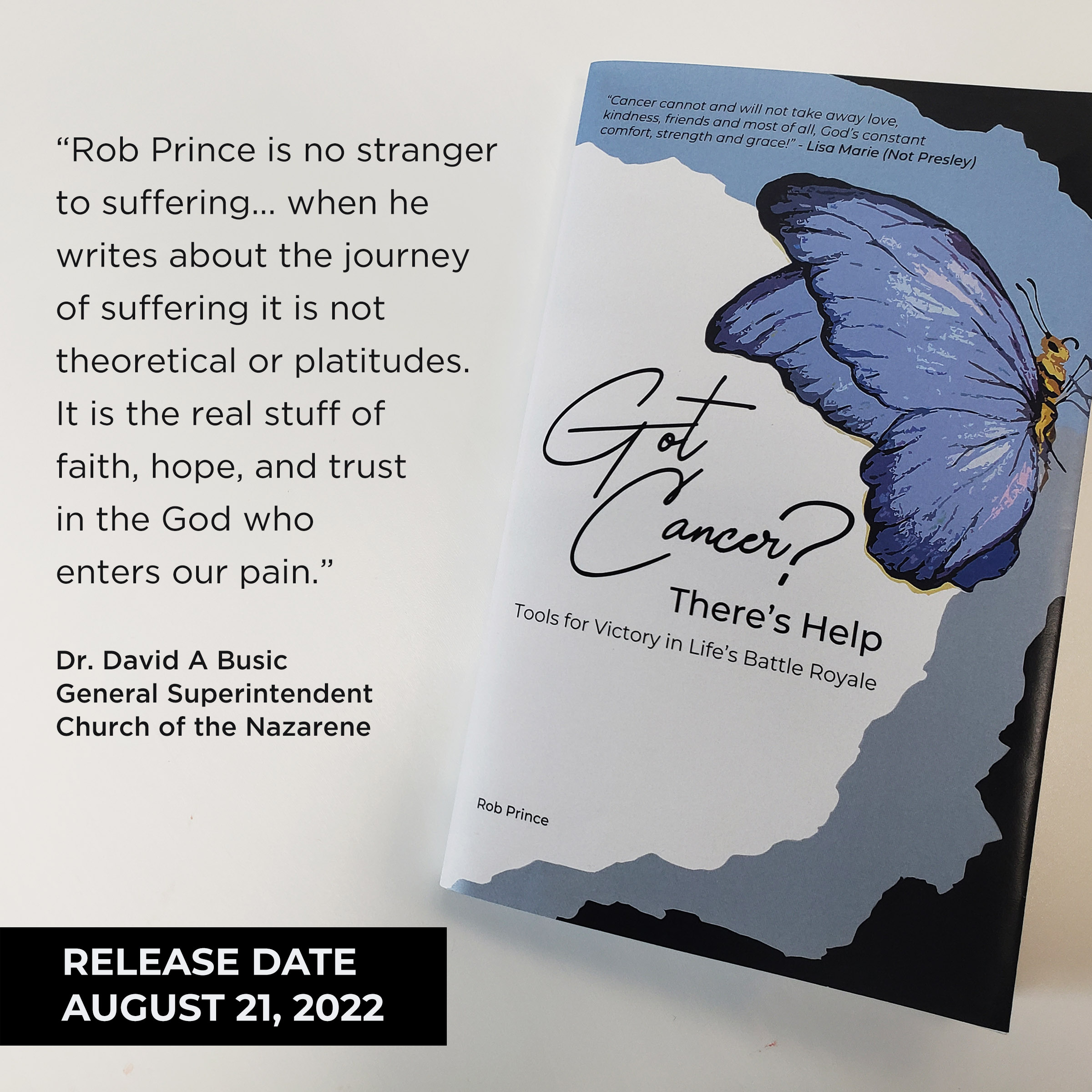
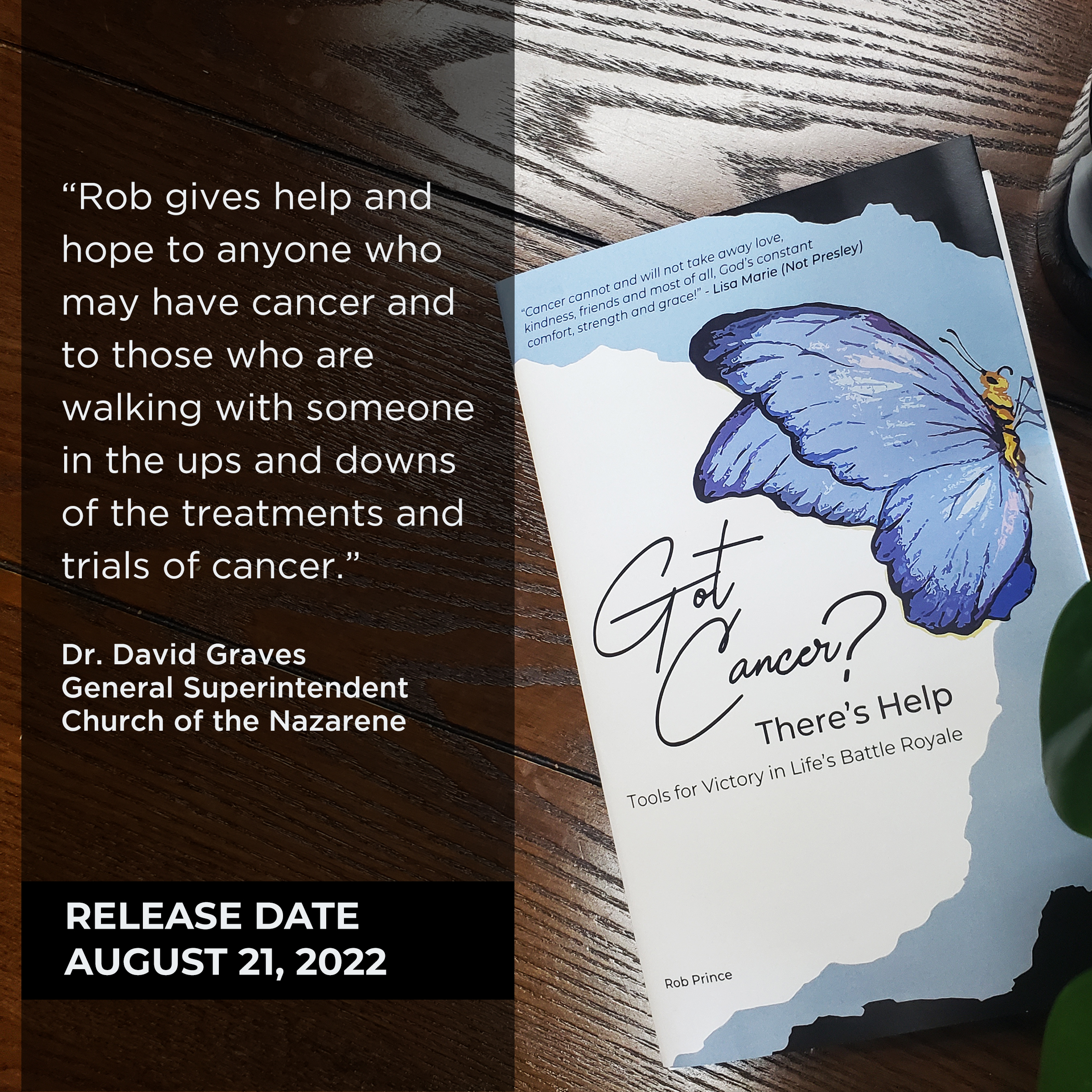
Why I wrote: Got Cancer? There’s Help: Tools for Victory in Life’s Battle Royale

Cancer: the word no one wants their doctor to utter. Ugh! Too many hear it. My friend, Dan Rexroth said, “40% of us will be diagnosed with cancer in our lifetime.” My dad heard it. Sister too. I heard it but the doctors got it wrong (Whew!).  SHAMELESS PLUG ALERT: That’s just one reason I wrote, Got Cancer? There’s Help: Tools for Victory in Life’s Battle Royale.

Another reason for the book is the example that Lisa Marie (not Pressley) has set for us. Lisa moved in with Karla and I last November. She has taught us many things as we have travelled this unknown territory with her. Her example and life have value and meaning and she (along with Jesus, of course) is the inspiration behind much of the book.

Obviously, my M.Div degree does not give me a license to practice medicine. The book isn’t a medical journal. It offers no cures. Neither is the book a “God’s-gotta-heal-ya” book. It’s not even a “God’s-in-control-so-sit-back-and relax” book. I address the issues of theodicy (where’s God in my suffering?) in my last book. ANOTHER SHAMELESS PLUG ALERT: Got Cancer? There’s Help give tools for a victorious fight even as the cancer rages on. It gives hope that God’s can still work in the midst of severe trials and continued bad reports. It offers steps to focus on what’s truly important in life. 

Unlike my last book (OLD SHAMELESS PLUG ALERT), Chronic Pain: Finding Hope in the Midst of Suffering, I don’t have any personal knowledge of cancer (other than the false news). One former parishioner sent me condolences for my diagnosis (I don’t have cancer). But my life experiences while pastoring so many with cancer, and what Lisa has taught us have enabled me to write on the ways to be victorious even when the news stinks. 

I don’t suspect I will get rich from this book (someone said 95% of books sell less than 200 copies). It offers no cures to cancer. Still, my hope and prayer is that there are some folks who can be helped by reading it. My light-hearted style of writing attempts to bring a smile at life’s joys and tough times too. A smile not based on no pain or a cancer-free report (that would bring more than a smile it would be a shout of Hallelujah) but based on a confidence that in our trials big and small, God still is with us. 

After preaching, I believe God has called me to write. So, you could say that’s the last reason for this latest book. I simply had to write it and to not write would be disobedient. 

A proof copy of the book is supposed to arrive today. I’ll be making final edits and then send it off to be published. The release date is August 21 and Lisa and I have scheduled a book signing following the service at Central Church that morning for anyone who would like to purchase the book at the discounted church rate ($12 instead of $15.99 on Amazon). You can pre-order the Kindle version now on Amazon.

I hope you and your loved ones never get cancer, but if they do (FINAL SHAMELESS PLUG) Got Cancer? There’s Help: Tools for Victory in Life’s Battle Royale will be a blessing.

When the Church Loses This… It’s Lost

Church leaders around the country are scratching their heads and asking themselves why are people leaving churches in droves (and why pastors are leaving too). There have been many reasons given:

  • The pandemic got people used to watching a service at home.
  • The pandemic pushed people to the fringes and caused them to act like idiots. 
  • The music (pick your preference) is: too loud, too old, too new, too blah, blah, blah…
  • The preacher stinks (ouch)
  • The church has become too political
  • The church isn’t political enough
  • The term “evangelical” has become a political and not a religious term
  • There are too many other things vying for people’s time and money
  • The youth pastor (pick your preference) is: too liberal, too conservative, too blah, blah, blah..
  • The church talks too much about social ills
  • The church doesn’t talk enough about social ills.
  • The church is not affirming to all people
  • The church is too affirming of people’s lifestyle choices.
  • The church folks aren’t loving, kind, caring and sometimes are downright mean
  • Too many doubts, too few answers

and the timeless, age-old criticism…

  • Too many hypocrites 

Some of these things are true. Some not so true. Here’s my take: People are mostly leaving because the church has been distracted by things other than the teachings of Jesus. People in 2022 don’t hate Jesus. They want Jesus. They love Jesus. They want more of Jesus and they feel (true or not true) that they aren’t getting Jesus in church. Instead they are getting– pick the churches’ preference: too liberal, too right wing political, too much social justice, not enough social justice, blah, blah, blah and they’ve headed for the exits.

Churches have gotten distracted by many things (and some are good things), but those distractions cause them to miss the main thing– which is Jesus. In many churches the fight has been over “what would Jesus do?” Maybe the focus should be on “How would Jesus respond to what others are doing?” There are plenty of people/churches who have thought right, but responded wrong and their members have headed for the exits.

We need to be like Paul in 1 Corinthians when he wrote: For I resolved to know nothing while I was with you except Jesus Christ and him crucified. (1 Corinthians 2:2). The Corinthian Church was divided too. Paul’s answer to the troubled church was a singular emphasis: Jesus.

The church must likewise resolve: To know and do nothing but proclaim Jesus Christ and him crucified!

Keep the focus on the main thing: Jesus.

Remind me again: How Have Religious Leaders Changed?  

If you don’t see the similarities between some of America’s church leaders and Caiaphas and the religious leaders in John 11 then you aren’t looking close enough. Here’s a quick recap if you are not up on your first century politics: In John 11, Jesus raised Lazarus from the dead and it throws the religious leaders into a frenzy. They call a secret meeting and say: If we let him (Jesus) go on like this, everyone will believe in him, and then the Romans will come and take away both our temple and our nation (John 11:48).

This is the only place in the New Testament where the term “the Romans” was used. Slow down, would-be scoffer—I know there is a book in the Bible called “Romans” and there are Roman centurions and Roman governors, etc., but this is the only place where the term “the Romans” is used to describe the Empire of Rome as a political and more important military entity. The religious leaders knew “the Romans” had the capabilities to destroy the temple and the nation. They were afraid that Jesus would so upset the apple cart (by doing such revolutionary things as preaching, healing, feeding people and raising the dead apparently), that the Romans would come in and destroy everything.

Here’s the rub: The Romans did destroy everything in the year 70AD and their aggression had nothing to do with Jesus. Here’s the other rub: John may have written this gospel AFTER the temple had been destroyed. In other words, the original readers of John would have been keenly aware that the Romans destroyed what the religious leaders were clinging to and it wasn’t because of Jesus or Lazarus. 

My point: The religious leaders in John 11 were plotting to kill people in an effort to save the “holy” religious institutions. Somehow in their twisted logic, they concluded that sinning would be OK if it meant saving the institutions. Make no mistake the Temple and the Nation of Israel were important and holy. But God Almighty did not need these bozos (no offense to Bozo) to “save” them by killing innocent people. If God Almighty wanted the temple saved from destruction, it would have been saved without Caiaphas and his henchmen.

Does any of this ring a bell? It should. We all know religious leaders who’ve attempted to do criminal things in an effort to “save” a church, publication, college or denomination. They have lied; coveted; cooked the books to make themselves or the institution look better; and probably somewhere, like those in John 11, have even plotted murder in an effort to “save” the church. 

God doesn’t need our sin-stained help to “save” the church. 

But the devil is sure using “insider” people to destroy it.

WARNING: IF THE CHURCH STOPS ACTING LIKE JESUS, THEN LIKE THE TEMPLE in AD70, GOD WILL LET THAT FORM OF THE CHURCH DIE. 

If leaders sin in an effort to “save” the church, we’ve already lost her. She will die. If we replace Jesus with anything (even good things), the church will die. Our focus must be on the main things (Loving God. Loving People. Making Christ-like disciples) or the church will die. Don’t be distressed over this news. God Almighty will raise up someone else to carry on His work. The Message of Jesus will continue until our King returns with or without us. The only question is: Will it be with us? I pray it will be.

What’s Needed this Independence Day

Independence Day is just around the corner. Maybe you’ll be celebrating the day in the backyard with friends or in a cabin in the woods or on a golf course. You might even take time to be thankful for the freedom to do such things. I hope you do much more. 

Usually this time of the year, some preacher type will quote 2 Chronicles 7:14 (if my people who are called by my name will humble themselves and pray…  you know the verse). The minister will then call on the people to pray. Recognizing the importance of prayer (or at least not wanting to appear to be a person contrary to prayer), the congregants will agree that prayer is an important faith practice for the betterment of our country. “Amen. Amen. Amen,” 100% of the group will chime. That’s the good news.

Here’s the bad news: Most people aren’t praying for our country. The Barna group in 2017 reported (see the stats here) that 79% of Americans prayed at least once in the last three months. I’m not sure if the pandemic would have increased or decreased those numbers, but in any event, that’s not a particularly high standard– one prayer every ninety days. Of those who were praying once in three months, only 26% with a high school or less education reported to have prayed for our nation (only 17% of the college graduates did). I wasn’t a math major, but I don’t think that is very good either. The only ones praying for our country are 22% (give or take) of the pray-ers, who might only be being praying very occasionally. No wonder we are a mess. 

Barna didn’t ask the other important question: Did you DO something other than pray? Did you participate with God in the answer to those prayers? I don’t think we’d like the answer to that question. James wrote a five-word indictment of too many pew sitters: faith without deeds is dead (James 2:26). In other words, “thought and prayers” alone doesn’t cut it. You gotta do something. Sadly, when people aren’t praying and they aren’t doing anything, this is the formula:

Little faith + Little action = a county in trouble.

Our country is divided. We need prayer (of course). We need action too. There is a long list of things you can do this Independence Day to make our country a better place: include a lonely neighbor in your cookout; clean up a vacant lot in the city; sign up to volunteer at a hospital, local school, soup kitchen or nursing home; write a letter to an incarcerated person; take a plate of cookies to the local fire or police station; have your kids color a picture and send it to a soldier overseas; volunteer to watch the kids of a single mom; take a roll of quarters to a laundromat and give strangers a free load of clean clothes; or surprise a teenager with an unexpected gift. 

After you do any of these things (or something completely different. Use your imagination there are hundreds of possibilities), then pray. Pray for the people who were touched by your actions. Pray that they would be blessed by the Lord. Pray that, in turn, our country would start being a better place.  

President John F. Kennedy in a famous speech said: “Ask not what your country can do for you – ask what you can do for your country.” The answer: It’s not sending “thoughts and prayers” (and then not even praying). It’s actions and prayer (real prayer) that our country needs. You want a better country? Stop complaining and partner with the Almighty to make our country a better place. Actions and faith (quoting the great theologian, Larry the Cable Guy) will “get ‘er done.” Maybe James could have written: 

Faith + Deeds = a Better Country.

We need to Hear from our General Superintendents

Why did we only hear crickets coming from the GMC following last week’s Roe vs Wade controversial decision from the United States Supreme Court? Other leaders of denominations issued statements. World Leaders chimed in (most in outrage of the decision). So why was there nothing from our leaders? I shared on Facebook the statement from the Florida District Superintendent, Rev. Dale Shaeffer. It was very good. Why didn’t the Board of General Superintendents (BGS) issue something similar?

The standard line (or so I’ve been told) is that we are an international church and the General Superintendents do not speak into national matters. That’s why no statement was given condemning racism following George Floyd’s death or why there hasn’t been statements valuing life following any of the recent tragic school or church shootings. 

They have spoken up before. After the Orlando Pulse night club shooting in June of 2016, the BGS issued a statement. You can read it here . That was 6 years ago, there have been numerous incidents since then in USA/Canada that warranted a similar statement, but we haven’t heard from the BGS. One time is not enough.

The General Superintendents are good people. I trust them. They are our friends. I know they hate racism, love life and are want the best for our church. We need to hear from them.

I don’t know the ins and outs of running a denomination. They are busy and it’s a difficult task. I’m just a pastor in Flint, Michigan. I only know pastoring churches. So, I will approach these matters as if the United States were a member of my church.

Let’s say I have 160 members of my church (The Church of the Nazarene is in 160 countries give or take a few). Suppose one of those members contributed somewhere around 94-96% of the income to my church. I would hope that I would treat the fat cat (no offense USA/Canada) the same as those 159 other members who gave little or were unable to give. I would hope that I would overlook their monetary contributions and the church’s near total dependence upon them. But I know, in reality, I wouldn’t be able to do it.

If there was a tragedy to that member, I would be the first person there. If they were experiencing joy, I would be joyous with them. I would want to know their concerns and if they got off track, I would hope as their pastor, I would lovingly steer them back. I would be keenly aware of the health and well-being of that member. That one member’s health would be essential for the health and well-being of everyone in the church. If that member died, the whole church would be in trouble.

I wish the Board of General Superintendents took a similar approach to USA/Canada. The six members of the BGS are all elders in the Church of the Nazarene. Treat USA/Canada like you would a member of a local church who is in trouble. The USA/Canada church might not be dying, but it’s hurting. We need the good words from our General Superintendents. We need them speaking into our situations and national events. We need them to model leadership and wisdom for the rest of us. We need to be able quote them and their strong words in our churches when crucial events take place. Yes, we have the manual, but we need the voices of our General Superintendents to help us. 

Please no crickets. We need our Generals Superintendents to speak because we love and value their words. Like Paul in Acts 18, I pray our BGS has a vision from the Lord that says, “Do not be afraid; keep on speaking, do not be silent. For I am with you.” (Acts 18:9-10)

What is the Commandment Most likely to be Broken this Summer?

Summers in Michigan are the best. It’s rarely super-hot for long stretches of time. Daylight is longer. We have lakes. Lots of lakes. A few are even Great Lakes. There are plenty of good ice cream joints. There’s golf courses galore. Summers in Michigan are great (did I already write that?). It’s true.

But (there’s always a big but)… Michigan summers do not bode well for church attendance. People are on a lake or in their campers or up north or a golf course or watching their future major leaguer play right field in a little league tournament in Battle Creek or out looking for a new ice cream joint. I’ve had people in June tell me, “See you in September, pastor.” They weren’t joking.

I’d like to point out that commandment #4 (Remember the Sabbath day and keep it holy) does not offer a Michigan exception clause. But I won’t point that out because I will sound too much like an old curmudgeon who in the next breath would yell, “Get off my lawn you rotten kids.” I’d like to point out that God still intends for us to prioritize a time of worship—every single week even in the summer. I’d like to write, “Don’t forget the Sabbath, even if you live in the Great Lake State.” But…

Ok, you’ve talked me into it (or I’ve talked me into it or maybe, just maybe, the Lord has talked me into it). I will write it. Please note: I’m not the first to do so. Moses wrote on stone tablets. My tablet is an Apple. The fourth item on both lists is: Remember the Sabbath day and keep it holy.

Jesus “broke” this commandment a few times (usually to heal someone) and his actions sent the “best” Sabbath keepers of them all, the Pharisees, into a tizzy. (Quotation marks are around the word “broke” because when Jesus was “braking” the Law, in the Pharisees view, he was actually fulfilling the law by loving God and loving people. Quotation marks are around “best” in reference to the Pharisees because they forgot the reason for which the Sabbath was created thereby making them not the “best” at all). Still Jesus knew the importance of the Sabbath, but he also knew the importance of love and compassion. Jesus said, “Do not think I have come to abolish the Law or the Prophets; I have not come to abolish them but to fulfill them.” (Matthew 5:17). Jesus was keeping the Sabbath’s priorities straight, even as the Pharisees viewed him as breaking it. 

Sabbath keeping is more than church attendance. I get it. Missing a church service isn’t sending anyone to the “Bad Place.” I get that too. One can be in church on a Sunday and still break the Sabbath. One can be in nature and have a wonderful time of worship. I get all of that. Still too many of us, in our “freedom,” we have become lackadaisical in our remembrance of a Sabbath day. Maybe in our Michigan summers, commandment #4 is the most broken commandment of them all. (Next might be “Do not covet” as your neighbor pulls in his new boat into the driveway). My point: Don’t break any of the commandments in a Michigan summer or anytime. All ten are important. Let’s just keep the Lord first in all we do! 

Now get off my lawn!

What will be said about the 30th General Assembly of the Church of the Nazarene?

One year from now, the 2023 General Assembly (GA) of the Church of the Nazarene will be in the books and we will be in our churches discussing the events of the past week. Clearly writing from a North American perspective, the church I currently see is divided like never before. Will a GA expose these divides and bring healing or gloss over them as they continue to fester?

The Board of General Superintendents (BGS) had a difficult decision on even convening the 30th General Assembly. Covid is still a real thing (take it from me, I had Covid last week). Delegates from some world areas will have great difficulty in obtaining a visa. As such, in many world areas, districts will be voting not for the most qualified from their district to be a delegate but from those who are available (with visa in hand). The result will be less world representation, possibly a less qualified and a more-North American-centric assembly. 

In spite of these problems, the BGS made the right decision. In each of the last several assemblies, a resolution has been submitted to move GA from four years to five, and every time it’s been rejected.  GAs are expensive and a logistical monstrosity is the argument, but the delegates have repeatedly said that moving to every five years will lessen our relationships and widen any divides that might exist. Thanks to Covid, the validity of the anti-five-year-assembly argument will be shown as it will have been six years since the last GA. The BGS has seen that our church family (like all families in the pandemic) has been shaken. We need to gather.

The theme chosen, “Jesus is Lord,” seems to indicate that the BGS recognizes the divides and hope to bring unity by getting the church back to the basics. It’s like the old football story of how legendary coach of the Green Bay Packers, Vince Lombardi, after a loss held up a football and said “This, boys, is a football.” The General Superintendents appear to be doing the same for the church as they hold up a banner that says: Jesus is Lord. 

I hope it works. Our family is teetering. Factions are gathering. Newsletters are sent. Blogs (ahem) are written. Social media is not anyone’s friend. The pandemic and our six-year gap have hurt us. Unity is essential to our church. As we watch the United Methodist church implode, one needs no prophetic anointing to see the same thing happening in the Church of the Nazarene if we do not gather and come together in unity. Nothing is more uniting than “Jesus is Lord.” It is the most basic of the essentials. 

What will we be saying about the 30th General Assembly in one year? That depends entirely on the amount of prayers lifted this year. Pray cursory prayers and we will further divide. Pray fervent and intentional prayers and the Holy Spirit just might bring revival to our old church and rekindle the flame of Christ. The world still needs a strong, biblical, holiness message and a united church delivering it. If we can’t do it, God will raise up someone who can. Pray that we might unite around the ancient truth that Jesus is Lord and set about making Christ-like disciples in the nations. 

Basketball Lingo in Church

With the end of the basketball season in sight (maybe next year Pistons), here are a few terms in basketball world and their usage in the church world too:

Alley-oop: Teens caught behind the church skipping the worship service. 

Center: Only allowable placement of the communion table in the front of the sanctuary. Don’t even think of moving those plastic flowers given in memory of Grandma Smith in 1994. They are Center too.

Dribble: Communion cup failure.

Double dribble: When a worshipper’s spouse likewise spills his/her communion juice.

Double Double: How many scoops of ice cream is permitted at the church social.

Dunk (Baptist version): The only baptism method allowed.

Dunk (Episcopal version): Communion by intinction, please.

Fast Break: Cheating during Lent.

Fouled Out: Potluck disaster when the chicken is gone. (Fowl? Foul? You know what I mean.)

Free Throw: A complimentary lap blanket made the by the senior ladies’ missionary society

Full court: A bride with six bridesmaids.

Half court: When three bridesmaids get sick from the shrimp cocktail at the Bachelorette Party.

Hoops: What the youth pastor has to jump though to get an increased ministry budget for “coffee with the kids.”

Lay Up: Clergy is down sick, who’s going to preach?

Opening tip: At the beginning of the sermon when the preacher indicates it’s going to be a long-winded affair.

Over and Back: The church hopper returns.

Pick and Roll: Grabbing a worship folder and promptly making a telescope out of it.

Point guard: The person who tallies the boys vs. girls’ competition in Vacation Bible School 

Power forward: The preacher is sick, but preaches a fiery message anyway

Rebound: After telling a groaner joke, the preacher tells a funny one.

Shirts vs. Skins: The potluck dilemma between eating more fried chicken skins or popping the buttons off your garments.

3 Pointer: The preacher’s sermon.

Travelling: What evangelists used to do.

(Rob’s Basketball Memory Lane: 14 years ago today, June 16, 2008, I was in the Boston Garden with my friends Dr. Larry and Lynn Bollinger and Rev. Rod Green watching the Boston Celtics defeat the Los Angeles Lakers to win the NBA championship. I have never had more drunk Bostonians—not the Bollingers—hugging me following that game on the way out of the arena). 

What I learned about Sin and Temptation from the Cooper Hill’s Cheese Roll Competition

When a Christian succumbs to temptation, it’s not like stepping off a cliff. It’s more like what happens at the Cooper Hill’s Cheese Rolling Competition. It’s running down the slippery slope after a meaningless prize that doesn’t end well.

Last week thousands of spectators and daring competitors descended upon Gloucestershire, England’s Cooper’s Hill for the traditional Cheese Rolling event that has occurred since the 1800s. The slope of Cooper’s Hill is so steep that very few contestants manage to stay on their feet, instead tumbling head-over-heels down the 200-yard-slope in a desperate effort to catch the coveted dairy prize – a weighty 8lb Double Gloucester. While the cheese can never actually be caught – with a brief head start, it soon reaches breakneck speeds – the Cheese Rolling winner is the first person to roll, run, or fall across the line at the bottom of the hill. Most of the people don’t make it down Cooper’s Hill unscathed. One year 33 competitors were treated for everything from splinters to broken bones!

How is this craziness like a Christian’s fall into sin?

A Christian doesn’t sign-up for sinful behavior like a competitor registering in the Cooper’s Hill Cheese Roll. There may be some thought of the consequences, but often not a lot. But neither does one fall into sin with an unknown or unlucky leap off a cliff. More often, sin begins as a simple meander down a destructive trail that the Christian knows is not good (the Holy Spirit is CERTAIN to issue a warning). They wander off anyway. Like at Cooper’s Hill, those falling into the Enemy’s trap start down the hill picking up speed as they chase after the meaningless temptation (usually not much more valuable than an 8lb. chunk of cheese). Very quickly, the misdirected Christian’s pace turns into a tumbling, bumbling, breakneck-impossible dive. Like what is known by the waiting ambulances at the bottom of Cooper’s Hill, a crash is inevitable. 

When gazing onto temptation’s slippery slope and dreaming of obtaining some not-much-better-than-cheese prize, the Enemy fails to tell that the “prize” stinks and the dangers are certain. They Enemy doesn’t tell of the heartaches and pain. Even if never found out, even if the Christian’s secret foray down this slippery slope stays secret, is the “prize” worth it? Instead of pleasure, riches or fame only guilt and hidden shame are the result. Living a lie is no “prize.”

I was not injured at the Cheese Roll Competition on Cooper’s Hill. Of course not, I was thousands of miles and an ocean away, sitting in my living room. I cannot fall down Cooper’s Hill if I am nowhere near it. It’s the same with sin’s slippery slopes. If you never enter the temptation’s downward grade, you can never be its prey. Don’t even start down the trial. Don’t look at the slope. Don’t rationalize the thrills. Don’t scheme on how it might be done. Listen to the Spirit and stay away. Stay far way. Stay an ocean away if possible.

Of course, you know all of this. You already know about the “slippery slopes” of sin, don’t you? You’ve heard plenty of sermons on the topic. Me too. So why tell you again? Because a friend of mine found out the hard way this week. He knew all about temptations, slippery slopes and falling into sin. He knew it all and went down the trail anyway. Some people are forever wounded. His life is wrecked. His family destroyed. The Enemy left that part of the story out too.

Garage Sale Evangelism

Our garage sale last Thursday and Friday was a success. Not moneywise. We won’t be heading off to Tahiti from the proceeds. I did get rid of a few things that have been cluttering up our house. Two old couches? Gone (sold one and gave the other one away to a good home). Two sets of box springs and mattresses? Gone. (not sold, gobbled up by the sanitation workers’ truck). Bongos? Gone. A walker that my mother-in-law no longer needs (given away to a husband for his needy wife). A few other things. Gone. It makes me want to sing this little ditty to the tune by Helen Griggs:

Gone. Gone. Gone. Gone,
Yes, my junk is gone.
Now my clutter is set free
And in my heart’s a song
Buried in somebodies’ home,
Not in my basement all alone.
I shall live with less to own.
Hooray!
My junk is G-O-N-E gone!

My junk being gone, gone, gone is not the best news from the garage sale. I got to talk to my neighbors. A lot of them. I asked one lady if we planned a “cul-de-sac barbeque” this summer, would she and her husband come? She said, “Sure, we’d love it!” 

I got to talk to the guy at the end of the cul-de-sac. Our next-door neighbor’s daughter bought one of the couches. I learned that a lady from Central church has children and grandchildren on the next street over. 

“Do they go to church?”
 “No.”
“Have you invited them to Central church?”
 “Yes.”
“Well, tell them their pastor is on the next street over.”

Now, Karla and I have somebody else to pray for as we go on our nightly walks. I hope they are outside soon so I can say “Hi,” and invite them to a BBQ too. There are a few others in our neighborhood that attend Central church. Some regularly. Some not so much. But now I know folks a little bit better. I know how to pray a little bit more. Karla and I will need to plan a “Central Church in neighborhood cookout” too. A “cul-de-sac cook out” and a “Central-in-my-neighborhood” cookout?  Why not. I like Koegels’ hot dogs on the grill.

We don’t need to go to Africa, Panama or across the world. I’ve got a mission field across the street. You do too. What are you doing to reach your neighbors for Jesus?  Jesus said, “Love your neighbor.” What if we took those words literally and started to be pro-active in loving our neighbors?  Don’t talk religion if you plan a party. Don’t talk politics either. Just make it fun. Get to know your neighbors. As the Lord (not you) opens the doors, you might have a chance to talk about faith. It might not happen during the first or second event. But keep being kind. Keep loving. Keep showing the grace and truth of Jesus. It takes time. 

But It’s worth it!  Wouldn’t it be great if that once cranky neighbor, finds Jesus, does a 180 and becomes so loving and kind that you ask St. Peter (or whoever handles the housing accommodations in the sweet-by-and-by) if you could be neighbors in your heavenly mansions too?

What’s Missing in our Society is Too Often Missing in our Churches 

“He must become greater, I must become less” (John 3:30). 

John the Baptist at the height of his popularity defers to Jesus and basically says, “It’s not about me, it’s about Jesus. I don’t need the spot light, Jesus does.” It’s a humility that, quite frankly, is missing too often in many of us who claim Christ.

We don’t have to be first. 
We don’t have to be best.
We don’t have to have our way.
We don’t have to have the last word.

We do have to be humbly faithful. (Key word: Humbly)

Jesus said, “Love your neighbor as yourself” (Mark 12:31). That’s humility. Humility is thinking of yourself in the same manner that you would think of anyone else. No more. No less. Humility isn’t listed in the Fruit of the Spirit. A Christ-like humility is the cumulative expression of the Fruit of the Spirit. In other words, the result of our displaying love, joy, peace, forbearance, kindness, goodness, faithfulness, gentleness and self-control (see Galatians 5:22-23) is a holy humility. Jesus said, “I am gentle and humble in heart” (Mathew 11;29). It’s being like Jesus.

The Fruit of the Spirit = Holy Humility = Christ-likeness. They are all the same. 

Note: One can be humble without holiness, but one cannot be holy without humility. 
Humility without holiness is a welcomed surprise. 
Holiness without humility is impossible. 

We’ve lost humility in our culture. This lack of humility is pushing many to the edges. Those edges used to be called the “fanatical fringe.” No longer “fanatical,” this “I’m-right-you’re-wrong” arrogance and lack of humility is now mainstream and happening in all arenas of life (including the church). If the culmination of the Fruit of the Spirit is a holy humility; then the culmination of the acts of the flesh (also mentioned in Galatians 5—includes, but is not limited to, “hatred, discord, jealousy, fits of rage, selfish ambition, dissensions, factions and envy”) is a fanatical, self-centered, anti-Christ-likeness and is all too common. 

One might expect those who have no allegiance to Jesus to think and behave in an arrogant manner, but not Christians, right? “Holiness” people invalidate their descriptor when they show the same lack of humility as those who make no claims about Christ. Peter wrote to first century church leaders: “Be sympathetic, love one another, be compassionate and humble” (1 Peter 3:8). Paul told the people in Ephesus, “Be completely humble” (Ephesians 4:2). He could have said, “Be completely holy.” The best leaders are humble leaders. The best Christians are humble, holy Christians. It’s anti-cultural. It’s not the norm anymore. Humility is missing in our society and too often it’s missing in our churches too. 

A holy humility is the way of Jesus. Walk in the Way!

Why is Pentecost the least Celebrated Holiday of the Year?

Easter is a big deal. It should be. Jesus rose from the dead. Can’t get bigger than that. So we celebrate this universe-altering event by a bunny giving out colored eggs, baskets filled with goodies and eating Peeps. Of course, it all makes perfect sense to me.

Christmas is an even bigger deal (in many people’s minds). Think of it as the baby shower of the Christian faith, only everyone gets presents. Hooray. Christmas has even more traditions than Easter that have absolutely nothing to do with Jesus’ coming into the world. (Sorry Rudolph).

Pentecost seems like it is no deal at all. No baskets. No Presents. No special dinners. No parties. No time off from work. Nothing. For the average American church goer the following holidays are all bigger deals than Pentecost: 

  • Thanksgiving (except for Detroit Lions’ fans); 
  • Memorial Day, 4th of July, and Labor Day (Yahoo! Three day weekends are great!); 
  • Super Bowl Sunday (Gotta love football); 
  • Any Sunday with an NFL game (Gotta love even more football); 
  • Halloween (Forget tricks, gimme treats.), 
  • New Year’s Eve (Whew, we made one more trip around the sun), 
  • Mother’s Day (Don’t forget to call mama); 
  • St. Patrick’s Day (Green is keen); 
  • St. Valentine’s Day (Honey, will you marry me? Not original, but effective); 
  • Arbor Day (Trees, tress and more trees); 
  • Martin Luther King Jr. Day, President’s Day (We still love three day weekends!), 
  • the birthday of your second cousin twice removed (What’s his name? Who cares? Pass the cake), 
  • practically any of the other 365 days on your calendar.

Pentecost gets the short end of the calendar stick. But Pentecost is a really big deal. It’s the day the Holy Spirit came supernaturally upon the 120 believers and transformed the rag tag bunch (most of whom had failed Jesus miserably less than a couple of months earlier) into the turn-the-world-upside-down Jesus champions, more commonly known as “The Church.” What happened on the original Pentecost is a bigger deal than most everything on the list above. Of course, Christmas and Easter are big deals (don’t @ me), but so is Pentecost. It’s a much bigger deal than any “holiday” in the third paragraph list (sorry mom, it’s true). 

Why don’t we celebrate Pentecost more? We will have a red cloth draping the cross, candles reminding us of the tongues of fire, and the reading of scripture in different languages. That’s it. That’s what will happen in the church building on Sunday to recognize that it’s Pentecost Sunday. But maybe the true Pentecost celebration is when the Church starts behaving in a manner that would make the first Pentecost celebrators proud. It’s when we help a neighbor, feed the hungry, and care for the needy. Pentecost is best celebrated when, like in Peter’s bold sermon, we proclaim the Savior and see a life (or 3,000 lives as in ol’ Pete’s case) transformed by the power of Jesus Christ. The Bible says all of heaven rejoices at this good news (See Luke 15). Heavenly Parties > Earthly holiday parties. Much greater!

You can have your blowing out of birthday candles (and spitting all over the cake that I’m about to eat); your Christmas fruit cake and Easter’s deviled eggs—I hope to celebrate Pentecost by telling someone about Jesus—the one who died and rose again!

The One Thing All Church Leaders Should Do on Their Summer Vacation

There are plenty of things a church leader could do on their summer vacation. Have someone lead a devotion while in the car. Listen to Christian music. Take a good Christian book to read on the beach or by the campfire. Watch a church service on-line. But the one thing all church leaders should do is find a church to attend on Sunday

You read that last point correctly. All the introverts reading this article just threw up. I’m not kidding, find a church. Go in. See what being a stranger is like. You’ll feel a little awkward. That’s OK. It might be a good service. But even if it’s not, you will definitely be a better follower of Jesus (and a better church leader) if you attend a church on vacation. Notice the signage and how easy it is to get around. Ask yourself, “Is the signage in my church helpful to a visitor?” You’ll see what to do (or not to do) when a visitor sits by you. Were the folks sitting by you friendly? Are you friendly to the visitors that happen to sit by you in church? Moreover, it’s worth taking the family to church on vacation because, in so doing, the message sent to your kiddos is that church, God and “remembering-the-Sabbath-and-keeping-it-holy” matters. 

One time on vacation, we attended a church in Ohio somewhere. It was pre-Google days and pre-GPS days. We had a catalog with all the Nazarene church locations in the entire country and a paper map. It was just before 11AM on a Sunday morning and we followed our map to a little church. Only the church building had been sold since the catalog was printed and it was now a Free Methodist Church (Free Methodists are good people, so we stayed). 

The church had maybe forty people. We were clearly visitors. During the passing of the peace time (pre-covid, of course), a lady in front of us turned around and asked if we were from the town. 

“No, we attend a Nazarene church in Michigan,” was our reply.

“Oh, the Free Methodists have much better preachers than the Nazarenes.”

I’m pretty sure, Karla was about to agree, but the lady quickly turned around and didn’t give any of us a chance for conversation. Maybe since we weren’t from there or weren’t Free Methodists, she didn’t want to waste her “pleasantries” on us. She began to greet others. No one else talked to us. Not. One. Person. Maybe that was one of the reasons that church only had 40 people in it.

Still I was reminded how important it is to notice visitors when they enter a strange building. I was taught that even if the visitor is a “one-timer,” they still might be exactly where God wants them. Maybe, just maybe, God has a divine appointment set up for that one-time only visitor. Maybe that divine appointment includes you. I didn’t get much out of the sermon, but I was taught a lot that Sunday. 

Church leaders need to know what it’s like to be a visitor. They need to constantly be asking, “What’s it like to be a newbie in our church? Are we friendly? Is it easy to find the restrooms, the worship area or the nurseries?” Good church leaders take an hour of their summer vacation to do a little reconnaissance to improve their home church.

Get out of the Church Building and Enjoy the Son (that’s not a typo)

The church has left the building. Literally. Last year Central Church had two outdoor services, on the 4th of July and on Labor Day Sunday. Both were big days. Worship service led from a semi-truck bed and fellowship times following. July 4th had free hot dogs. Labor Day we had food trucks. Pastor Joel and the band were like rock stars (in the best possible way) as they sang praises to Jesus. Prior to the Labor Day Sunday service, while the band was warming up, I went to our neighbors who were setting up a garage sale. I apologized for the noise and offered to buy their lunch from a food truck for the trouble. They gladly accepted the invitation for a free lunch and said music “noise” wasn’t a problem. They liked it.

During the service, Pastor Joel felt led to purchase their entire garage sale (It was mostly baby clothes) and donate everything to Little Lambs, the Nazarene compassionate ministry center that distributes baby clothing and other items. Pastor Joey approached our neighbor and asked how much money they would want for all of the stuff in the garage sale. $100 was the response. Joey offered them $200 and they were overwhelmed by the generosity. Of course, we bought their lunch as promised too. File that under: Be the Best Neighbors (That’s one of our Growing Together core commitments). But something even better began to happen at our 4th of July Sunday Service.

A neighbor from downtown the street heard the music. She came for a better listen and liked it. She called her daughter and they started coming to church. The daughter, Christina, now helps lead a Bible study at the local rescue mission.

During that service, another neighbor named Howard heard the music and walked down the street with his grandson, Trevor. They liked the music too. They returned on Labor Day Sunday for the next outdoor service. After that, Howard and Trevor started attending occasionally and two weeks ago, Howard and Trevor were baptized. If you just heard a noise, it might have been from the angels still rejoicing in heaven shouting, “Praise the Lord!”

Did you ask if our outdoor services are worth it?  Yes. Yes. Yes, they are. Not only does it give us a chance to meet our neighbors, sometimes it gives a chance for our neighbors to meet Jesus. We need to get out of our church buildings and enjoy the Son (that’s not a typo).

This Sunday is the first of our Central outdoor services (all three summer holiday weekends we will be outdoors). The service begins at 11AM. Bring a lawn chair and your Gospel of John Journal as we begin our summer series in John. (Don’t have a journal? No worries. Get your free copy this Sunday). Following the service, we will have free hotdogs, chips and bottled water and the Roaring Twenties Ice Cream Truck will be here for tasty treats to purchase. My weather app says it is supposed to be perfect weather on Sunday morning (oh oh… I hope I didn’t just jinx us. I don’t believe in jinxes, so we should be fine). It’s going to be a great day.

Who knows, maybe next spring (or even later this summer when we have a lakeside baptism), we will see another neighbor getting baptized.

Learning the Hard Way

What happened to Hymenaeus and Alexander? Do you remember these guys? Paul mentions them in his letters to Timothy.
 
Hymenaeus apparently was teaching a heresy that the bodily resurrection of the dead had already taken place which made everyone in the church a little upset. (See 2 Timothy 2:16-18). Alexander was a coppersmith who did a great deal of harm to Paul (See 2 Timothy 4:14-15). Paul says both fellows were “shipwrecked.” That’s not good. They were so far gone Paul writes, “I have handed over to Satan to be taught not to blaspheme.” (I Timothy 1:18)
 
Would you ever say that about anyone? Seriously, would you ever hand someone “over to Satan”? I’ve just preached a whole series on helping those who feel like the “Odd Man Out” and said Jesus welcomes all. It’s “Odd Man (or Woman) In” with Jesus. Paul’s words don’t sound very “Odd-Man-In-ish.”
 
“Here, here, Mr. Satan, may I call you, Lucifer? Board member, Mr. Knows-It-All, has been giving me fits ever since I have arrived at this church. Since you are the expert, could you give them a lesson on the “why-nots” of blaspheme? I’m handing him over to you. He’s out.”
 
You would never ever say that. Me neither. So why did Paul?
 
Paul is speaking figuratively, not literally. No conversation between the Prince of Darkness and Paul took place. Instead, Paul, in effect, was saying, “These guys have decided to do life in their own strength, power and wisdom, so I guess they are gonna have to learn the hard way.” That’s how we’d put it: “They will learn the hard way.”
 
Learning the hard way is going at life alone; trying to push through tough times without seeking counsel from the Lord or anyone else; never picking up your Bible (or the danger for preachers: only picking up your Bible for sermon prep not for a “time with Jesus”). Learning things the hard way usually involves falling flat on your face. Learning the hard way is, well, hard.
 
Learning things the easy way is through listening to godly mentors, reading scripture, trusting the input of other believers, discerning the Holy Spirit’s voice. (Disclaimer: this doesn’t mean life is “easy.” We might learn the “easy way” that life is sometimes very hard. Disclaimer’s disclaimer: Learning the easy way during the hardships in life is a deep and blessed knowledge that Jesus is with us).
 
I don’t know if Hymenaeus and Alexander ever came around and saw their shipwrecked lives for what they were. I hope so. I also hope that none of us need to learn things the hard way. Instead be let’s open to God’s leading. Find a godly mentor and trust his/her wisdom. Read the Bible for your own nourishment, not to simply regurgitate scripture for someone else’s edification. Seek the Lord in all things.
 
The easy way to learn is the best way (duh!). I sure hope Hymenaeus and Alexander figured that out.
 

A day in the life of this pastor

  • Awake at 4:30AM. Up at 4:45AM.
  • Coffee and a bagel thin (Toasted. Butter and jelly. Strawberry, of course).
  • Devotions.
  • Read the news.
  • On Facebook long enough to wish friends “Happy Birthday,” but get off before seeing someone’s conspiracy theory or how a pastor in California is a dope.
  • Do Wordle. “Scour.” Three tries. (FYI… today’s Wordle took me six tries. Ugh!)
  • Work on sermon. Last “Odd Man In” sermon. (No spoiler alerts, just come on Sunday)
  • Exercise.
  • Pray while on elliptical and exercise bike.
  • Shower. 
  • Dress. 
  • Help take down the beds—new carpet installed in the bedrooms today.
  • Leave for the church.
  • Listen to Louis Armstrong, “What a wonderful world.”
  • Detour to Starbucks.
  • Get to church.
  • Talk with Deb, my super assistant, about events for the day and week.
  • Spill my mocha drink all over the floor.
  • Am I more upset that coffee spilled or that my $5.25 drink is now a big fat stain on the floor?
  • Try to clean it up. Deb helps too.
  • There’s still a stain. Ugh!
  • Call in the “dream team of clean.” (Our facility crew)
  • Apologize for being uncoordinated.
  • Quickly answer a few emails. 
  • Meet with Vi and Tim McIlvoy to discuss Del’s funeral. 
  • 95 years of life. 55 years of marriage.
  • Wore out four or five Bibles.
  • A great man went to heaven.
  • More emails and a few texts.
  • Leave for Brighton to have lunch with a pastor.
  • It’s pouring outside.
  • Head pounding.
  • Hope it doesn’t rain like this on Saturday for our IN FLINT work day. 
  • Will Panera’s cream of broccoli soup help my head? Can’t hurt. 
  • He shares.
  • I share.
  • Hope the conversation helped.
  • Back home to put up the beds on newly installed carpet.
  • Tigers on the TV while working.
  • Tigers lose (Shocker).
  • Find a house on Zillow that looks interesting. Hello Judy Cox.
  • Going to move? Probably not. Maybe. 
  • Supper: Soup and grilled cheese. (rainy days are soup-for-lunch-and-dinner days).
  • Back to the church. 
  • Try to figure out a closing song for the choir service with Nate.
  • Love divine all love excelling.
  • You can’t go wrong with a Charlie Wesley ditty.
  • Lizzy Benjamin sticks her head in to say “Hi.” There’s great teenagers at Central.
  • Go to the family center where people are eating Deb Pruitt’s tasty dinner (Italian and headaches isn’t a good combo. But it looks good).
  • Go from table to table talking with those gathered for dinner.
  • Dennis Johnson is doing great after so long in the hospital with Covid. A walking miracle.
  • Quay brought a toy truck. He’s letting Dennis Freeman play with it.
  • Jessica Roland, future missionary, did great the night before sharing with the church board her hopes and dreams.
  • Boston and Pastor Amanda are eating with some of our great teenagers.
  • Eat a piece of cake with Deb, Sam and Mary Ann.
  • Shhhh… I’m on a diet.
  • Meet with a young couple for pre-marriage counseling. Hope they have as happy a marriage as Vi and Del. I think they will.
  • Listen to tail end of choir practice. 
  • Did you hear that Dr. Joe Ewing died?  Funeral is Saturday. Joe was my dentist. I also used his Michigan Football tickets a time or two. He was a good man!
  • Say my good byes and head home.
  • Watch a little basketball then the Adam Project on Netflix with Karla. It’s so so. 
  • Bedtime.

Why the daily run down? Pastoring is full of many activities. Old folks. Young folks. Death. Life. Marriage. Worship planning. It’s a smorgasbord of life. That’s why I love it. Today will be different than yesterday. Whatever happens I hope Psalm 118 rings out true for you and me: This is the day the Lord has made; We will rejoice and be glad in it. (Psalm 118:24).

Evangelism: Then and Now

Evangelism 50 years ago went like this: 

Step 1: See person (Personal knowledge of person’s life not required).
Step 2: Invite person to church.
Step 3: Person comes to church, hears a salvation message and accepts Jesus into his/her life.

That’s not how evangelism works these days. Evangelism in 2022 looks more like this:

Step 1: Listen to your friend speak on how all churches either: a) want your money; b) are anti-intellectuals; c) are political hacks; d) full of hypocrites; or e) all of the above.
Step 2: Listen to your friend tell you how they’ve been hurt in churches in the past. 
Step 3: Apologize for the church’s failure in your friend’s life.
Step 4: Serve in the community.
Step 5: Talk (don’t brag about serving in the community. Don’t even mention it, unless your friend says something like: “What did you do on Saturday?” And you say, “Oh, some folks from my church and me were sorting groceries at the food bank. Go back to talking about the weather or whatever small talk is the conversation of the hour).
Step 6: Listen to friend scoff, “Churches don’t serve in communities much.” 
Step 7: Listen some more without getting defensive. Just listen.
Step 8: Talk a little bit (mostly about regular life happenings. Occasionally mention how God helps you. Don’t worry as friend rolls eyes.)
Step 9: Serve in the community again (ask if the friend would like to serve too. Maybe the friend will. Maybe not.).
Step 10: Listen as the friend talks about how churches need to stay out of politics.
Step 11: Listen as friend talks about how bad things are in our world. 
Step 12: Talk a little bit about how Jesus really can help.
Step 13: Friend has personal troubles.
Step 14: Listen to your friend tell about a family crisis.
Step 15: Listen to friend’s worries.
Step 16: Listen about friend’s anxiety.
Step 17: Talk a little bit and offer to pray for your friend (Maybe they will let you. Maybe not).
Step 18: Invite the friend to watch last Sunday’s church service on-line. Tell them it helped you.
Step 19: Listen as friend says they don’t have time. 
Step 20: Listen as friend talks about more troubles.
Step 21: Listen as friend says they watched a little bit of the worship service.
Step 22: Smile. God is working– you know it. It’s a secret. Don’t tell your friend why you are smiling. 
Step 23: Get coffee together and invite friend to join you at church.
Step 24: Listen as friend comes up with an excuse about how busy he/she is.
Step 25: Listen as friend says “Christianity is good for you, but probably won’t work for me.”
Step 26: Talk a little bit and say, “I don’t know, Jesus might surprise you.”
Step 27: Invite friend to watch a church service on-line again and tell friend “If you have questions, I will be happy to talk about it.”
Step 28: Listen to friend say, “Hey, I watched a service.”
Step 29: Listen as friend says, “Thank you. I did feel a little something.”
Step 30: Talk a little bit about how Jesus is speaking and how Jesus loves your friend.
Step 31: Listen to friend’s doubts.
Step 32: Listen to friend’s fears.
Step 33: Tell friend what a change Jesus has made in your life.
Step 34: Listen to friend’s questions.
Step 35: Try to answer friend’s questions.
Step 36: Pray with friend as they invite Jesus to be Lord of their life.
Step 37: Invite friend, who is now a believer, to join you in church on Sunday.
Step 38: Friend comes to church.
Step 39: Begin to disciple your friend.

Evangelism takes longer these days. But it is still worth it!

Always be prepared to give an answer to everyone who asks you to give the reason for the hope that you have. But do this with gentleness and respect. 1 Peter 3:15

The Most Unheeded and Un-obeyed words of Jesus (by the church)

A DIVIDED world needs a UNITED Church! That’s not my quote, I read those words somewhere last week. It’s true.

What we are experiencing in America is not unprecedented. There have been other times in US history when our nation was divided (Hello? We had a Civil War).  I am not suggesting that opposing sides are ready to bear arms, I am suggesting that there are similarities. The healing remedy then and now is for the Church of Jesus Christ to come together in love and mission. 

Today… it’s not north and south.
It’s left and right. 

It’s not Yankees and Rebels.
It’s Conservatives and Liberals.

It’s not blue and grey.
It’s red and blue.

It’s not slavery v. freedom.
It’s Roe v. Wade II.

Read it again: What our divided world needs is a united church.

“Impossible,” you say. Churches are dividing more than ever (Exhibit A: The schism in the “United” Methodist Church). It’s not just our Methodist sisters and brothers driving in opposite directions on a divided highway. Churches, individual churches of all denominations, are divided more now than ever (Exhibit B: The Mask v. No Mask debates). Sadly, as we in the church debate such things, our world is going down the tubes. 

Under our watch, we are seeing the greatest decline in Christianity in America. Read that previous sentence again. Slowly. We are living in a post-Christian America. It’s an avalanche. It’s happening in our families. People are walking away from the divided church in unprecedented numbers. Now think about what you are actively doing about this reality? The church must be united in love and mission to face this daunting task. Here’s (a seemingly novel) idea: How about if we listened and strove to obey Jesus’ final prayer for us, when He prayed:

I pray also for those who will believe in me through their message, that all of them may be one, Father, just as you are in me and I am in you. May they also be in us so that the world may believe that you have sent me. I have given them the glory that you gave me, that they may be one as we are one— I in them and you in me—so that they may be brought to complete unity. Then the world will know that you sent me and have loved them even as you have loved me.  John 17:20-23

Could it be that those words of Jesus are the most unheeded and un-obeyed words by the church? According to Jesus prayer, when we are one the world will know and hear the message. If we aren’t one, how can they hear? If we aren’t one, how can they see Jesus?

What our divided world needs is a united church. 

Pro-Life? Pro-Choice? I am Pro-People

The cultural wars in our country have been on full display this week with the leaked Supreme Court document regarding the upcoming Roe v. Wade ruling. There is anger and shouting on all sides. I am unapologetically pro-life. All life. Notice I did not write pro-unborn. That’s part of it. I am pro-unborn. I am also… 

Pro-baby. 
Pro-toddler.
Pro-kindergartener. 
Pro-elementary child. 
Pro-middle-schooler.
Pro-high-schooler. 
Pro-college student. 
Pro-everyone else.

I am pro-people. 

That’s what pro-life means to me: Pro-everyone living and breathing on planet earth. No exceptions. As such, I rejoice that the “least of these” might be protected, but I am also heartbroken that we do not have an adequate health and social service system to manage the turmoil, stress and health (mental, emotional and spiritual health) of the women seeking abortions. I am pro-life, but I am also pro-we-have-to-do-better-for-these-women. Is it ok to be pro both of these things? Can’t someone be pro-people? That’s what I am. 

Being pro-people means I am also…

Pro-adequate housing. 
Pro-better health care.
Pro-better mental health treatment.
Pro-better foster care.

Being pro-people also means…

Pro-ending genocide in Ukraine.
Pro-ending gun violence in America.
Pro-ending drug addiction.
Pro-ending the suicide epidemic.
Pro-ending racism.
Pro-ending the vitriol rhetoric.
Pro-ending the demonization of those who disagree with me.
Pro-ending all those things that divide us.

Being Pro-people also means…

Pro-pray harder.
Pro-hate less.
Pro-love more.
Pro-Hey-Christian-get-off-your-pew-and-do-something.

I pray that God’s Kingdom would come and His will done in Flint (on Earth) as it is in heaven. That means that I am fighting for the things Jesus would fight for—that is, people. That’s why he came to earth and went to the cross: For God so loved the world that he gave his one and only Son, that whoever believes in him shall not perish but have eternal life. (John 3:16)

Jesus is pro-people. Me too.

The 6 Words Our Society Needs Church Leaders to Say

John Maxwell once said, “If no one is following you. then you are not leading. You are taking a walk.” There is a little bit of pressure in saying: “Do what I do. Follow me” But that’s what great leaders say. Jesus repeatedly said it. Paul did too. Paul gave early church leaders plenty of challenging words in his writings, but his biggest challenge was the one he put on himself. He told the rag-tag group in Corinth: Follow my example, as I follow the example of Christ. (1 Corinthians 11:1). 

Dear church leader could you say what Paul said? Follow me, as I follow Christ.

Could you tell the people whom you influence: “Put me under a microscope. Examine my life. Look at my social media posts. Notice how I interact with those people who get under my skin. Checkout my time commitments. Look at my bank statements and how I spend my money. Hear my interactions with non-believers. Am I attempting to influence people toward Jesus? Watch me in a crowd or view me when I’m all alone. Look at my life, then do what I do.” Could you say that?

A defeatist would say, “Oh no, don’t look at me, I will mess up.” (Of course, you will mess up. You are a human, the last time I checked).  Visionary, godly leaders says, “I take on the challenge to live in a Christ-like manner in all of my relationships and in all areas of my life. Will I mess up? Hopefully not often. But when I do, I will get back up and move forward, because that’s what Christ-like leaders do. Follow me, as I follow Christ

Dear church leaders, here’s an even bigger challenge: Could we say the same thing about your church to other churches? “Look at us. Not in an arrogant, ‘look-at-me-I’m better-than-you’ sort of way, but look at the way we operate. Audit our books. Notice where we spend our monies. How do we treat one another? Pay attention to how we care for the ‘the least of these.’ Are we investing in our community? What are our evangelism techniques? Look at what we are doing for Jesus and then do that. Follow us as we follow Jesus.”

Could we say those words? Could you offer that challenge to your surrounding churches or to other churches across the country? If not, why not?

“The times– they are a changin.” There are challenges from the left and right. Temptations are all around. People are walking out of churches and not looking back. Our society is becoming more and more post-Christian. Under our watch is the greatest decline in Christianity in America. Right now. It’s happening under our noses. The message of Jesus is being shut out. Can this post-Christian trend be turned around? What are we doing about it?

I believe the tide can turn. I believe God can work in America. I believe revival can come. How? Change occurs when Godly leaders personally and local churches collectively say, “Follow us as we follow Jesus.” Then actually living into those expectations. 

The six words our society needs church leaders to say: Follow me, as I follow Christ.  

Can you say it? 

Will you say it?

Don’t just say it, live it out. Follow me, as I follow Christ!

“IN FLINT” Longer than Any Place Else

As of May 1, I will have officially been at Flint Central Church longer than any of my previous churches. I’ve been around these parts for 8 years and 6 months. My next longest tenure was Lenexa (Kansas) Central Church, 8 years and 5 months. Apparently, I like “Central” churches. I suspect I will retire here. Lord (and congregation) willing. The good people of Flint Central church have put up with my silly stories, my head slapping, my high-pitched exclamations, my stories of Karla, my love of Michigan sports and all the rest of my antics longer than any other church. 

Maybe we should give everyone who calls Central Church “home” a medal. The “I-Survived-Rob” medals should not be made out of gold, silver or bronze, but the jury is still out on which medal type is appropriate. Should it be platinum to reward those who have endured my goofiness or tin to reflect my goofiness? Hmmmm….

A few years ago, I was going through some deep soul searching. There was some trouble and drama. Aging and dealing with dementia In-laws. Personal health issues. Church messiness. Kids too far away. You know the deal. Blah. Blah. Blah. Ugh! During that time, I prayed, “God did you call me to the city of Flint or to the Flint Central Church of the Nazarene or to someplace else?” Should I “like a bread truck, move my buns” or like an oak tree plant my roots deep, deep, deep in the ground?

We decided to plant our roots deep. I’m glad we did.

Like all storms, the sun was always shinning. I just didn’t see it. The clouds moved, many of the troubles passed and God’s faithfulness was new every morning. Now, I’m amazed at the transformation taking place in our church.

  • I love our pastoral staff.
  • I love our church board.
  • I love our office staff, facility crew, and tech people. They are the best!
  • I love what God is doing here.
  • I love the generosity displayed in our IMAGINE Initiative.
  • I love that our nurseries are being refreshed. After 25 years, it’s time. The offices too.
  • I love that there will be new signage around the building
  • I love that our kiddos will have a place to play outside. Central Park is coming in 2023.
  • I love that our debt will soon be gone and we will be able to better invest in Flint in 2024.
  • I love how the Spirit of God is moving in our services.
  • I love what Central church people are doing for Jesus outside of our church walls.
  • I love that God is calling young people into ministry.
  • I love that Jesus is not done with our older people. (Myself included. You don’t retire from the Lord’s Army. You re-enlist).
  • I love that the Spirit is drawing new people; they are staying and getting involved. 
  • I love our church. 

All this to say: thanks for putting up with me. I love you all and can’t wait to see what Jesus does next at Central Church.

Fine Print at the bottom of the page: Central Church is not a perfect church. There is no perfect church. I’m the pastor and I’m far from perfect (ask Karla). The Enemy is still at work. He’s no dummy. He can see the good things God is doing too. Don’t be surprised if that Old Snake ups the attack. He hates what’s happening. Drama and messiness could return. Personal health isn’t guaranteed. Family junk happens. That’s why it is vital for all of us to keep our eyes on Jesus. You can be sure that Jesus never disappoints. Greater is He who is in us than he that is in the world!