Too Many Distractions or Too Little Urgency? Yes

I’ve been trying to put my finger on what’s wrong with the North American church. Why, for the most part, are churches not growing? Why are we not seeing revival? Why are the “Nones”—those who identify with no religious affiliation—increasing in number while churches continue to decline?

I’ve heard plenty of explanations. Politics has sucked the life out of the church. Sexual misconduct among pastors and leaders has damaged our witness. Anxiety, busyness, worry, and the pressures of ministry have drained pastors of their strength and resolve. We’re living in a post-Christian culture. The list is deep and wide.

But I wonder if we’re overlooking something fundamental: a loss of urgency.

Has an all-or-nothing faith been replaced by a take-it-or-leave-it attitude? Has the North American church looked at the widespread indifference of the population, thrown up its collective hands, and essentially said, “Well, it’s a shame people aren’t coming to church anymore. Life is complicated. Evangelism is hard. People are cold. It’s an impossible quagmire. Boo-hoo. Pass the chips, please.”

An urgency that once marked the church seems to have given way to complacency. It’s not necessarily laziness or a lack of calling. Perhaps the sheer size of the challenge has worn us down. The resistance seems so great, the obstacles so numerous, and the prospects so discouraging that we’ve lost the fire to keep pressing forward.

Or maybe the problem are distractions.

Has the North American church become so preoccupied with other things that it has lost touch with its God-given mission to make disciples of Jesus Christ?

We weren’t called to build buildings, win elections, defeat our perceived enemies, police church attenders, sniff out liberals, or torch fundamentalists. We weren’t called to spend all our energy fighting cultural battles while neglecting the very people Jesus came to seek and save.

Nor were we called to confuse holiness with a Pharisaical obsession with rule-keeping, fault-finding, and hunting for heretics. Biblical holiness is not a witch hunt. It is a life increasingly transformed by the Spirit of God—a life that bears the fruit of the Spirit and reflects the character of Jesus. Somewhere along the way, have we become more passionate about defending our positions than fulfilling our mission? More energized by the people we oppose than burdened for the people who are lost? More committed to winning arguments than winning people?

So which is it? Too many distractions or too little urgency? Is our lack of urgency the result of our distractions? Or have our distractions become a convenient substitute for the urgency we’ve lost?

Maybe it’s both.

Maybe distraction feeds complacency, and complacency makes distraction easier to justify. We get busy doing things that feel important while neglecting the one thing that matters most.

Whatever the cause, the answer is the same: we must recover a desperate pursuit of those who are far from God. We need to return to a faith that puts our hearts on the line, our resources on the line, and even our reputations on the line. A faith that says nothing matters more than Jesus and the mission He has entrusted to us. Less distraction. More urgency.

That means putting the proclamation of the gospel front and center. Loving people. Calling people to repentance. Teaching people to obey Jesus. Living lives marked by holiness, compassion, and the fruit of the Spirit. Going after the actual lost sheep instead of congratulating ourselves for persuading a few wandering sheep from another pasture to join our flock.

The church doesn’t need another culture war to fight or another enemy to defeat. It needs a renewed vision of Jesus, a fresh surrender to His mission, and a burning burden for people who are far from Him. It needs to fall on its knees, return to the gospel, and rise with a fire in its bones.

The church needs fewer distractions and a greater sense of urgency. It needs an urgency so consuming that lesser things lose their grip on us.

Not tomorrow.

Not when the culture changes.

Now.
Canada Needs Jesus. The Church of the Nazarene needs Canada

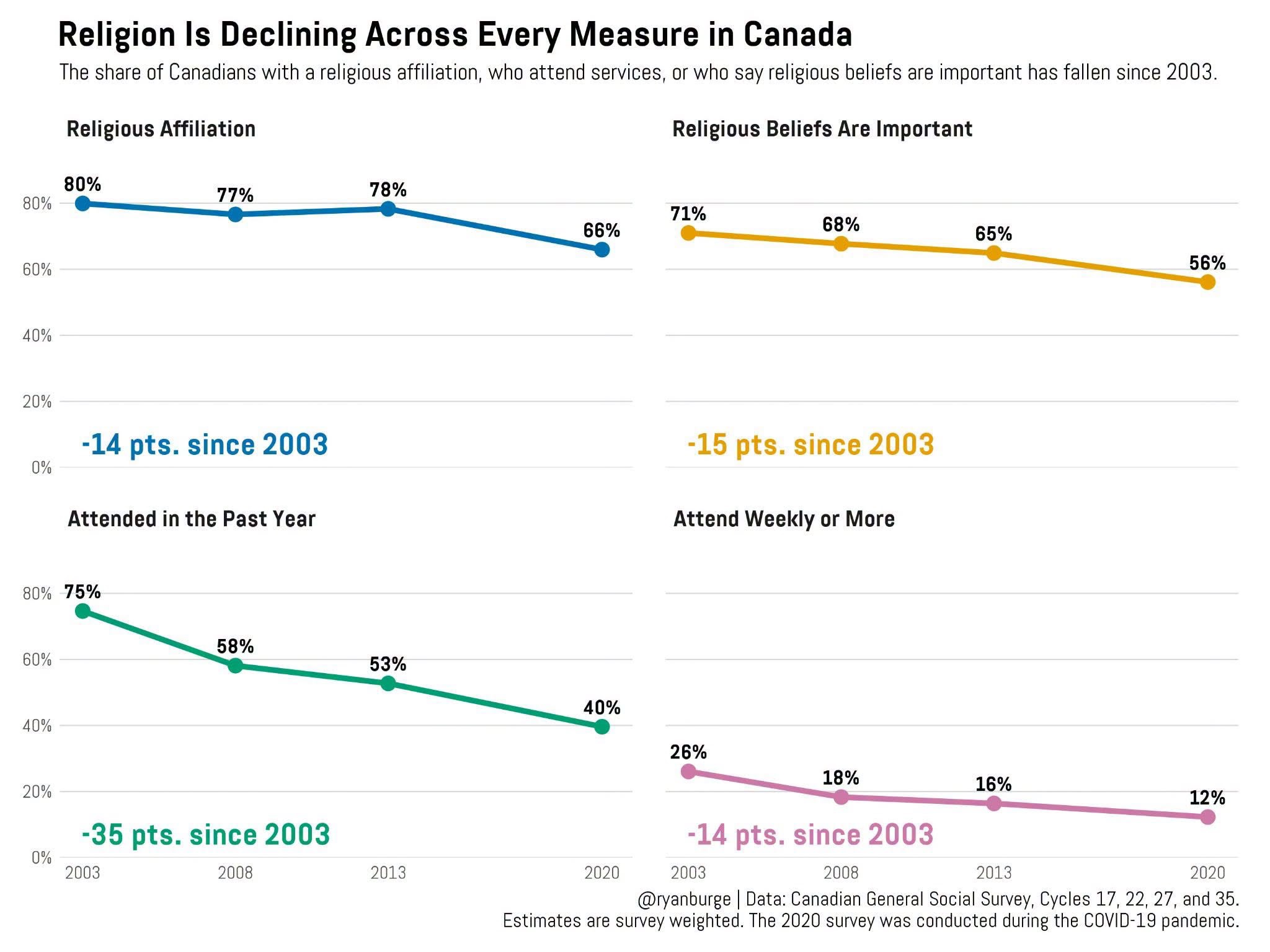
Ryan Burge recently released a series of graphs examining religious life in Canada (see graphs). Although the data only extends through 2020, the trends are troubling. They point to a decline in religious affiliation and practice. Logically, it seems those numbers have worsened rather than improved by 2026.

The Church of the Nazarene groups Canada and the United States together in the USA/Canada Region. Yet any geography buff knows that Canada is an enormous country, spanning a vast landmass and home to approximately 41.8 million people. The Church of the Nazarene divides this expansive nation into five districts. Under the leadership of Canada National Director Mark Collins, the denomination has 365 licensed and ordained ministers, 148 churches, and 12,215 members across the country.

The Church of the Nazarene has a long and meaningful history in Canada. The first Nazarene church in the country, located in Oxford, Nova Scotia, predates the formal establishment of the Church of the Nazarene denomination, having begun in 1902. Remarkably, it continues to meet in its original building.

Canada is also home to Ambrose University in Calgary, the denomination’s affiliated educational institution. Over the years, Canada has produced many outstanding leaders. Perhaps the most notable is Edward Lawlor, who served as a general superintendent from 1968 to 1976. Raised in Canada, Lawlor also served as district superintendent in both Alberta and Canada West. More recently, Stan Reeder, a Canadian native, served as the USA/Canada regional director.

Like New England in the United States—where Vermont and New Hampshire rank among the least religious states—Canada presents significant challenges for those seeking to make Christlike disciples. The work is difficult, but it is not impossible. The spiritual challenges facing Canada should not lead us to despair; rather, they should deepen our commitment to prayer, mission, and faithful witness.

What Can We Do? We can pray.

  • Pray for Mark Collins as he provides leadership and direction for the Church of the Nazarene in Canada.
  • Pray for the five district superintendents: David Skidmore, Steven Ottley, Gordan McCann, Randy Barrington, and Rose Brower-Young.
  • Pray for workers to enter the harvest fields, remembering Jesus’ words in Luke 10:2: “The harvest is plentiful, but the workers are few.”
  • Pray that God will open doors for the gospel, strengthen local churches, and raise up new leaders.
  • Pray for a spiritual awakening across Canada—a revival that renews the Church, draws people to Christ, and inspires a new generation of disciples.
  • Pray that the Nazarene Bible College and Shepherds Circle (shameless plug) might assist encourage and equip pastors for the days ahead!

The USA/Canada Region is vast, diverse, and filled with both challenges and opportunities. Canada must not be overlooked, and its spiritual future must not be written off. The mission field is too important, the gospel is too powerful, and the call of Christ is too compelling for us to surrender hope.

Canada is not beyond the reach of the gospel. Let us pray, work, give and believe God for a revival. This land must not be lost to the Kingdom of God or to the mission of the Church of the Nazarene.

Sell the Building. Save the mission.

When does a church make the hard decision to sell its aging, neglected, and increasingly expensive building? From my observation, usually about five years after they should have reached that conclusion.


Here are the facts: Many congregations sacrifice Christ’smission for the sake of an aging building. Time, energy, and money are poured into patching a leaking roof, maintaining an ancient heating and cooling system, and figuring out how to heat a building that is three times the size needed for the shrinking number of people who attend.


There is sentimental value. A church building can hold decades of wonderful memories—salvations, baptisms, Spirit-filled revivals, weddings, funerals, answered prayers, and transformed lives. People can point to a particular spot at the altar and remember where they decided to follow Jesus or where their marriage was restored.


Those memories are real. They matter. That’s what makes the decision so hard.


Selling the property can feel like admitting defeat—as though the church is losing the battle. But in many cases, if the church is going to preserve its mission, the building may have to be sacrificed. The church exists for people, not for a building.


When Jesus told Peter, “I will build my church,” He wasn’t talking about brick and mortar. He was talking about a people—a community of disciples called to carry His message into the world.


That mission has never depended on a building. In fact, a congregation’s mission can sometimes be hindered when people begin to believe the building is the reason the church exists. It isn’t. The church exists to bring people into fellowship with Christ. It exists to make disciples, baptize them, and teach them the ways of Jesus. If the constant drain of money, time, and energy required to maintain a building is hindering that mission, perhaps it’s time to put a “For Sale” sign in the front yard.


But where would the congregation meet? That’s where creativity and faith come in.

Depending on the size of the remaining congregation, they could meet in homes, schools, township halls, community centers, or even reach an agreement with another church to share space. It would require change. It would require humility. Undoubtedly it will require faith.

But what if selling an aging building wasn’t the end of the church? What if it was the beginning of a new vision?


Imagine a congregation freed from the burden of maintaining a building it no longer needs. Imagine redirecting those resources toward people—toward evangelism, discipleship, missions, children, families, the poor, and the community. Imagine a church rediscovering that its mission is not a building.


The mission is people.


Times have changed, but Jesus hasn’t changed. The world still needs Jesus. That mission has never required a building. The early Christians understood this. They carried the gospel into homes, marketplaces, prisons, and even the catacombs. They didn’t wait for the perfect facility before they fulfilled the mission Jesus had given them.


The question should not be, “How do we maintain our building?”  The better question is:

“How can we fulfill the mission Jesus us called us to accomplish? Do we need to let go of our building to see it happen?”


An A-to-Z Guide for Pastor Appreciation Month

Appreciate your pastor even when it’s not October.

Be in Church this Sunday

Complain about the temperature in the sanctuary (just kidding, bring a sweater) 

Devote yourself to holiness

Equip others to serve with you.

Forgive when he/she makes a mistake or forgets a prayer request (pastors are human too)

Give to missions

Have your pastor’s back when nay-sayers are around

Invite a neighbor to church

Jump in and help

Keep your pastor in your daily prayers

Love your pastors’ family

Make your church a joy-filled place

Never Gossip

Or put up with those who are gossiping.

Place something in the offering (a tithe is even better) 

Question every decision (OK. Joking again. Trust the pastor’s leadership).

Remember to apply the sermon during the week.

Say an “Amen” when during the sermon. 

Text your pastor good news (and say, “no need to text back”) 

Uplift your pastor whenever possible

Volunteer in the areas that no one wants to volunteer.

X-hibit the qualities of Christ.

Your example matters. Let others see you appreciate your pastor.

Zealously, cheerlead on your church’s behalf.

P.S. Giving a gift card to a nice restaurant is good too!