Who is Attending Church “Whenever the Doors are Open”?  Apparently not too many.

Ryan Burge released a survey recently about people who attend religious services multiple times a week (see graph).  In other words, who attends church “whenever the doors are opened.”  According to Burge, the number of white evangelicals who attend “whenever the doors are open” is only 18% (non-white evangelical was slightly higher at 21%).  This is a telling factor in church life today.
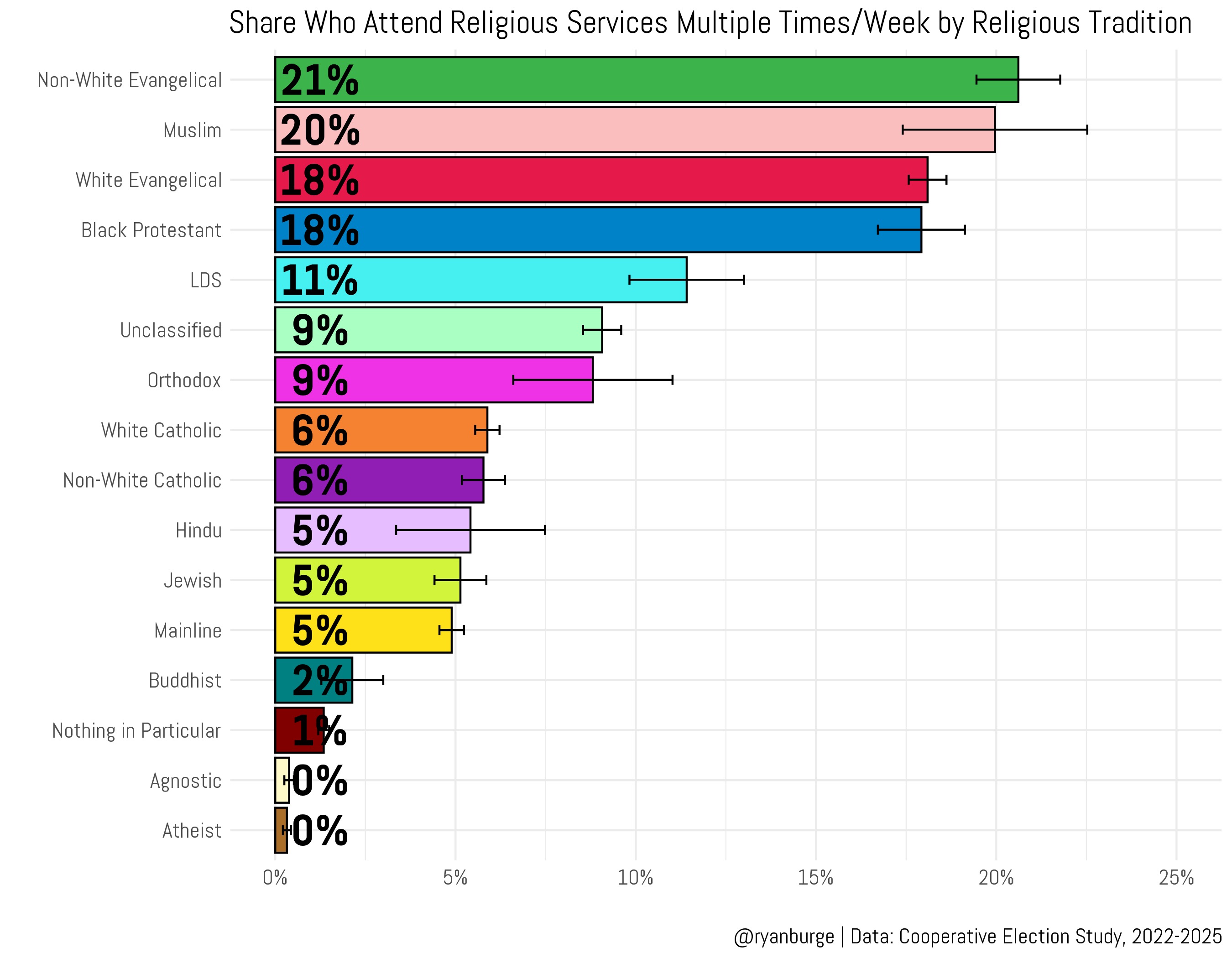
Not only is Sunday morning attendance down in many churches, but less people are attending as frequently as members once did.  I’ve told the old joke that “I had a “drug problem” when I was a kid.  My parents’ “drug” me church Sunday morning, Sunday night and Wednesday night too.” It’s not happening as much these days. In part, many churches no longer have Sunday night services. While many churches still offer Wednesday activities and separate youth group gatherings, participation is still down (apparently). 

No doubt, there are several factors have led to lessening of participation in religious activities. Competing elements for one’s time (both for the adults and minors); homes where both parents are working or single parent homes that leave less time for religious or extracurricular activities; and as stated the cessation of services offered by churches. 

The obvious effect of these numbers (no matter how legitimate the reason) is a lessening of discipleship. Less face time in religious services and around fellow believers leads to less discipleship, less engagement and less connectivity to the church and the things of God. 

Much like the old argument, “which came first—the chicken or the egg?” one can debate the question– has a lack of discipleship led to less participation in religious services or has a lack of religious services led to a discipleship lapse? The answer most likely is “Yes.” It’s both. We have a discipleship problem that has led to many not feeling the necessity to be present as frequently within the church community. People see little value in attendance in the other gatherings. Additionally, less frequent participation has created a less discipled membership. The greatest service in the world can happen, but if one isn’t there, an individual can’t learn, grow, or be blessed.

If the goal is to make “Christ-like disciples in the nations,” does 18% participation in multiple services indicate that we are failing in that endeavor?  Can a person become Christ-like if only attending one service a week? The answer might be in what constitutes or qualifies as a “religions service”?  Does Burge’s survey include a small group that meets during the week? What if one meets regularly with a religious mentor or is independently motivated to biblical and devotional reading and prayer? 

Obviously, one can grow in the Lord through those means and become a devout follower of Jesus without attending multiple services in a week. It’s possible. But is that happening on a regular basis? It seems not likely. Generally, for most people, community is what fosters growth. People thrive on peer-to-peer learning. Intentional discipleship is needed. There are soul-strengthening benefits of coming together on multiple occasions throughout the week. Conclusion: Maybe more than 18% of believers are actively being discipled, but whatever the number, it is not nearly enough. Former Point Loma professor Rueban Welch said it best years ago, “We really do need each other.”

Is Your Church Dead? Revitalization Won’t help

Is your church dead? The answers to the following questions might be a clue.

Are lost people coming to know Jesus? 
Have there been any baptisms of people who are not children of existing members? (not that children’s baptisms are unimportant, but the point is asking if the church is reaching people beyond its walls?)
Has someone other than the pastor led a teenager or adult to the Lord?
Is someone other than the pastor doing the work of an evangelist?
Does the church have a regularly scheduled, extended, intentional, time of prayer?
Has anyone in the church answered the call to full time ministry?
Has the church issued a local minister’s license in the last three years?
When was the last time the church abandoned the normal flow of a worship service to allow the Spirit of God to move? 

If the answer is “no” or “never” to the majority of these questions, the church is dead. No matter how many people are filling the pews; no matter how nice the people are; no matter how knowledgeable the pastor is– the church is dead.

News Flash: Dead is not fixed by revitalization.

Revitalization is a buzz word in church circles these days. But can we be honest about what many churches need? (Hint: it’s not revitalization). It’s a resurrection. Revitalize implies that the church is somewhat alive and needs a kick start. Maybe it’s a new program; a new pastor; or a fresh coat of paint. It needs to be spruced up a bit and it will be fine. Revitalization is good for those churches with a pulse (there are many in this category), but for cold, dead churches (there are many in this category too) revitalization is like putting lipstick on a pig (or better stated “putting lipstick on a corpse”).

Resurrection recognizes the cold hard truth. The church is dead. Life hasn’t been evident for years. A few people may still show up on Sundays. Their tithe is keeping the lights on and the pastor underpaid, but the church is dead. New paint or a new sound system isn’t going to fix dead. The pastor alone can’t fix dead either. Death is only undone, by the work of God. Only God brings about resurrections. 

The disciples were “revitalized” after the resurrection of Jesus. Of course, they were. Jesus, who was dead, is now alive. Yahoo!! But in spite of that earth shattering news, the Bible records no new followers between Easter Sunday and Pentecost. Not one. Only 120 people managed to gather in the upper room. You’d expect more, wouldn’t you? 

But that small band of believers began to pray. They prayed and prayed and prayed. Then they prayed some more. Church resurrection begins with prayer (that’s our part). The Holy Spirit then answered the prayers of the remnant in a profound way. The church was born. It was resurrected (that’s God’s part). 120 people, newly filled with the Holy Spirit (resurrected, hope-filled people) poured into the Jerusalem streets proclaiming the Good News of Jesus. Resurrected people are missional. They’re evangelistic. Evangelism is the tangible result of a resurrected church. Evangelism leads to change lives and changes lives changes the course of churches. The church became alive. 

What resuscitates dead churches? Kindled in prayer, renewed and rejuvenated by the power of God– dead churches are resurrected through evangelistic victories. A Holy Spirit empowered evangelistic effort leads to new life. Resurrection is what the dead churches of America need today. Good News: God specializes in resurrections!

What’s not Missional (and what is). It might surprise you.

New carpet in the sanctuary is not missional.
Giving money to the poor is not missional (what?)
Having a great choir or worship band is not missional.
Giving money to missions is not missional either (yikes, really?  Really).
A new coat of paint in the fellowship hall is not missional.
Having nice people in the church is not missional.
Singing is not missional.
Tithing is not missional. 
Paying off building debt is not missional.
Putting together Crisis Care kits is not missional (that seems missional. It’s not).
Attending a Bible study is not missional.
Showing up Sunday after Sunday is not missional.
Smiling church greeters is not missional.
Having a knowledgeable pastor is not missional.
Teaching Middle School boys’ Sunday school class is not missional (award worthy, but not missional).
Being able to quote scripture is not missional.
Taking a dish-to-pass to the church pot luck is not missional.
Being holy is not missional (Wait a minute…).
Endowing a scholarship at a Christian college is not missional.
Praying for a senior citizen’s gout is not missional.
Simply loving your neighbor is not missional (C’mon, you’re going too far. Am I?)
Washing the church van is not missional.
Setting up the communion trays is not missional.
Going on a mission trip is not missional (you’re talking crazy now. No, I’m not).

All of the above are well and good. Not bad at all. Do them all. Please. Do. Them. All. 

Here’s what’s missional:
Drum roll please…

Missional is helping lost people to find Jesus. Period. 

John Wesley said it: “You have nothing to do but to save souls. Therefore spend and be spent in this work.” (Have. Nothing. To. Do. But…)

Jesus said it: The Son of Man came to seek and to save the lost.

If the top-of-the-page, aforementioned statements help lead lost people to Jesus, then they are certainly helpful to the mission. They can be missional. But in and of themselves, if they do not lead to people finding Jesus, they are good deeds. We are called to do them. But let’s not confuse it with being missional. The clear mission and mandate of the church is leading lost people to Jesus. Making disciples. Baptizing them. Teaching them to go be disciple-makers too. That’s missional. If your church is not doing it. It’s not missional. 

Is AI the Answer to the Prayers of the Church (in unexpected ways)? 

Like it or not, AI is coming. It will affect the church. This is not about pastors using ChatGPT to write sermons or AI producing a better church software.  It will be much more impactful. Here’s the kicker: Is it possible that AI is the answer to the church’s prayers (in unexpected ways)?

The Bad News: If one Googles “job losses caused by AI” there are numerous reports from a variety of news sources citing the coming labor crash (one example is HERE).  The consensus: people will lose jobs. It’s already happening. Of course, that is not good. The social impact of AI will be startling. Here’s more bad news: when church people lose jobs, church income is also reduced. Programs are lost. Ministries are cut. How can this be good for the church? 

Look at these facts:

Fact 1: AI induced job losses are coming (See above).
Fact 2: Pastors are getting older. More pastors are over 60 than under 60 in the USA.
Fact 3: There are not enough pastors-in-training in the current pipeline (in colleges or course of study) to fill the upcoming (and already here) pastor shortage.

The result: Individuals, who have college degrees but have lost their jobs because of AI, start looking and praying for a new career. Suddenly, but not surprisingly, they hear from the Lord. Could those unemployed college graduates, in their unanticipated job search, discover that God is calling them to something better? Could God use the AI created job market black hole to call men and women into full time ministry?  It makes sense. Why not? The fields are still “white unto harvest” and AI can’t replace pastors.

Moreover, in times of social upheaval and uncertainty (also coming, thanks to AI), people are more apt to turn to God. When people are at a loss, when times are challenging, people turn to Jesus. Could AI induce a revival? Again, why not? 

More pastors and a coming revival—aren’t those the very things for which we’ve been praying?

Please understand, I’m not advocating problematic social upheaval. I don’t want it, any more than anyone else. I’m simply noticing the winds of change. We are on the cusp of a new AI world. Moreover, the church needs to be prepared. (Shameless plug alert) Places like Nazarene Bible College are needed more than ever. We need pastors. Lots of pastors. They need to be trained. That need is going to grow, not lessen, because of AI. We’ve been praying for revival. It may be the unanticipated result of the coming AI revolution. So, heed the words of Jesus:

The harvest is plentiful, but the workers are few. Ask the Lord of the harvest, therefore, to send out workers into his harvest field.  –Jesus (Luke 10:2)

Acronyms and the Nazarene Ecosystem

Nearly 13 years ago, I left Mecca (Nazarene Version… aka Lenexa, Kansas) to pastor a church in Michigan. One thing I learned during my stint in the heart of Nazarene-dom (other than rubbing shoulders with the good people who love Jesus and the Church of the Nazarene) is that these people love acronyms too. Maybe a glossary should be distributed in membership class for the various abbreviations in the Nazarene world—it’s more than WEF, NMI, NDI, and NYI. Much, much more. Now, I’m back in Mecca. I’m going to have to re-learn the Nazarene abbreviated speak. 

Here’s my effort to fit back in:

ICYMI the BGS gave approval for me to lead the CPE* for NBC (not ONU, MNU or any other schools under the IBOE watch). The FAQ is what will the CPE* do? FYI, it’s about helping pastors. NGL, I’m not a VIP, certainly not the GOAT and it’s not DIY project. I’ll need help from GSs, RDs, DSs (especially those in USA/Canada). BTW, you might see me at PALCON, NYC, a DA and for sure at GA27. RN, I’m learning. LMK if you can help me. 

AFAIK I will be working at the GMC. ASAP. FWIW IMO my ETA at the GMC is in about 2 weeks. TBH IDK and IDC what the delay is, but I’m OMW! My office space is TBD. Put my desk next to NDI, NMI, NYI even by NCM, and I’m good. W/E. ATTS, I’m OOO, but NFL.

TIA. G2G TTYL. LOL

P.S. My BFFs at SD say don’t forget WEF

Translation (acronym used in bold) for the non-Nazarenes in the crowd:  

In case you missed it, the Board of General Superintendents gave approval for me to lead the Center for Pastoral Excellence* for the Nazarene Bible College (not Olivet Nazarene University, MidAmerica Nazarene University or any other schools under the International Board of Education watch). The frequently asked question is what will the Center for Pastoral Excellence* do? For your information, it’s about helping pastors. Not gonna lie, I’m not a very important person, certainly not the greatest of all time, and it’s not a do-it-yourself project. I’ll need help from General Superintendents, Regional Directors, District Superintendents (especially those in the United States of America and Canada). By the way, you might see me at Pastors and leaders conference, Nazarene youth conference, a District Assembly and for sure at General Assembly in 2027.  Right now, I’m learning. Let me know if you can help me. 

As far as I know I will be working at the Global Ministry CenterAs soon as possibleFor what it’s worthin my opinion my estimated time of arrival at the Global Ministry Center is in about 2 weeks. To be honestI don’t know and I don’t care what the delay is, but I’m on my way. My office space is to be determined. Put my desk next to Nazarene Discipleship International, Nazarene Missions International, Nazarene Youth international or even by Nazarene Compassionate Ministries, and I’m good. Whatever. All this to say, I’m out of office, but not for long

Thanks in advance. Got to go, talk to you laterLaugh out loud.

Post Script: my best friends forever at Stewardship Development say don’t forget the World Evangelism Fund.

You know, I think I’ll fit in very nicely!**

*There’s not an official name for the Center for Pastoral Excellence

**53 abbreviations used. Yup, I’m a Nazarene in good standing!

Thoughts from the Nazarene Theological Seminary Graduation 

The Nazarene Theological Seminary graduation on Saturday included all the familiar elements of such an occasion. “Pomp and Circumstance” played as the graduates processed. Academic regalia filled the room. There were moments of gravity and moments of levity. The commencement address was excellent—Dr. David Busic preached a thoughtful and engaging sermon, drawing creatively from the not-exactly-biblical text of “Humpty Dumpty.” Diplomas were awarded, families beamed with pride, and cheers rose with each name called. In many ways, it was exactly what one would expect from a graduation ceremony.

And yet, a few things stood out to me.

First, the seminary is no doubt the most diverse institution in the Church of the Nazarene. Racially it’s diverse. There were as many—if not more—graduates of color as there were caucasian graduates. Gender-wise, it’s diverse. There were as many female graduates as male. Maybe more. Denominationally, it’s diverse. It appeared that a significant number of those graduating were not Nazarenes. All of these facts are vastly different from the NTS that I attended in the late 80s. Back then, there were a handful of female and non-Nazarenes students and even less black students.

Second, there were roughly as many doctoral graduates as master of Divinity graduates. This raises an important question about our priorities in graduate theological education within the Church of the Nazarene. Neither group had over 20 graduates. A broader restructuring of graduate ministerial education is underway, and perhaps these numbers will shift in the years ahead. Also notably, there are more graduate theological education options (even within the Church of the Nazarene) than when I was a student. Maybe looking at the number of NTS graduates does not tell the whole story of Nazarene graduate theological education. Still, it seems that the number is woefully low. 

Third, I found myself wondering how many of those graduating either are, or intend to become, Nazarene pastors. Again, if less than half of the students are Nazarene, and if less than half of those students (that’s a guess) are planning on being pastors—those numbers should give us pause. There may be a variety of reasons for this, including, in some circles, a diminished confidence in the seminary or even in higher education more broadly. Regardless, the need remains clear: in these challenging times, it is essential for the church to have a well-educated clergy—men and women who can think deeply, communicate clearly, faithfully articulate our theology and mission and serve wholeheartedly in their communities. 

My new role of creating a Center for pastoral excellence through the Nazarene Bible College is not focused on graduate-level education. Instead, it centers on those at either end of the journey—those who may have completed their education (in some cases years ago) and those just beginning to explore a call to ministry. My work is about encouraging and equipping individuals wherever they may be along the ministerial pathway. Still, I cannot ignore a growing concern: are we adequately preparing our clergy for the realities they will face? Are we cultivating the depth of thought, theological grounding, and resilience that ministry today demands? In an unholy world, don’t we need more holiness pastors/preachers not less? If the “fields still white unto harvest” and if God is still calling men and women into pastoral ministry, where are these individuals? Are they not listening? Has something happened (or not happened) in between sensing a call and preparing and then fulfilling that call?

These are questions worth asking—and answering—together. In other words, we’ve got our work cut out for ourselves.

Hey, Pastors, Help Me so I can Help You!

As you may have seen, I have taken on a new role in connection with the Nazarene Bible College to create a center for pastoral excellence. (Here’s the link to the new job). I technically started last Friday (I write “technically” because prior to May 1, I had already been in meetings with the Bible college and with others connected to this start-up venture). Today is “technically” day four into a whole new world for me.

The big question I’ve been asked since leaving Flint Central Church is: “What in the Center going to do?”  It’s a good question. The simple answer is that Nazarene Bible College wants to help pastors. We want to care for them and their families. We want pastors to thrive when too often many feel isolated and alone. We want to regain a sense of holy, evangelistic urgency in a world that has lost its way. We recognize that District Superintendents need help too. They want to help and encourage pastors but too much of their time is putting out fires and dealing with legal wranglings. Additionally, we want to locate and assist those who are exploring a call into ministry. We hope to assist in training and empowering future pastors to be on-fire, evangelistic, holiness preachers. In other words, we want to restore (or start) a burning, holy fire deep inside the hearts of those called by God and in so doing flip the trajectory of many churches. 

Quite frankly, it’s a big job. Impossible maybe. It’s certainly bigger than me.  Someone once said, “Nothing is impossible with God.” I believe that is still true!

The Center doesn’t have a name. I don’t have a mailing address (I think I will be moving into the Global Ministry Center in Lenexa). I don’t have a phone extension or a work phone number. I don’t have a desk, stapler or official letterhead. I don’t have an assistant. I don’t have really anything other than a desire to help pastors and district superintendents in these challenging times. 

I do have an email address!  Please answer a few of the following questions (don’t answer all 19, you have better things you should be doing). Email me at rsprince@nbc.edu

  1. What do you see as the biggest obstacles that pastors face today?
  • Do you know a pastor who feels lonely or isolated? Without giving names, how do you know this to be true?
  • Would a pastor take advantage of a free (or close to free) retreat space?  If so, where should a retreat center be located? Should there be some spiritual direction in such a space or just let the pastors figure it out on their own?
  • Do you think pastors would take advantage of a low cost or no cost tele-help anonymous counselling service? In your opinion is such a service needed?
  • Do you consider it as unreasonable to expect bi-vocational pastors to work a 40 hour a week job, pastor a church, raise a family and complete the required course for ordination? Explain why or why not.
  • Do you think evangelism is a priority in most churches today?
  • How could pastors (and leaders) be trained into more/better in evangelism?
  • How often should a preacher preach on holiness? 
  • Do you think there are enough holiness resources available for today’s preachers? If not, what would you suggest could be improved? 
  1. Who would you like to hear speak at a conference?
  1. What do you see as the biggest obstacle that district superintendents face?
  1. I’ve heard of pastoral burnout, but not district superintendent burnout. Is that a thing?
  1. Do you think that men and women are being called with the same frequency as in years past?  If so, where are they? 
  1. How would you suggest District Superintendents fill empty pulpits in churches where the faithful members are dwindling and they can no longer afford a full-time pastor in an area with little employment opportunities for a bi-vocational pastor?
  1. With more pastors over 60 years old than under 60, and fewer men and women in the “ministerial pipeline,” what do you think will happen in ten years when the current faithful shepherds retire or get promoted to Glory?
  1. What do you think would be more appealing to those churches where pastoral placement is difficult—a “circuit riding” pastor that covers two or even three churches; a video type sermon offered by a leading regional pastor and leaders trained to cover the other pastoral duties; a trained “lay” pastor from a current member or the waving the white flag of surrender? 
  1. If money were no object, what would you do for pastors? For District Superintendents? 
  1. How do you view the future for denominations like the Church of the Nazarene?
  1. What else do you think I should know?

Thanks for your help. I’ll looking for help as we strive to come up with the answers our pastors and district superintendents desperately need.