Ten steps to a powerful movement to God.

Spiritual renewal with Dr. Dan Boone, Jon Nichols and the Woods Band is T minus 6 Days Away (there are also children’s workers and the pre-school and nurseries will be open).

Here are the steps for a great movement of God:

1.  Clear your calendar

2.  Plan on being at every service.

3.  Pray Samuel’s prayer: “Speak Lord, for your servant is listening.”

4.  Anticipate that God is going to speak directly to you.

5.  Sit down front (eliminate distractions)

6.  Sing every song, like you’re the only one in the room (hand raising is optional, but encouraged).

7.  Bring a Bible or have a Bible app open and ready. If you are a note taker, bring a notepad.

8.  Make a deal with God, if he speaks you will quickly move forward to an altar to pray.

9.  Make another deal with God, you won’t leave the altar until the matter with Him is settled.

10. Bring a friend (tell your friend to follow steps 1-10 too).

Imagine if every pastor, every board member, every Sunday School teacher, every small group leader, every musician, every singer, every usher, every greeter, every single person (man, woman or child) who calls Central Church “home” followed the steps listed above—we would have a mighty movement of God. 

It’s simple. 

Ten steps to a powerful movement to God. 

When you Wish Upon a Star… nothing happens.

I wish every church that believes the Bible is true and preaches Jesus was filled to the rim.
They aren’t.

I wish that when non-Christian people thought of Christians people they’d have nice, happy thoughts.
They don’t always.

I wish everyone who attended church before covid still attended church.
They don’t.

I wish people were nicer to those who have different political views.
They aren’t.

I wish gay people felt welcome to attend church.
They don’t in a lot of places.

I wish people didn’t get hurt in church.
Some do.

I wish anonymous letters that pastors receive contained the coward authors’ names.
They don’t.

I wish church leaders would lead in a “Jesus first” manner and not a “money first” manner.
They don’t always.

I wish kids didn’t have to worry that a shooter will come into their school.
They do.

I wish every pastor felt appreciated by his/her congregation.
Not all do.

I wish every teenager felt like adults understood what it’s like to be a teenager in 2022.
They don’t a lot of the time.

I wish Christians didn’t try to tackle nonexistent “boogeymen,” but instead went after the things Jesus said to tackle (feed the hungry, clothe the naked, give drink to the thirsty, help the sick, and visit the prisoner).
Some do, a lot don’t. 

I wish black people and white people could turn Dr. King’s Dream into a reality. 
Sometimes it seems we are years and years away from that happening.

I wish all the hungry people in our country had food.
They don’t.

I wish all innocent prisoners in jail were discovered to be not guilty of the crimes for which they are imprisoned.
They aren’t.

I wish there was no such thing as pornography.
There is.

I wish there were no rogue police officers, crooked judges or phony preachers for that matter.
There are a few.

I wish every lonely widow or widower had a friend to call when needed.
Many don’t.

I wish every child in the foster care system had a forever home.
They don’t.

I wish White Supremacists realized how stupid white supremacy is.
They don’t.

I wish. 
I wish. 
I wish.
I could go on and on.

Maybe I need to stop wishing and wishing and start praying and praying. Then maybe I should work to see those prayers become reality. 

Suppose a brother or a sister is without clothes and daily food. If one of you says to them, “Go in peace; keep warm and well fed,” but does nothing about their physical needs, what good is it? In the same way, faith by itself, if it is not accompanied by action, is dead.  James 2:15-17

When United Methodist Members Change Churches: One Nazarene’s Response

Our United Methodist (UM) brothers and sisters are splitting over Biblical interpretation and LBGTQ+ related issues. Local congregations must decide if they wish to stay with the denomination or exit. As this occurs, many churches will decide to remain UM (some because they agree with the Biblical interpretation shift and some for economics as the price for exiting is excessively high). In those churches that remain UM, some of their members may decide to leave. Since the Church of the Nazarene (CotN) is in the same theological tree, some may look to a local CotN as a landing place upon their exit. 

What should we offer these people?

1. Give them time. Allow them to grieve. Allow them to mourn the loss of their church home. This is hard. People will be making decisions to leave a church in which they have poured their time and resources. Some have raised their children there and it’s the only church they have known. It’s heartbreaking to leave a church you have loved. It will take time to recover.

2. Give them a space. Following months of heart wrenching decision-making both for themselves and their friends who remain UM, those looking for a church home need to simply worship in peace. Let them enjoy the singing and the Biblical preaching from the pulpit. Let them relax and take a deep breath. Invite them to join small groups, Sunday School classes and for dinner in your home. Make your church warm and hospitable. Pray that God will restore their joy. Like with all who grieve, not everyone will bounce back in the same time and manner. Give them space to move at their own pace.

3. Give them a voice. When those bereaving former UM members are ready, let them speak of their sadness. Empathize with this new reality for them. No need to offer pithy clichés like “It-will-be-ok” or “God-is-in-charge,” they know the “Sunday School” answers. Instead, these heartbroken people just need to have someone sit and listen. They will talk about it when they are ready.

3. Give them a place of service, when the time is right. Eventually, these folk, who in many cases, were the worker bees in their former church, will need a place to serve. Talk to them about their strengths. Ask them where they would like to serve and if they are ready. Then put them to work. Let them use their gifts and talents for the Lord. 

The situation in the UM church is heartbreaking on many levels. It used to be said that the CotN was running 20 years behind the UM in social matters. With the speed of communication these days, it appears that the timeline has shrunk. News travels fast. Attitudes and positions change more quickly. Will the CotN debate Biblical interpretation and LBQTQ+ issues too? Of course. The 2017 General Assembly displayed much unity regarding its statement on human sexuality (97% agreement), but that does not mean the issues contained therein will not be revisited. The CotN is not immune from the tilt of our secularized society. In other words, before casting stones at our UM kinfolks, let’s make sure our house is in order.

In all matters, pray that, like Jesus, we will be full of grace and truth.  Pray that we might fulfill Jesus prayer in John 17 to be one. Pray for God’s intervention with our brothers and sisters in the United Methodist Church. Pray for the new entity, the Global Methodist Church. Pray for a reconciling spirit and the return of the joy of the Lord. No one but our Enemy wins in these types of battles. Pray for God’s peace and mercy to all. 

The lack of Christ-like Leadership and the Demise of Christianity in America

Christian Leadership means leading in a Christ-like way. What’s a Christ-like way? It’s leading in such a manner that those around the person would think, “This person would wash my feet, if needed.” In other words, Christian leadership is all about servanthood. The Christian leader should ask themselves:

Do the folks I lead know I am servant first, leader second?
Do the folks I lead know of my devotion to Christ more than any other aspect about me?
Do the folks I lead look at my Christian walk and think I want to follow Jesus in the same manner?

If not, then you are not a Christian leader. The so-called leader might have a title with impressive letters like M.Div, D.Min. or Ph.D after their name. But if they aren’t leading like Jesus, they aren’t a “Christian” leader.

A recent study showed that by the 2070 less than 50% of Americans will identify as a Christian. See the article here). Why such a downfall? No doubt, many factors are involved. Still John Maxwell’s quote “everything rises and falls with leadership,” would deduce that a major factor for the fall of Christianity in America is the lack of Christ-like leadership displayed in the last few decades.

Too often Christian leaders (in many cases, certainly not all) have…

  • Climbed to the top, using the ways of the world instead of the way of Jesus.
  • Demanded to have their way and their rights, rather than picking up a towel and basin. 
  • Focused more on politics than Jesus.
  • Created boogeymen/strawmen to topple, while ignoring Christ and His kingdom. 
  • Been silent when needed to speak, and spoken when silence was the best response.
  • Kowtowed to those with money rather than being faithful regarding “the least of these.” 

At some point, some of these “the rising to the top” leaders may have voiced the importance of Christian servanthood over an autocratic management style. Only to reach the top of the ecclesiastical ladder, seduced by its power, and have subsequently responded more like a shark, rather than the Lamb of God.

The result? The world has been watching and is now rejecting Christ and His bride. People are walking away in droves. Christian leaders are still responding by casting stones at society and those leaving the church, rather than confessing our own sins. Leaders have no one to blame for the demise of the church in America than themselves. 

Is there any way to turn this trajectory around?  Yes, but it will come from followers of Jesus (leaders first) displaying the attitude of Jesus. It’s leading as Jesus– full of grace and truth. It’s servanthood over salaries, titles and position. It’s the way of Jesus. Unless we walk in the way of Jesus, we are no different than those walking the ways of the world.

The Parable of the Seed on a Shelf

Once upon a time, there was a seed that wanted to grow into a great champion pumpkin. But that little flat, one third of an inch, white pumpkin seed didn’t want any help in doing so. Sealed in his package of seeds and sitting on a shelf in the local hardware store, he declared to the others, “I’m going to grow into a great pumpkin one day. And I’m going to be a champion pumpkin all by myself.”

The other seeds in the bag laughed, “All by yourself?”

“That’s right, all by myself!” he proudly proclaimed.

Well, as good fortune would have it, a nice lady bought the package of pumpkin seeds and took them home. She didn’t have a big plot of ground, so she only planted some of the seeds. The seed that made “the great pumpkin” declaration was not one of the chosen seeds and remained in the bag, on a shelf, in the garage. 

“That’s OK. I don’t need anything else, I am going to grow into a great pumpkin right here!” the seed announced to no one in particular.

The lady tilled the ground and added cow manure to it. Cow manure is an excellent source of nitrogen, phosphorus and potassium which are all nutrients necessary for plants to grow and thrive. Then she planted the seeds in the rich dark soil. She looked up and smiled as the sun was beaming down on her and her planted seeds. She knew sunny warm days were important for seeds to grow. She made sure she watered the seeds every day without fail. Watering seeds is important too. She used fertilizer on the sprouting plant from time to time. Not too much. Not too little. When birds came to eat the buried seeds or when critters from the woods came to eat the growing vine and subsequent little blooms then pumpkins, she’d shoo them away with a holler and wave. If weeds tried to invade the plants’ space, she’d quickly pull those pesky intruders so they wouldn’t gobble up the nutrients in the soil.

The pumpkins grew and grew and grew. They grew larger than anyone had ever seen in that part of the country. All the nice lady’s friends urged her to take the pumpkins to the county fair. She couldn’t take them all, so she picked out two large, orange beauties and had some strong friends load them into a truck. 

At the fair, the judges inspected and smiled at both big, fat pumpkins. They couldn’t decide which was better, so both pumpkins won first place. Blue ribbons and much fanfare followed. Everyone wanted to know how to grow such large champion pumpkins.

Meanwhile, back in the garage and on the shelf, was the flat, one third of an inch, white pumpkin seed. It was still just a seed. But it had learned an important lesson: A seed can’t become a champion on its own. It needs good soil, lots of water, sunshine, fertilizer, someone to shoo the varmints and pull the weeds and some friends to help along the way. 

A seed on a shelf just cannot grow by itself. To be a champion, you need help.

Likewise, a person only sitting in a pew cannot grow either. To be a champion in our faith and in life, we really do need each other.

The end.

The Answer to Our Troubled Times Might Surprise You

Too many Jesus followers get caught up in the distractions of the today’s culture. We participate in meaningless arguments. We quarrel about things that in the end won’t matter. We debate who should be in and who is out of the church, even as the debates themselves push more and more people out. We say, “we don’t like the direction the culture is moving,” yet we offer no alternatives in our bickering. We make up strawmen-boogeymen, then prove our “intellectual superiority” as we tear down these so-called threats. Those with eyes in the world see through these phony tactics, giving further evidence to ignore the church and the Truth we are called to represent.

“Shout about the evils in the world,” they say. More and more people are willing participants in what was once called sin. “Preach the Bible,” they say. More and more people no longer believe that the Bible is true. Our megaphone yells fall on deaf ears. Our biblical quotes are meaningless to them. “If you can’t beat ‘em, join ‘em,” seems to be the resigned conclusion of some groups. Pretend these unsettling times will simply pass over. They won’t. Short of an all-encompassing, miraculous revival, these days are here to stay. 

Here’s the problem: If we imitate or ignore the culture for very long, the culture will soon ignore us. If we simply spout hate or biblical quotes with no love behind them, the ears of culture will not hear the message.

What’s the answer?

Jesus. 

It’s always been Jesus. it’s not conferences. It’s not gimmicks. It’s not the coolest thing. It’s not gathering in a holy huddle. It’s Jesus. It’s living out the Jesus life. It’s calling people to be like Jesus. The Jesus way has always been counter-cultural (Jesus was crucified by the prevailing culture of his day). It shouldn’t surprise us that in an ever-increasing secular society, the Jesus way seems foreign too. Furthermore (watch your toes), it shouldn’t surprise us when the prevailing religious culture is also offended by Jesus (see the Pharisees). Yet, when those in the prevailing culture see genuine Jesus followers humbly incarnating the captivating love of Christ Jesus in their everyday coming and goings, it is still compelling. 

The Jesus way doesn’t ignore truth (Jesus came full of truth). But the Jesus way presents truth not as a weapon to be brandished, but as a compassionate answer to our broken system. It’s the posture of Jesus to the woman caught in adultery, “neither do I condemn you. Go and sin no more.” Jesus humbly embodied grace and truth. Our culture is like that woman in John 8. It’s is broken, hurting, and yet also guilty. The answer isn’t picking up stones (or picket signs). We can’t ignore her. We can’t condone her sin. We need grace and truth. Grace is being compassionate and loving no matter what. Truth is being honest, no matter what.

The lyrics of old the hymn, “Tell me the old, old story of Jesus and His Love” is still the answer to our cultural divide. The third verse is particularly true in these loud and continuous days:

Tell me the story softly,
  With earnest tones and grave;
Remember I’m the sinner
  Whom Jesus came to save;
Tell me the story always,
  If you would really be,
In any time of trouble,
  A comforter to me.

To have any effectiveness at all, the church must “softly” and “always” be like Christ Jesus, full of grace and truth.

The Parable of the Zookeeper’s Dilemma

Once upon a time there was a zookeeper with a very nice zoo. There was only one problem with the zookeeper’s zoo. People weren’t coming anymore. They had plenty of reasons, but the truth is people just didn’t seem interested in what the zoo had to offer.

The zookeeper called for a meeting of all the animals to brainstorm for a solution to the zoo’s lack of support.

The alligator opened his very large mouth and bellowed out that the way to induce people to come to the zoo is to growl and howl and even bite a few people (if need be) to show them what an important zoo they are missing.

The monkeys declared that the best way to entice the people to come to the zoo is to imitate the behavior of the world outside of the zoo.  Have the animals working long hours in an office building. Have them busy from morning until night. Make them stressed out about getting their children into the best sporting activities and dance competitions. The fish in the aquarium were very concerned about making sure their youngest were in the best schools (of course). “Imitation is the greatest form of a complement.” the monkeys argued. 

The ostriches stuck their head in the sand. They didn’t want to think about the zoo and its troubles.

The Lamb, on the other hand, lying next to the lion whispered, “Just tell them the truth. We are trying to offer them something that the outside world doesn’t offer. It gets messy. We don’t always get it right. But tell them in here, when we are on our best behavior, they can find rest for their weary souls.” 

Few animals heard the Lamb’s suggestion. The alligators were busy growling and the monkeys were just plain busy. The ostriches asked, “What? Did you say something Lamb?”

A vote was taken and the alligator’s approach won. Growling, howling and bellowing commenced on the terribleness of life outside of the zoo. Most everyone except the lamb and the ostrich participated. 

But their growling and howling didn’t work and zoo soon closed. 

I guess the Lamb was right.

The end.

Describe your Church in Four Words (Bad Answers Only)

If you were asked to describe your church in four words or less what would you say?

Bad answers only:

  • Disliking people unlike us.
  • Holy rollers since 1908.
  • Worst potlucks in town. 
  • Our Music is loud.
  • Our Music? A lullaby.
  • There’s worse preachers (maybe). 
  • Ain’t done that before.
  • Theological water’s shallow end.
  • Alert: There’s Boogeymen everywhere
  • Neither hot nor cold
  • Heaven focused. Earth? Unconcerned.
  • Unchanged decorations since 1975.
  • Only Republicans may enter.
  • Voting Democrat. Hating Trump.
  • Ignoring what bothers you.
  • Biblical Theology? What’s that?
  • Pretending everything is ok.
  • Been there, done that.
  • If gay, stay away.
  • Against most everything innovative.
  • Old fashioned, Outta Touch.
  • Making old people happy.
  • Making young people happy.
  • Making nobody happy (usually).
  • If it ain’t broke…
  • Love it or leave.
  • Theology via Oprah Winfrey.
  • We aren’t perfect, just act like it (and we can’t count).

Those are bad. I hope none of those examples describe your church. What are four good words to describe your church? Our answer at Central Church: 

Connecting People to Jesus.

That’s it. 
Four words.
That’s the goal.
Connecting people to Jesus. 

Everything flows out of those four words.
When we are connecting people to Jesus, guess what? 

  • We are better connected to Jesus. 
  • We connect with others too. 
  • We become the best neighbors. 

As we accomplish that goal, “Connecting people to Jesus,” our prayer (for God’s Kingdom would to come and His will to be done in Flint as it is in heaven) will be realized more and more. 

Connecting People to Jesus is an all-on-board proposition. One or two pastors can’t do this alone. Everyone must buy in for it to be a success. Today’s big question: 

How are you connecting people to Jesus?

When “Hate the Sin, Love the Sinner” Doesn’t Work

Christians have long voiced the opinion to, “Hate the sin. Love the sinner.” But is this realistic? In case you are wondering, “Hate the sin but Love the sinner” is not Biblical. In fact, you would probably have an easier time finding Old Testament support for the saying “hate the sin and hate the sinner even more.” (See any number of psalms of David when he was running for his life and asking God to strike down his pursuers). “Love the sinner, hate the sin” is an attempt to keep our judgment from getting too personal. But is it possible? Can Christians separate sin from sinner?

Here’s the problem: 

If the “sinner” doesn’t: 
a) believe what he/she is doing is “sin”, and
b) don’t feel loved in what he/she is doing; 
won’t even the use of the terminology of “sinner” and “sin” lead non-believers to conclude that the “Hate the sin, love the sinner” mantra-following-Christians are hateful? If the “sinner” doesn’t believe he/she is a “sinner” and doesn’t “feel loved” or “accepted” because of their behavior– are they truly loved? 

It has been often said that Jesus was a “friend to sinners.” Apparently, he figured this dilemma out. The Apostle Paul might suggest putting all interactions between the followers of Jesus and “sinners” through a “fruit test.” Are our posts, speech and thoughts full of love, joy, peace, patience, kindness, goodness, faithfulness, gentleness and self-control (the fruit of the spirit)?  Wouldn’t we say exhibiting the Fruit of the Spirit is having the mind of Christ? So do our words, actions, posting on social media reflect those characteristics? I’m convinced as we live into the Fruit of the Spirit and in so doing have the mind of Jesus, those who are far from God will still know they are loved (and in turn give God Almighty the opportunity to work on their hearts) even as we disapprove their behavior.

Notice what’s not on the Fruit of the Spirit list. The characteristic may be important (some are, some aren’t), but it’s not on the list.

  • Truth-telling? Important, but not a Fruit of the Spirit. 
  • Criticizing? Not important and not one of the fruits (although I’ve had church members who were convinced criticizing was their spiritual gift).
  • Being right? Not on the list.
  • Holier-than-thou attitudes? Are you kidding me? Not on the list.
  • Corrector-of-all-things-on-social-media? Not on the list. 
  • Defending the Almighty? Not on the list. 
  • Being popular? Not on the list. 
  • Passive aggressive? Really, really not on the list. 

Listen, don’t buy into the extremes in this debate. It’s not:
1) To Love me, you must affirm my behaviors; or 
2) If we love them, then we affirm behaviors that we don’t want to affirm.

Here comes the deep theological rebuttal to both extremes: Baloney.

It’s complicated. It’s messy. I still can’t get away from Jesus call to “Love our enemies,” which, in effect, means love everybody. Since we are already loving our friends and family. Hence our job is to love; run our actions through the Fruit of the Spirit; and God’s job (as I understand it) is to convict wrong behavior. Let’s do our job and let the Almighty do his job. It’s hate the “sin” (even if we have a different definition of “sin”), but love the “sinner” (even if the one in question doesn’t believe they are a “sinner.”). Or to make even simpler: Just love people and let God take care of the rest. 

Animal Idioms and God’s Kingdom

To all the eager beaver followers of Jesus who want to be the top doghold your horses and let’s talk. The straw that will break the camel’s back is trying to be a road hog on the highway to heaven. I’ve watched like a hawk this old world, so take it straight from the horse’s mouth, don’t be a copycat or a monkey see, monkey do sort of person. Also, don’t be cutting kitty corners and taking cat naps. Be fully aware, fully awake and fully aligned with the Spirit. If it sounds fishy or smells like a rat it probably is. Don’t go rushing in like a bull in a china shop. More than likely you’ll be opening up a can of worms as you go off on a wild goose chase. Folks like that drop like flies as the dog days drag on. It’s a rat race out there. A real dog eat dog world, where ungodliness is raining like cats and dogsTake a gander, our Enemy is like a fox in the hen house these days. But his swan song is coming, He’s about to eat crow and a whole lot worse.

But I’m putting the cart before the horse. If you work until the cows come home, you might think you are casting pearls before swine or beating a dead horse. You may be poor as a church mouse with no nest egg for the future. Following Jesus is no cash cow. You probably won’t be a fat cat, but don’t let it bug you, just be faithful. Here’s something to crow about, Jesus loves you. You’re not in the dog house or a black sheep

Be busy as a bee, until He returns. You might have butterflies in your stomach or ants in your pants, but no need to go cold turkey. There are plenty of fish in the sea. It might not be like shooting fish in a barrel these days, but you’ll get the lions’ share, if you don’t clam upchicken out or let the cat get your tongue. Just take the bull by the horns, and share who Jesus is. Holy cow, people are still hungry as a bear to see faith in action.

Of course, the elephant in the room is: can you be faithful to the end without looking like what the cat dragged in? Yes, you can kill two birds with one stone—loving God and loving people! Listen don’t be a fish out of water or have a bee in your bonnet, get in church. The Church is not a “birds of a feather flock together” kind of place; think of it more like Noah’s Ark– where the lion and the lamb are in the same boat. 

Allow me to let the cat out of the bag, it will be no kangaroo court, when the Great Shepherd separates the goats and sheep. The sheep will be in hog heavenpigging out at Banquet of the Lamb. The goats will be sitting ducks. And our Enemy? Will he go free? When pig’s fly! The worm has turned. He’s a lame duck. His chickens have come home to roost and his goose is cooked.

Maybe I’m a one trick pony, but Jesus is more than enough for me. 

FYI… If you think this article was for the birds, just know that there are 67 animal idioms in it. Who says you can’t teach old dogs new tricks? Make that 68.

General Superintendent Powerball

Has the Church of the Nazarene (CotN) been choosing General Superintendents (GS) all wrong? The current way makes perfect sense. Duly elected General Assembly delegates vote (if they get a visa and are in Indianapolis for the election) for any ordained elder between the ages of 35 and 68. It seems downright democratic the way GSs are chosen. But is it the best way to govern a church? Is it truly democratic? Is it Biblical?

Questions rise each presidential election cycle as people wonder if the nation’s best and brightest two people out of the 330 million citizens are on the ballot?  Could Nazarenes wonder if our democratic system produces the best and brightest too?

This new method of selecting a GS is fundamentally biblical, albeit uses a biblical model that has been rejected probably since Luke put it to writing. My reference is the selection of Mathias as the apostle to replace Judas. If you will recall, in Acts 1, the disciples gathered, prayed, narrowed their choices to two individuals and then in a purely undemocratic way, cast lots to see who should be apostle #12. Mathias was the lucky winner. There is no evidence that the early church used this method for choosing leaders again (there is also no Biblical evidence of elections either). Before scoffing, at the foolishness of the method, maybe we should rethink it.

General Superintendent Powerball is putting all qualified candidates in a hat (granted it would need to be a really, really big hat) and drawing out six random names. The GS candidates would be any elder within the age requirements who is willing to serve the church. Any elder? That’s right. Surely there are plenty of Holy Spirit-filled men and women worthy to fill such a role. This random selection method would not be limited to regional directors, college presidents or prominent pastors who are favored in the current system, but every eligible elder could put their name in the hat. Picking six random names would eliminate the “popularity contest” feel of the election of a GS. Small church pastors, minority pastors, those ordained elders serving in remote locations, and all elders who don’t have a chance in our current system would be given an equal opportunity. No more ballot after time-consuming-ballot at General Assembly. Put the elders’ names in a hat, have the General Assembly pray and then pick out six names. The whole process would take ten minutes. It’s General Superintendent Powerball.

Much more than a time saver, General Superintendent Powerball would bring a new, diverse committee every four years. It would essentially limit the term of a General Superintendent to one four-year appointment (the odds that the same person being chosen in consecutive General Assemblies would be very slim). General Superintendent Powerball could bring a new perspective to the church. No politics in the process. No popularity contests. No gossip and whispers of who might be elected. No feelings of entitlement would exist since the selection is for only one term. Moreover, once randomly selected, our current system of the necessity of a unanimous agreement of the BGS for major decisions would neutralize a possible rogue or completely unqualified person serving in this role. (finally, a good reason for the current committee leadership structure). The General Board and General Assembly would still set policy and give direction. 

Besides it’s biblical roots, it isn’t a totally novel idea. Malcolm Gladwell, in his Revisionist History Podcast (Season 5, episode 3. Hear it here) interviewed Adam Cronkite who is a co-founder of a non-profit organization called Democracy in Practice. The organization believes lotteries are the most democratic method of choosing leaders. Lotteries give an equal opportunity for everyone to participate; empowers those who under normal circumstances would not have a meaningful voice; and rotates leadership. Those three qualities would be worthy goals for the BGS.

“A General Superintendent Powerball would not bring the most qualified leaders to this role,” someone from 17001 Prairie Star Parkway (home of the Global Ministry Center of the CotN) might grumble. 

To that worry, I ask two questions:

1) How do you know those chosen would not be qualified? 
There are plenty of good, holy-spirit filled, well-qualified leaders in anonymous places who would prayerfully and wonderfully serve. 

2) Is a strong “leader” needed? 
Strong leaders have been elected. The current BGS are all leaders who have risen in the church ranks and have been in positions where the “buck stopped with them.” But that’s not conducive to the BGS system of a ruling-by-a-committee-of-six. Can a “the-buck-stops-here” leader thrive in a collaborative environment like the BGS?  Or should the CotN choose individuals who work well in groups and who best understand collaboration? Truth be told, the CotN needs both leaders and collaborators. Again, who is to say that such a leader/collaborator would not be chosen in a random selection process? 

Someone else might descent to the General Superintendent Powerball notion by saying, “We could get six GSs who don’t speak English and would need a translator wherever they went.”  

To that objection I say, “Yup. It would complicate things, no doubt.” Then, I would ask, “Are we truly committed to being an international church or not? I’ve read and re-read the manual and the ability to speak English does not seem to be a requirement. Maybe a rural pastor faithfully serving in remote Bangladesh could bring a perspective to the BGS than has never been brought forth. Maybe a modern urban pastor in post-Christian Denmark could likewise bring an assessment not often seen in the hallowed halls of the GMC.”

Do I seriously think General Superintendent Powerball system will happen anytime soon?  No. 
Do I think we need to rethink who and how we pick leaders? Yes. 
Do I think we need to redefine the role of General Superintendent? Yes.
Do I think term limits should be in place for General Superintendent? Yes. 
Do I think we need to rethink the value of a singular one-term General Superintendent? Most definitely, yes.

Think about it. If nothing else, General Superintendent Powerball would shake things up (literally) in our 114 year old denomination. 

My Prayer for the Upcoming School Year

Dear Lord,
I pray that this school year, we will see ….

Prayer not pressure.
Someone once said, “as long as there are ‘pop quizzes,’ there will be prayer in school.” It’s true. The state might dictate what can be done “in public” but it cannot eliminate a faithful student praying for his/her day, fellow students, bus drivers, teachers, administrators and everyone else. For many students, school is a stressful environment. Prayer is the remedy for undo life pressures in school or otherwise. Prayer. Not peer pressure. Not societal pressures. Prayer.

Victories not Violence.
Can you believe we need to pray for an absence of violence in our schools? Sadly, we all know violence is part of our new American reality. Let’s pray that not one school in the country is the victim of the insanity that has gripped our places of learning in recent years. Instead, of violence, let’s vow to see victories in academics, in mental health, and in personal development. 

Courage not cursing.
Facing academic challenges can bring courage to face those tests or bring curses of impending doom. Facing trying circumstances with courage and confidence is the road to success. Cursing today’s difficulties only leads to more troubles tomorrow. 

Bridge-building not Bullying.
Differences among people are a part of life. Race, religion, and socio-economics create differences. Some kids are into sports, others are in band or robotics, the list could go on and on. Being different isn’t the enemy. Our differences can bring a fullness of the American experience to those who determine to build bridges. Bullying, on the other hand, denies opportunities to learn and appreciate those who have faced life from a different point of view. The bully might win the moment, but the bridge builder wins in lifetime achievements.

Cooperation not competition.
 Competition has its place—in sporting events, in talent contests, in spelling bees. But cooperation should be a worthy goal in our educational pursuits. Working together. Seeing the contributions that others bring to the group is what is needed in our increasingly divided society. Let’s pray for more cooperation. 

Parental Involvement not indifference.
Good students need parents involved, interested and inspired to help their children reach their God-given potential.

Role models not rude modes of expression.
Teachers and coaches are no more or less perfect than you and me. They make mistakes. Say dumb things. Make bad decisions They are human in other words. But as we pray for the year, let’s pray that the adults in the classroom room, playing field or school bus display examples that the children in their care might want to emulate. Respect. Kindness. Empathy. Let’s pray that the adults display all the things that made them desire to be a teacher or coach in the first place.

…A school year where all God’s children will flourish and grow to new heights.

Amen

Is the Church of the Nazarene the Next Radio Shack?

Fact #1: Waldenbooks. Montgomery Wards. Sears. Kmart. Borders. Howard Johnson’s. CompUSA. Blockbuster. Dress Barn. Circuit City. Toys R Us. Frank’s Nursery and Crafts. Payless Shoes. Bill Knapp’s. Chi-Chi’s. Sports Authority. Woolworths. Thom McAn. All defunct. All done. Nowhere to be found. Dead. Dead. Dead. 

Fact #2: Every poll shows that people are heading for the exits in churches too. Church attendance is at an all-time low in the United States. 

In light of the above facts, here are two questions for the church: 
1) Will the Church of Jesus Christ be added to the first list? and, 
2) More specific to my tribe, will the Church of the Nazarene be added to that list?

Short answer to question #1: No.
 The Church of Jesus Christ will prevail. Jesus said, “I will build my church, and the gates of Hades will not overcome it” (Matthew 16:18).

Short answer to question #2: Maybe.
Jesus told one church: “You have forsaken the love you had at first.Consider how far you have fallen! Repent and do the things you did at first” (Revelation 2:4-5).

Jesus told another church: “Wake up! Strengthen what remains and is about to die, for I have found your deeds unfinished in the sight of my God. Remember, therefore, what you have received and heard; hold it fast, and repent. But if you do not wake up, I will come like a thief, and you will not know at what time I will come to you.” (Revelation 3:2-4)  

Jesus told still another church: “So, because you are lukewarm—neither hot nor cold—I am about to spit you out of my mouth. You say, ‘I am rich; I have acquired wealth and do not need a thing.’ But you do not realize that you are wretched, pitiful, poor, blind and naked” (Revelation 3:16-17).

The failures of the churches in Ephesus, Sardis and Laodicea makes one wonder if the Church of the Nazarene could be the next Radio Shack? Have we forsaken our first love? Do we need to be awakened? Are we lukewarm in a world that desperately needs white hot? 

The Church of Jesus Christ will prevail, but some variations will fall away. See the Mars Hill Church of a few years ago. See many of the churches listed in Elmer Town’s 1969 Classic, The Ten Largest Sunday Schools and What Makes Them GrowMost of those churches are either gone or are a shell of their former self. Maybe I should write a book titled: The Ten Largest Churches and What Made Them Die. I really don’t like that title. Instead here is my outline on my (probably never-to-be-written) book: The Ecclesiastical Fork: Which Road will the Church Take?

Part I: The Road to the Church Graveyard: 
Pretend nothing is wrong. Lose relevancy in a changing culture. Reminisce of the glory old days. Allow factions to grow. Be satisfied with the status quo. Be silent on issues of justice and mercy. Seek money and power instead of righteousness and holiness. Make decisions based on fear. Chase young people out. Have no one casting vision. 

Part II: The Road to Stayin’ Alive (cue the Bee Gees): 
Dream. Try new methods. Talk about Jesus constantly. Be united. Prioritize reaching/keeping young families. Be good neighbors. Pray. 

Churches committed to these seven values will not die in any cultural environment.

When Free Hot Dog Night Wasn’t a Prize

The Tigers played the Guardians (don’t you dare call them the Indians) on Tuesday night and I was there. Our friend Lisa Marie (don’t you dare think she’s related to Elvis) had never been to a night game at Comerica Park. So off we went with Lisa, her nephews (Dillon and Davis) and my “I-hate-baseball but I love my husband” wife, Karla

I sat in section 114. Row 30. Seat 23. Those seats were close enough to the action that you could see the players without binoculars; but far enough away that should a foul ball clunk you in the bean, you deserved it. You could read War and Peace (at least the Cliff Notes) by the time the ball would actually hit you (a slight exaggeration). Lisa and her nephews sat in Row 29. We sat behind them. Why is this important? Read on.

In the third inning, a camera man came and sat in the aisle by us. I thought someone was about to propose to a soon-to-be fiancé (or about to be broken hearted with a big fat “thanks but no thanks” rejection). No proposal was made. Instead as the cameraman zoomed in on our row, row 30, and it was announced, yes, our row 30, was the Ball Park Dog Row Giveaway Winner. Hip Hip Hooray! I know, I know, my dear Flintstones, it wasn’t Koegels. But free is free and I was happy. (see picture)

My dilemma: No one was hungry. Karla had already eaten a mountain of nachos, the boys and Lisa had nachos, pizza, brats and a partridge in a pear tree (they’re growing boys what do you expect). Me? I hadn’t eaten anything. My tummy was a little rumbly from my lunch at a Middle Eastern restaurant. Final Score: Shawarma 1. Rob 0. 

But the dogs were free… 

I have been to 100s of ballgames down through the years and never, not even once, have I won anything. The closest I ever came to a win was when an ex-boyfriend of Karla was a contestant in an in-between innings, time-filler games on the big screen. Let’s just say, the game ended without a prize winner. I looked at Karla with a silly grin as if to say, “You got a winner in me, baby.” I’m not sure Karla was convinced. All this to say, we had two free hot dogs that no one wanted. What would you do?

I got the hot dogs. I ate one. I’ll show that stinking Shawarma who’s boss. Karla gave her hot dog to the five-year old sitting over a few seats. Nothing tastes better than a free hotdog at a baseball game. My joy quickly gave way to the losing effort by the Motor City Meow Meow’s. They lost 5-2. It wasn’t that close. 

My losing ways weren’t over. Let’s just call the rest of the night, “Shawarma’s Revenge” (the title I wanted was “Night of the Living Dead,” but that was taken). Ugh!  To be fair, maybe it was the non-Koegel hot dog at the game or my gall stones (yup, I got em and a kidney stone too) or who knows what. It wasn’t a fun evening. 

My Point: Sometimes you can be in a wonderful place (read: Comerica), surrounded by friends and still feel lousy. Sometimes everyone can be cheering (read: not at Comerica) and you don’t feel like cheering. Sometimes you can win a prize (free dog night), and later discover it was no prize (burb). Sometimes life isn’t a home run (unless you are the away team at Comerica) and it seems like you are striking out (Now, I’m talking the Tiger’s language). Just remember this: God is still with you!  Even when you don’t feel it. Jesus promised, “Never will I leave you, never will I forsake you.” (Hebrews 13:5). Feelings pass. The sun will shine. You will smile again. 

Given the Choices, I’d Rather be an Optimist

Pessimists’ cup is always half full (at best).
Optimists say “my cup overflows.” Psalm 23:5

Pessimists wake up say, “Ugh! Another miserable Monday, I can’t wait for the weekend.”
Optimists wake up and say, “This is the day the Lord has made. I will rejoice and be glad in it.” Psalm 118:24

Pessimists pray: “Take me to heaven, dear Jesus, and get me off this forsaken planet!”
Optimists pray: “May your Kingdom come and your will be done on earth as it is in heaven.” Matthew 6:10

Pessimists are full of fear. 
Optimists love to quote John: “Perfect love chases away all fear” 1 John 4:18

Pessimists say, “Why pray? The situation is hopeless.”
Optimists believe James words are true: The prayer of a righteous person is powerful and effective. James 5:16

Pessimists make things about themselves which leads to division and strife.
Optimists “make every effort to keep the unity of the Spirit through the bond of peace.” Ephesians 4:3

Pessimists know that in times of trouble, “it’s every man (or woman) for themselves.”
Optimists know “The Lord is my helper; I will not be afraid. What can mere mortals do to me?” Hebrews 13:6

Pessimists tend to look at the people different from themselves as enemies. 
Optimists remember that Jesus says, “Love your enemies.” Matthew 5:45

Pessimists think everyone is against them.
Optimists repeat daily “If God is for us who can be against us.” Romans 8:31

Pessimists are restless and troubled.
Optimists eagerly quote Paul, “Be anxious about nothing.” Philippians 4:6

Pessimists concur with conspiracy theories on social media predicting doom and gloom and say, “Woe is me.”
Optimists continually live out Paul’s word: Finally, brothers and sisters, whatever is true, whatever is noble, whatever is right, whatever is pure, whatever is lovely, whatever is admirable—if anything is excellent or praiseworthy—think about such things. Philippians 4:8

Pessimists say, “I can’t do anything about the plight of this world.”
Optimists say, “I can do all things through Christ” Philippians 4:13  

Pessimists see the troubles in the world and say: “The world is bad and getting worse”
Optimists see the troubles and remember Jesus words: “Take Heart, I have overcome the world.” John 16:33

Pessimists say: “As things have always been. so shall they always be.”
Optimists point to Jesus who said, “I am making all things new.” Revelation 21:5

Like John Wesley before me, and Jesus, John and Paul before him, I want to be a radical optimist. I believe in miracles. God can transform the worst of the worst. Lamentations 3 is my heart and song: Because of the Lord’s great love we are not consumed, for His compassions never fail. They are new every morning; great is Your faithfulness. (Lamentations 3:22-23)

Given my choices, I’d rather be an optimist.

A Place for Old People (Hint: I’m not talking about the “Next Stop is Heaven” Rest Home)

According to McDonald’s, I am a senior citizen (yes, I recently purchased a senior coffee). According to my AARP junk mail, I am eligible for exciting benefits. According to my wife, who says I don’t hear her half of what she says, I say, “Huh?” According to my Wheel of Fortune watching ways, I am in an age demographic that Medicare supplement marketing firms love. According to my very-stylish-in-the-90’s-but-not-so-much-now clothing, I am as fashionable as Fred Sanford (if you have to ask “who?” consider yourself a “whipper-snapper”). According to my aforementioned use of “whipper-snapper,” I am outta touch with today’s lingo.  My music tastes are groovy. Six year olds are more tech savvy than me. I could go on and on, but you get the idea.  Our senior adult pastor, Dr. Steve Anthony says, “If you think you are a senior, you are.” It’s me, O Lord, it’s me.

But that doesn’t mean I am ready for the Next Stop is Heaven Rest Home (or similar facility). God has a place for those of us with “snow on the roof.” Not surprising, Solomon wrote, “Gray hair is a crown of glory; it is gained in a righteous life” (Proverbs 16:31). Abraham was pushing a baby buggy at 100. Simeon, Anna and Elizabeth were up in years when they played a role in the birth narratives of Jesus. There is no expiration date on serving the Lord.

Clearly, I am nothing like Moses, who upon his death the Bible says: “Moses was a hundred and twenty years old when he died, yet his eyes were not weak nor his strength gone” (Deuteronomy 34:7). Forget 120, my eyes are already bi-focaled and no one has mistaken me for Jack LaLanne (“who” again? See above comment regarding Fred Sanford). Moreover, I’m not saying I doubt 85+ Caleb’s personal assessment of his abilities (“I’m just as vigorous to go out to battle now as I was then.” Joshua 14:11), but c’mon Caleb? Seriously, dude you’re 85? Apparently, I’m no Caleb. Like the old gray mare, “I ain’t what I used to be.” 

But I can still do something for the Lord. You can too. Even if that something is prayer– notice I didn’t use descriptors like “just prayer” or “only prayer.” Prayer is the most power weapon in our arsenal. As such, there is not retirement plan in the Lord’s Army, instead He calls us to re-enlist.

Many of us, old-timers, can do much more that pray. We can be kind to a neighbor. Help another senior. Go on mission trips. Mentor a young person. Share joy and love with the youngest ones. We can all work for a better tomorrow and be a blessing in many ways. Our strength may wane (we aren’t Moses); we might not be as vigorous for battle like Caleb (cough, cough), but the Lord is not finished with us. So, get off your Davenport; turn off Jeopardy; grab your shawl and pocketbook; order a senior mcCoffee and let’s go and make a difference for Jesus. He’s not done with you or me.

Church Complainers and Grumbler’s Beware!

The minster of the Gospel has many titles: pastor, preacher, shepherd, and clergyperson. The label not listed in your thesaurus under synonyms, is the one I like least: “church complaint department.” If something is happening in the church (be it good, bad, or indifferent), someone will complain. I would not be surprised that if some of my former parishioners (and maybe one or two current ones) had been in the upper room on the day of Pentecost, one of them would have complained that the noise of the rushing wind was too loud. Someone else would have complained that the tongues of fire made the room temperature rise to a very uncomfortable level. Maybe another grumbler would have even said, “Can you please speak English? All these different languages are very confusing.” Grumble. Grumble. Grumble.

James is pretty straight forward when he wrote: Don’t grumble against one another, brothers and sisters, or you will be judged. The Judge is standing at the door! (James 5:9). James is serious. He sounds like when my dad told us for the fifth time to do something. If we didn’t jump to it, fed up with our laziness, he’d start to stand up from his Lazy-boy. I learned quick: dad’s getting up from his chair following a demand for a chore to be done (that wasn’t done in a timely manner), could end with a motivating swat to one’s backside. He was a “spare-the-rod-spoil-the-child” sort of guy. Dear Grumblers and Complainers take it from me, “The Judge is at the door” is code for: BEWARE! Stop doing what you are doing or else… 

Please note: I’m not talking about honest, kind, constructive criticism. Constructive criticism implies that one is working for a positive solution. When you are “constructing” a house, you are building something better on the property. “Constructive” is the key word in that phrase. Constructive criticism says, “Let’s look at our current reality and build something better.” That should happen in every church. Just like people, there are no perfect churches. Every church could improve and constructive criticism is the way to get there. It’s saying, “Here’s our reality, together, let’s make it better.” That’s a good thing.

Complaining and grumbling, on the other hand, simply says, “I don’t like it and let me tell you why… grumble, grumble, grumble.” There is no contribution for solving the (perceived?) problem. There’s no offers of help or the desire to have a meaningful discussion. Instead it’s more of a “We’ve-never-done-it-that-way” mindset, and “we-won’t-be-starting-now” bull-headedness. Grumble, grumble, grumble.

Complainers and grumblers inside the church do more damage to the church’s witness than those outside the church. Every time a church insider grumbles on social media, the Enemy wins a battle. When church outsiders see church insiders complaining and grumbling, they conclude, “Why go there? Whatever they are preaching/teaching must not help. The church goers are mean, complainers. I get enough of that nastiness at work and home. No thank you.”

Beware, church complainers, the Judge is standing at the door.

Pastors’ Post Traumatic Pandemic Stress Disorder (PPTPSD) is Real

Pastors’ Post Traumatic Pandemic Stress Disorder (PPTPSD) is real.  Pastors are battle weary. Disappointed and saddened by the extremists on both sides of the common issues have sucked the life out of the most devout clergyperson. Angry church folks seem eager to lob their hot potatoes in the pastor’s direction.  They come flying from the left and right. It seems that every day is a new fight. There’s always a new hill on which he/she is to die upon. It’s exhausting. Pastors’ Post Traumatic Pandemic Stress Disorder (PPTPSD) is no joke.

The PPTPSD pastor looks at the once occupied pews, and realizes that those who used to sit there have been tricked into making church attendance one of many options for a Sunday morning. If they are coming at all. Staring down empty seats, makes one question whether any difference was made prior to the pandemic. “Did I teach them anything? Was it in one ear and out the other? Was church attendance simply a showoff, look-at-me performance or sacred endeavor to meet regularly with God? What am I doing here?” 

The pastor suffering from PPTPSD looks at those same former occupiers of the pews and sees pictures on social media of them sipping coffee from a Bible verse inscribed mugs, spewing platitudes of godliness and telling their followers what’s wrong with the church. It creates more deep-in-your-gut-stress. 

Those fighting for their very survival see friends and colleagues who likewise suffered from PPTPSD, and threw up their hands and said, “it ain’t worth it.” They are now selling insurance, working at non-profits or Chick-Fil-A. Can anyone blame them? The corporate world offers non-believers who want to hear that Jesus is making all things new. Too often, the church world is filled with cynics who have been discipled by a news channel. How many times can pastors bang their heads up against that wall and not be affected?

Exhausted and beaten the PPTPSD pastor looks at the toll the past couple of years have taken on his/her family. They don’t like what they see. Their family is weary too. Is PPTPSD contagious? Apparently. The family’s question is: “Couldn’t you sell insurance too?  It has to be better than this.” It’s hard to argue to the contrary.

The PPTPSD pastor looked to denominational leadership for help. Too often those with the big desks are so intent to not rock anyone’s boat that they are eerily silent when needed most. Sitting in an ivory tour is safe when the world is crashing. But it’s not helpful to the struggling, in the trenches, clinging for their ecclesiastical life and sanity while trying to minister clergyperson. They plea, “Help us, help us.” Crickets. Silence.

What’s the answer to the PPTPSD pastor’s most honest and deepest question: How can I make it another day? Surprisingly, it is the same answer if asked on their most successful and wonderful day (it’s sounds Sunday-Schoolish): It’s Jesus. It’s still Jesus. Jesus must be the supreme focus. Nothing to the Right. Nothing to left. Just Jesus. Stay focused on Jesus.

Jesus said, “Come to me, all you who are weary and burdened, and I will give you rest.”  (Matthew 11:28) The Pastors’ Post Traumatic Pandemic Syndrome Disorder sufferer needs to hear those words now again and again. Rest. Let Jesus give you rest. Rest might include a professional counselor. Rest might mean pausing ministry to focus on you and your family’s well-being. Rest might mean a lot of things. But it’s mostly a settled spirit from Jesus himself.

And maybe, who knows, while Jesus is comforting you, he just might make it uncomfortable for your absent or cynical or cable-news-immersed critics. Jesus has been known to flip some tables at the sight of posers. He’s done it before, He can do it again. Let Jesus take care of those folks and their hot-potato-lobbing ways. It’s not your job, Pastors’ Post Traumatic Pandemic Syndrome Disorder survivor. Jesus is near. Jesus hears. Hang in there. You’ll make it if you keep your eyes on Him.

A Prayer Too Big for God to Handle?

“May your Kingdom come and your will be done In Flint as it is in Heaven” is the prayer that we pray (almost ad nauseam) around Central Church. If you are going to pray anything a lot, it makes sense that we should pray what Jesus taught us to pray. Here’s our belief: Jesus wouldn’t have taught us to pray it, if God had no intention of answering it.  

Now the BIG the question: How in the world is God going to answer that prayer? Have you been in Flint? The streets aren’t golden; the boarded-up houses aren’t mansions; and, Mott Lake is not the Crystal Sea.  

Full Disclosure #1: Jesus said, “on Earth” not “In Flint,” but wouldn’t “In Flint” be included in Jesus’ instructions? I think so…

Full Disclosure #2: I frequently admit the following in funeral services: I don’t know much about heaven. I can’t describe the Pearly Gates. I don’t know the depth of the Crystal Sea. Don’t ask me if your mansion is a split-level ranch or an English manor. Don’t know. Don’t care.

Having offered my little provisos, the Bible does give us some insight into heaven. Here’s a list (not exhaustive) of things that WILL NOT BE In heaven:

  • No suffering, sickness and pain.  See Revelation 20. No need for hospitals in heaven.
  • No death. No obituaries. No Caskets. No funeral homes.
  • No hunger: Jesus said: “The kingdom of heaven is like a king who prepared a wedding banquet for his son”(Matthew 22:2).  Not sure Jesus was equating heaven with the Golden Corral, but we all agree that hunger will not be a problem.
  • No inadequate education systems: Paul wrote: Now I know in part; then I shall know fully, even as I am fully known (1 Corinthians 13:12)
  • No racism. Revelation 7 says, there will be folks from every tribe and people group.
  • No housing shortages. Jesus said, “In my Father’s House are many rooms” (John 14:2)
  • No prisons. No prisoners. No crime. No need for need for security guards or police. 
  • No cats (OK. That’s a joke. Calm down, “cat people.” Maybe there will be cats. Definitely there will be dogs).

Can we agree that there will be none of those things in heaven (except for the silly feline line)? 

If God’s Kingdom were to come and His will done in Flint as it is in heaven, then those aforementioned things would be done away with in Flint too. Wouldn’t it?  Maybe not the funeral homes, hospitals, and prisons. We still live in a sin stained world. But we can dream of a time when there are less people incarcerated. Less crime. Could the other societal ills mentioned above– poverty, racism, and inadequate housing, be no more too. Why not? 

Before you quote Jesus saying, “the poor you will always have with you.” (John 12:8), everyone knows that Jesus was not endorsing a lack of regard for the poor. Jesus’ desire is not for the poor to stay impoverished (I mean this in the most non-prosperity gospel way, that is, I mean it in a “dignity-for-all” sort of way). His desire is for all to have life and have it abundantly (John 10:10).

Back to my question—how will God bring an end to earth’s troubles like crime, racism, poverty, hunger so that our city may be as it is in heaven? It’s a big question. But is it too big for God to answer? I don’t think so. 

The way God answers such outrageous prayers is through outrageous people who look a lot like you and me.

  • It’s you and me being the hands and feet of Jesus until He returns. 
  • It’s you and me participating in a new and glorious future with God Almighty. 
  • It’s you and me taking Jesus to our world. 

It might seem crazy, but the Creator of the universe choose to use you and me to bring about His kingdom and His will in Flint (or your home town) as it is in heaven. 

Let’s get to it. We’ve got a lot of work to do!

In Lieu of Flowers…

Reading obituaries comes with the job of being a pastor. Even when I am not officiating the service, nearly always I will read the obituary of a recently departed parishioner.  Some folks, like Vivian Nelson– the Central saint who was recently promoted to glory, write their own obituary. Sometimes it seems like Joe Friday from the old Dragnet TV show wrote it: “Just the facts, Ma’am.” You’ve read them. You know. Obituaries give the important details of a person’s life: where they worked; what they liked; the family members remaining and those who have already died; and, of course, the dates of birth and death. If the deceased wasn’t necessarily a flower-type of person, the last line of the obituary will read something like: In lieu of flowers contributions can be made to “Central Church of the Nazarene.”

This week, I saw an obituary that said: “In lieu of flowers, please root for the Jets they need all the help they can get.”  It was funny. The poor New York Jets fan (at least they have one Super Bowl ring, unlike the woe-begotten Lions’ fans) didn’t need flowers, but even from the grave he was calling for his teams’ success.

Reading that obituary got me thinking, “in lieu of flowers” what would I want people to do following my funeral. Don’t cheer any more or less for the Detroit Lions, they are a lost cause. What action would I want people to take in light of my passing? I’ve got a few ideas for Karla (or whomever) is writing my obituary. Here you go:

In lieu of flowers…

  • Give your heart, your whole heart, to Jesus.
  • Serve your neighbor
  • Determine to bring a smile to someone’s face today
  • Buy lunch for a lonely widow.
  • Tudor a struggling student
  • Buy school items for a local elementary school and then volunteer to help.
  • Ask where you could be used in your church’s children’s ministry.
  • Hate Kids? Ask where you can serve in the youth ministry.
  • Hate Teenagers too?  See Item #1. 

And if you are a rich friend reading my obituary, how about this one: In lieu of flowers please pay off the debt of Central church so we can fulfill the IMAGINE promise of ministering “in Flint as it is in heaven” a lot quicker, better and more generously. 

I hope you don’t consider this a morbid discussion. Like our milk jugs, we all have an expiration date. Still, I’m not planning on this list showing up in the Flint Journal anytime soon, but in lieu of my not passing, how about doing some of those items anyway.

Why I am Hopeful for the Church of the Nazarene (a very biased opinion)

For all the talk of people leaving (stats don’t lie), divisive social issues, and politics taking greater role than Jesus in some churches (ugh… c’mon man), I am hopeful for the future of the Church of the Nazarene. 

I am hopeful (although biased because of my current assignment) because…

1. Central Church’s recent ministerial students.
 One of Central’s recent ONU grads (class of 2021) is now married and solo pastoring on our district. A 2022 Nazarene Bible College graduate from Central, will be pursuing a master’s degree while assisting our age-level teams. A Central church ONU senior, is our summer intern and an ONU sophomore, is interning at a non-denominational church as a worship leader. Besides these, there is at least one middle school student and one high school student who currently are sensing a call to ministry. If these young people are an indicator, the future is bright, Church of the Nazarene, very bright.

2. The young pastors with whom I minister alongside.
Three of our current pastors are under 35 (an executive, middle school and high school pastor). All three are ordained. All three are very gifted. I am proud to serve with them. They are energetic, creative and committed to the message of holiness. Stop the millennial bashing, these ministers are a blessing.  

3. The older pastors with whom I minister alongside. 
Central Church’s older-than-me pastors are our Senior adult pastor, former District Superintendent, Dr. Steve Anthony and his assistant Rev. Don Philips. They have been my biggest supporters. They have been the best cheerleaders for our younger pastors (Dr. Anthony’s grandson is the solo pastor in #1). Don’t look for these men in rocking chairs, they work wherever is needed to the advance the Kingdom. 

4. The happy-in-middle pastors with whom I minister alongside are terrific too. 
These pastors are committed to proclaiming the truth of God’s love with fervor and compassion. Worship pastors who minister to all ages; Children’s pastors who love boys and girls– one of whom is modelling to the entire church by fostering two children in addition to her other three children (her oldest daughter is married to Dr. Anthony’s grandson and the “solo” pastor in point #1); and our other executive pastor oozes leadership and wisdom.* 

Pastors alone don’t make a great church—which is why I am even more hopeful. 

5.) We’ve had a BIG Combined Sunday School Class for July all the teachers are young adults. 
All our classes were suspended for the month of July with one teacher teaching everyone from ages 13 to 90. It’s a big, big class. The teacher each week has been a young adult. Our senior adults are the teachers’ biggest supporters. There are plenty of great young adults in the Church of the Nazarene ready and able to move with us old-timers into the future.

7. Committed lay leaders make or break a church, and like at Central Church in churches across the globe there are good people filling the seats.
Ministry could not happen without strong, loving, fruit-of-the-spirit-infused, generous laypeople. Our church board and pastors had their annual cookout at my house this week, it’s such a blessing when lay leaders and pastors enjoy each other and share a mutual goal of seeing God’s kingdom come “in Flint as it is in Heaven.” Our church is not alone. The Church of the Nazarene is blessed plenty of people that want to see Christ-like disciples made in the nations.

8Central Church has tried her best to keep Jesus as our Central (no pun intended) focus.
Do we have differences of opinion about many of the divisive issues of the day? Yes. Has everyone agreed with every decision? No. But if we want to reach 100% of our city (not just 50% in our divided land) we must keep Jesus front and center. We truly believe that God will answer the prayer he taught us to pray (we’ve modified it for our setting, but it would be true throughout the earth): “May your Kingdom come and may your will be done in Flint as it is in heaven.”

9. The Church of the Nazarene will go as far as the local church takes it.
While every large organization has people in leadership roles that make you wonder about their abilities (and sometimes… yikes…their salvation), by far, the vast majority of our leaders truly love the Church of the Nazarene and message of the holiness. Our denominational leaders working at the Global Ministry Center and in regional offices across the world want to proclaim the Good News through evangelism and compassion. My current DS is working hard to keep our churches focused on Kingdom work. Other DSs are like him. I appreciate the genuine loving effort by our leaders. That being so, still the strength of the Church of the Nazarene is not in Lenexa, Kansas, regional or district offices. It’s the local church. We will move forward as local churches thrive.  

As I look around my church, I am hopeful for the Church of the Nazarene. Look around your church and I believe many of us will be hopeful too.

*Understandably, I am biased and blessed to minister alongside such a wonderful team. Don’t poll my church folks as to who is the weakest link, I might not like the answer. Maybe not every church has a pastoral staff lineup as we have a Central Church. Still, there are thousands of older, middle aged and younger pastors who are qualified and committed to building the Kingdom of God through the Church of the Nazarene. There are far, far, far more good hard-working women and men in ministry than the few stinkers that make the gossip lists (err… prayer requests).

Church Work in the 2020s isn’t for Sissies

We’ve been through and/or are still going through…

The pandemic. (We thought Covid was done. It’s back again. It never left. Ugh.)
Politically divided. Red v. Blue.
Congressional hearings.
War in Ukraine. 
Roe vs Wade.
Uvalde.
Gas is $5 a gallon.
Flight Cancellations.
401K? What 401K?
First no toilet paper. Then no building supplies. No semi-conductor chips. No baby formula. No peanut butter. 
The cherry on top: A recession. Excuse me, soon-to-be-declared, recession. 

What is the next shoe to drop?
When will it end?
Will the 2020’s be known as “the lost years”?

All of the above have made people different from just five years ago. They are…

  • More nervous about the future (too many variables have made predictions less predictable)
  • More numb to gun violence. (with each mass shooting comes an increased numbness).
  • More aware of our friend’s lives, but less connected to them (thank you, social media).
  • More likely to have moved to a fringe in ideology. (people live in a vacuum).
  • More apt to have a short fuse. (Less face to face interaction has deteriorated our interpersonal skills).
  • More aware of personal space (close talkers, coughers and sneezers, please, keep your distance).
  • More excuses to miss church. (Coffee. PJs. Sofa. On-line church? Oh yeah, I’m staying in today).
  • Less people in the pews (see above)
  • Less answers from experts (they don’t know how to handle today’s issues either)
  • Less resources. (Gas. Five. Bucks.)
  • Less kindness. 
  • Less Patience. Who am I kidding? 
  • Less all the fruit of the spirit.

While todays issues are new to us, each age has faced its challenges

  • The 60’s didn’t have phones or cameras in pockets, but there was societal unrest and the Vietnam War.
  • The 40’s didn’t have TVs, but WWII still was raging
  • The 30’s didn’t have indoor plumbing in many areas, and The Great Depression.
  • The 1860’s didn’t have electricity or motorized vehicles, but had the Civil War.

All those times were divisive and difficult without the resources and conveniences of today, and the people survived. Some even thrived. The Church marched on. We will too. 

The One Constant throughout: Jesus is Lord. And because of that fact…

Be encouraged.

Be faithful.

Be strong.

That is why, for Christ’s sake, I delight in weaknesses, in insults, in hardships, in persecutions, in difficulties. For when I am weak, then I am strong. 2 Corinthians 12:10

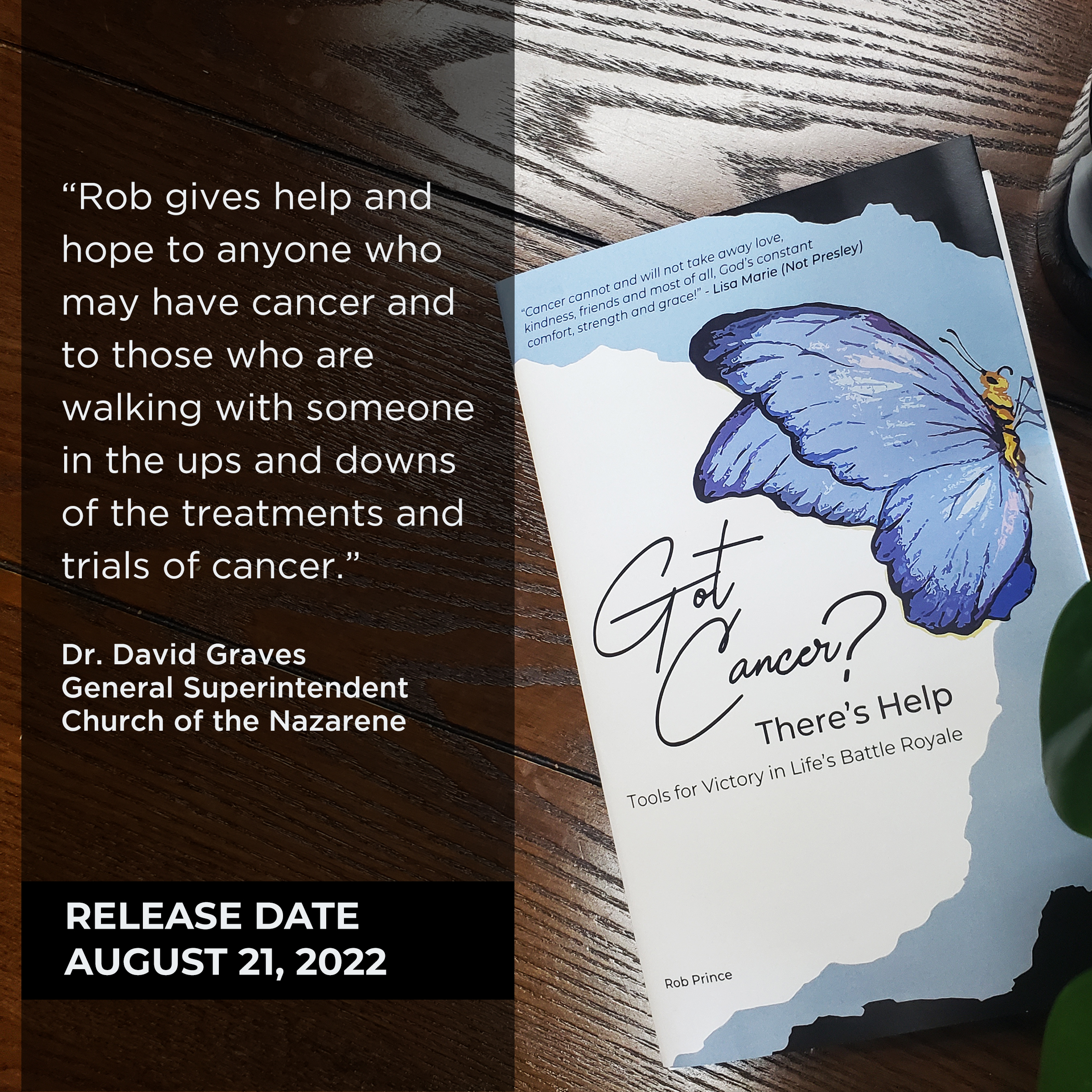
Why I wrote: Got Cancer? There’s Help: Tools for Victory in Life’s Battle Royale

Cancer: the word no one wants their doctor to utter. Ugh! Too many hear it. My friend, Dan Rexroth said, “40% of us will be diagnosed with cancer in our lifetime.” My dad heard it. Sister too. I heard it but the doctors got it wrong (Whew!).  SHAMELESS PLUG ALERT: That’s just one reason I wrote, Got Cancer? There’s Help: Tools for Victory in Life’s Battle Royale.

Another reason for the book is the example that Lisa Marie (not Pressley) has set for us. Lisa moved in with Karla and I last November. She has taught us many things as we have travelled this unknown territory with her. Her example and life have value and meaning and she (along with Jesus, of course) is the inspiration behind much of the book.

Obviously, my M.Div degree does not give me a license to practice medicine. The book isn’t a medical journal. It offers no cures. Neither is the book a “God’s-gotta-heal-ya” book. It’s not even a “God’s-in-control-so-sit-back-and relax” book. I address the issues of theodicy (where’s God in my suffering?) in my last book. ANOTHER SHAMELESS PLUG ALERT: Got Cancer? There’s Help give tools for a victorious fight even as the cancer rages on. It gives hope that God’s can still work in the midst of severe trials and continued bad reports. It offers steps to focus on what’s truly important in life. 

Unlike my last book (OLD SHAMELESS PLUG ALERT), Chronic Pain: Finding Hope in the Midst of Suffering, I don’t have any personal knowledge of cancer (other than the false news). One former parishioner sent me condolences for my diagnosis (I don’t have cancer). But my life experiences while pastoring so many with cancer, and what Lisa has taught us have enabled me to write on the ways to be victorious even when the news stinks. 

I don’t suspect I will get rich from this book (someone said 95% of books sell less than 200 copies). It offers no cures to cancer. Still, my hope and prayer is that there are some folks who can be helped by reading it. My light-hearted style of writing attempts to bring a smile at life’s joys and tough times too. A smile not based on no pain or a cancer-free report (that would bring more than a smile it would be a shout of Hallelujah) but based on a confidence that in our trials big and small, God still is with us. 

After preaching, I believe God has called me to write. So, you could say that’s the last reason for this latest book. I simply had to write it and to not write would be disobedient. 

A proof copy of the book is supposed to arrive today. I’ll be making final edits and then send it off to be published. The release date is August 21 and Lisa and I have scheduled a book signing following the service at Central Church that morning for anyone who would like to purchase the book at the discounted church rate ($12 instead of $15.99 on Amazon). You can pre-order the Kindle version now on Amazon.

I hope you and your loved ones never get cancer, but if they do (FINAL SHAMELESS PLUG) Got Cancer? There’s Help: Tools for Victory in Life’s Battle Royale will be a blessing.

When the Church Loses This… It’s Lost

Church leaders around the country are scratching their heads and asking themselves why are people leaving churches in droves (and why pastors are leaving too). There have been many reasons given:

  • The pandemic got people used to watching a service at home.
  • The pandemic pushed people to the fringes and caused them to act like idiots. 
  • The music (pick your preference) is: too loud, too old, too new, too blah, blah, blah…
  • The preacher stinks (ouch)
  • The church has become too political
  • The church isn’t political enough
  • The term “evangelical” has become a political and not a religious term
  • There are too many other things vying for people’s time and money
  • The youth pastor (pick your preference) is: too liberal, too conservative, too blah, blah, blah..
  • The church talks too much about social ills
  • The church doesn’t talk enough about social ills.
  • The church is not affirming to all people
  • The church is too affirming of people’s lifestyle choices.
  • The church folks aren’t loving, kind, caring and sometimes are downright mean
  • Too many doubts, too few answers

and the timeless, age-old criticism…

  • Too many hypocrites 

Some of these things are true. Some not so true. Here’s my take: People are mostly leaving because the church has been distracted by things other than the teachings of Jesus. People in 2022 don’t hate Jesus. They want Jesus. They love Jesus. They want more of Jesus and they feel (true or not true) that they aren’t getting Jesus in church. Instead they are getting– pick the churches’ preference: too liberal, too right wing political, too much social justice, not enough social justice, blah, blah, blah and they’ve headed for the exits.

Churches have gotten distracted by many things (and some are good things), but those distractions cause them to miss the main thing– which is Jesus. In many churches the fight has been over “what would Jesus do?” Maybe the focus should be on “How would Jesus respond to what others are doing?” There are plenty of people/churches who have thought right, but responded wrong and their members have headed for the exits.

We need to be like Paul in 1 Corinthians when he wrote: For I resolved to know nothing while I was with you except Jesus Christ and him crucified. (1 Corinthians 2:2). The Corinthian Church was divided too. Paul’s answer to the troubled church was a singular emphasis: Jesus.

The church must likewise resolve: To know and do nothing but proclaim Jesus Christ and him crucified!

Keep the focus on the main thing: Jesus.

Remind me again: How Have Religious Leaders Changed?  

If you don’t see the similarities between some of America’s church leaders and Caiaphas and the religious leaders in John 11 then you aren’t looking close enough. Here’s a quick recap if you are not up on your first century politics: In John 11, Jesus raised Lazarus from the dead and it throws the religious leaders into a frenzy. They call a secret meeting and say: If we let him (Jesus) go on like this, everyone will believe in him, and then the Romans will come and take away both our temple and our nation (John 11:48).

This is the only place in the New Testament where the term “the Romans” was used. Slow down, would-be scoffer—I know there is a book in the Bible called “Romans” and there are Roman centurions and Roman governors, etc., but this is the only place where the term “the Romans” is used to describe the Empire of Rome as a political and more important military entity. The religious leaders knew “the Romans” had the capabilities to destroy the temple and the nation. They were afraid that Jesus would so upset the apple cart (by doing such revolutionary things as preaching, healing, feeding people and raising the dead apparently), that the Romans would come in and destroy everything.

Here’s the rub: The Romans did destroy everything in the year 70AD and their aggression had nothing to do with Jesus. Here’s the other rub: John may have written this gospel AFTER the temple had been destroyed. In other words, the original readers of John would have been keenly aware that the Romans destroyed what the religious leaders were clinging to and it wasn’t because of Jesus or Lazarus. 

My point: The religious leaders in John 11 were plotting to kill people in an effort to save the “holy” religious institutions. Somehow in their twisted logic, they concluded that sinning would be OK if it meant saving the institutions. Make no mistake the Temple and the Nation of Israel were important and holy. But God Almighty did not need these bozos (no offense to Bozo) to “save” them by killing innocent people. If God Almighty wanted the temple saved from destruction, it would have been saved without Caiaphas and his henchmen.

Does any of this ring a bell? It should. We all know religious leaders who’ve attempted to do criminal things in an effort to “save” a church, publication, college or denomination. They have lied; coveted; cooked the books to make themselves or the institution look better; and probably somewhere, like those in John 11, have even plotted murder in an effort to “save” the church. 

God doesn’t need our sin-stained help to “save” the church. 

But the devil is sure using “insider” people to destroy it.

WARNING: IF THE CHURCH STOPS ACTING LIKE JESUS, THEN LIKE THE TEMPLE in AD70, GOD WILL LET THAT FORM OF THE CHURCH DIE. 

If leaders sin in an effort to “save” the church, we’ve already lost her. She will die. If we replace Jesus with anything (even good things), the church will die. Our focus must be on the main things (Loving God. Loving People. Making Christ-like disciples) or the church will die. Don’t be distressed over this news. God Almighty will raise up someone else to carry on His work. The Message of Jesus will continue until our King returns with or without us. The only question is: Will it be with us? I pray it will be.

What’s Needed this Independence Day

Independence Day is just around the corner. Maybe you’ll be celebrating the day in the backyard with friends or in a cabin in the woods or on a golf course. You might even take time to be thankful for the freedom to do such things. I hope you do much more. 

Usually this time of the year, some preacher type will quote 2 Chronicles 7:14 (if my people who are called by my name will humble themselves and pray…  you know the verse). The minister will then call on the people to pray. Recognizing the importance of prayer (or at least not wanting to appear to be a person contrary to prayer), the congregants will agree that prayer is an important faith practice for the betterment of our country. “Amen. Amen. Amen,” 100% of the group will chime. That’s the good news.

Here’s the bad news: Most people aren’t praying for our country. The Barna group in 2017 reported (see the stats here) that 79% of Americans prayed at least once in the last three months. I’m not sure if the pandemic would have increased or decreased those numbers, but in any event, that’s not a particularly high standard– one prayer every ninety days. Of those who were praying once in three months, only 26% with a high school or less education reported to have prayed for our nation (only 17% of the college graduates did). I wasn’t a math major, but I don’t think that is very good either. The only ones praying for our country are 22% (give or take) of the pray-ers, who might only be being praying very occasionally. No wonder we are a mess. 

Barna didn’t ask the other important question: Did you DO something other than pray? Did you participate with God in the answer to those prayers? I don’t think we’d like the answer to that question. James wrote a five-word indictment of too many pew sitters: faith without deeds is dead (James 2:26). In other words, “thought and prayers” alone doesn’t cut it. You gotta do something. Sadly, when people aren’t praying and they aren’t doing anything, this is the formula:

Little faith + Little action = a county in trouble.

Our country is divided. We need prayer (of course). We need action too. There is a long list of things you can do this Independence Day to make our country a better place: include a lonely neighbor in your cookout; clean up a vacant lot in the city; sign up to volunteer at a hospital, local school, soup kitchen or nursing home; write a letter to an incarcerated person; take a plate of cookies to the local fire or police station; have your kids color a picture and send it to a soldier overseas; volunteer to watch the kids of a single mom; take a roll of quarters to a laundromat and give strangers a free load of clean clothes; or surprise a teenager with an unexpected gift. 

After you do any of these things (or something completely different. Use your imagination there are hundreds of possibilities), then pray. Pray for the people who were touched by your actions. Pray that they would be blessed by the Lord. Pray that, in turn, our country would start being a better place.  

President John F. Kennedy in a famous speech said: “Ask not what your country can do for you – ask what you can do for your country.” The answer: It’s not sending “thoughts and prayers” (and then not even praying). It’s actions and prayer (real prayer) that our country needs. You want a better country? Stop complaining and partner with the Almighty to make our country a better place. Actions and faith (quoting the great theologian, Larry the Cable Guy) will “get ‘er done.” Maybe James could have written: 

Faith + Deeds = a Better Country.

We need to Hear from our General Superintendents

Why did we only hear crickets coming from the GMC following last week’s Roe vs Wade controversial decision from the United States Supreme Court? Other leaders of denominations issued statements. World Leaders chimed in (most in outrage of the decision). So why was there nothing from our leaders? I shared on Facebook the statement from the Florida District Superintendent, Rev. Dale Shaeffer. It was very good. Why didn’t the Board of General Superintendents (BGS) issue something similar?

The standard line (or so I’ve been told) is that we are an international church and the General Superintendents do not speak into national matters. That’s why no statement was given condemning racism following George Floyd’s death or why there hasn’t been statements valuing life following any of the recent tragic school or church shootings. 

They have spoken up before. After the Orlando Pulse night club shooting in June of 2016, the BGS issued a statement. You can read it here . That was 6 years ago, there have been numerous incidents since then in USA/Canada that warranted a similar statement, but we haven’t heard from the BGS. One time is not enough.

The General Superintendents are good people. I trust them. They are our friends. I know they hate racism, love life and are want the best for our church. We need to hear from them.

I don’t know the ins and outs of running a denomination. They are busy and it’s a difficult task. I’m just a pastor in Flint, Michigan. I only know pastoring churches. So, I will approach these matters as if the United States were a member of my church.

Let’s say I have 160 members of my church (The Church of the Nazarene is in 160 countries give or take a few). Suppose one of those members contributed somewhere around 94-96% of the income to my church. I would hope that I would treat the fat cat (no offense USA/Canada) the same as those 159 other members who gave little or were unable to give. I would hope that I would overlook their monetary contributions and the church’s near total dependence upon them. But I know, in reality, I wouldn’t be able to do it.

If there was a tragedy to that member, I would be the first person there. If they were experiencing joy, I would be joyous with them. I would want to know their concerns and if they got off track, I would hope as their pastor, I would lovingly steer them back. I would be keenly aware of the health and well-being of that member. That one member’s health would be essential for the health and well-being of everyone in the church. If that member died, the whole church would be in trouble.

I wish the Board of General Superintendents took a similar approach to USA/Canada. The six members of the BGS are all elders in the Church of the Nazarene. Treat USA/Canada like you would a member of a local church who is in trouble. The USA/Canada church might not be dying, but it’s hurting. We need the good words from our General Superintendents. We need them speaking into our situations and national events. We need them to model leadership and wisdom for the rest of us. We need to be able quote them and their strong words in our churches when crucial events take place. Yes, we have the manual, but we need the voices of our General Superintendents to help us. 

Please no crickets. We need our Generals Superintendents to speak because we love and value their words. Like Paul in Acts 18, I pray our BGS has a vision from the Lord that says, “Do not be afraid; keep on speaking, do not be silent. For I am with you.” (Acts 18:9-10)