Jesus Demands We Give Up a Whole Lot More for Lent than Coffee or Chocolate

Christians around the world begin observing the season of Lent today. It’s Ash Wednesday. Many people in observance of this season will fast from something dear to them. You’ve heard folks say, “I’m giving up ______ for Lent.” The fill in the blank answer can be anything from coffee to alcohol to chocolate to TV to social media to you-name-it. 

Of course, Jesus didn’t speak about the season of Lent. “Lent” isn’t mentioned in the Bible. Jesus never said, “Hey in the 40 days leading up to my death and resurrection, do this?” He never told us to give up chocolate or coffee. What he told us to give up was much, much more.

In discussing the cost of being a disciple in Luke 14, Jesus said these words:  those of you who do not give up everything you have cannot be my disciples” (Luke 14:33. Underlining mine). “Everything” is a little bit bigger ask than giving up donuts or coffee. “Everything” is, well, everything. Clearly, Jesus hasn’t asked us to leave everything like he instructed the rich young ruler… or has he? Our attempts to distance ourselves from the rich young ruler seems to justify our exemption from Jesus’ leave-everything-and-follow-me instruction. We say we are nothing like the Rich Young Ruler (Truth Alert: By world’s standards nearly all Americans are rich). Our excuse making leads us to thinking we don’t need to leave everything, in fact, we don’t need to leave anything to follow Jesus.

Contrary to popular belief, Jesus doesn’t promote an easy way. His demands are hard. He said,“small is the gate and narrow the road that leads to life, and only a few find it” (Matthew 7:13)?  We like to think that the road to life is wide and most everyone is on it… ummm… maybe not. Jesus also said, “Not everyone who says to me, ‘Lord, Lord,’ will enter the kingdom of heaven, but only the one who does the will of my Father who is in heaven.Many will say to me on that day, ‘Lord, Lord, did we not prophesy in your name and in your name drive out demons and in your name perform many miracles?’ Then I will tell them plainly, ‘I never knew you. Away from me, you evildoers!’ (Matthew 7:21-23). We like to think if we are doing the big and mighty (read: prophesying, chasing demons and miracles or in our context– preaching, putting the Enemy to shame in big ways or leading miraculous ministries), then clearly we are doing God’s will…. ummm… maybe not. We like to think if we say the magic words (Read: Lord, Lord) then we are “in”… ummm…maybe not. The black-and-white demands of Jesus should make all would-be followers take notice.

What if we were to take Jesus literally. What if Jesus meant what he said? What if (not just for Lent but for all times) we give up everything. We take up a cross and follow him (Jesus said to do that too). We give up our rights. We give up having things our way. We give up our importance. We give up our demands. We give up our position. 

The way of the cross is the road of humility. It’s the road of peace-making. It’s the road of gentleness, kindness, patience, faithfulness and self-control. It’s the road that refuses to gossip, grumble and backbite (social media included). It’s the high road. The Jesus road. The narrow road.  

What if this season of Lent (and always) we acknowledge that Jesus calls us to give up everything—that’s a whole lot more than chocolate or coffee for 40 days.

Have American Christians Chosen Easy over Faithful?

It’s easier to put forth a mission statement to “Make Christ-like Disciples in the nations” than it is to make a Christ-like disciple in one’s hometown.

It’s easier to blame the plethora of factors that have contributed to the decline in the church than it is to except responsibility for one’s own lack of effort or involvement in disciple making. 

It’s easier to say, “All of Scripture is God-breathed” than it is to follow one verse such as, “The foreigner residing among you must be treated as your native-born. Love them as yourself” (Leviticus 19:34).

It’s easier to think “Love your enemies” only applies to a superficial, ambiguous “enemy” in the great big world and not to one’s rival at work or school or church.

It’s easier to show a poster on social media stating that a denomination, like Jesus, stands with the outcast, than it is to engage the messy, complicated, long-hours-of-conversation with a trouble person struggling with identity, belonging, faith and life.

It’s easier to read “Love your neighbor” than it is to know the names of those people who live in one’s neighborhood. 

It’s easier to eat at Ruth’s Chris Steak House than it is to feed the hungry.

It’s easier to drink Fiji Natural Artesian Water ($3+ per bottle) than it is to build a well in Africa for those without access to clean drinking water.

It’s easier to live behind double locked doors, than to invite the stranger in.

It’s easier to buy another item for an overstuffed closet than it is to clothe the naked.

It’s easier to talk about being tough on crime, than it is to visit a prisoner.

It’s easier to place the elderly and infirmed into a facility and quickly ignore them, then it is to visit and care for them. 

It’s easier to rationalize Jesus warning in Matthew 25 than to heed His words: For I was hungry and you gave me nothing to eat, I was thirsty and you gave me nothing to drink, I was a stranger and you did not invite me in, I needed clothes and you did not clothe me, I was sick and in prison and you did not look after me.’(Matthew 25:42-43). 

It’s easy to choose the wide, crowded road than the narrow, lonely path.

It’s easier. Not better. Not faithful. Just easier.  

(FYI…it doesn’t end well for “easy.” See Matthew 7:13-14)

The USA Church of the Nazarene Attendance Decline is NOT the Result of Culture, Politics or Leadership, It’s Something Much More Personal

The 2023 Church of the Nazarene USA/Canada worship attendance statistics have been posted and as expected the numbers are not good. You can read all the stats here. All seven regions in the USA experienced decline. Of the 73 districts in the USA only nine experienced growth. Four of the five districts in Canada experienced modest gains (Canada Pacific District reported the same numbers as last year). The total decline for the USA church was 22,220. Maybe more telling of the dire circumstance is that there were only 23 new churches started in the entire USA. Only the South Central Region (SNU) had more churches at the end of the year than the beginning, These numbers are troubling. They are the current reality for the USA church.. 

How did we get here? The three most quoted theories:

  1. shifting cultural landscape. The USA  is a different place than it was in 1964 (as Dr. Busic’s recent sermon has reminded us). It’s true. A lack of confidence in the church and traditional understanding of scripture regarding issues like LBGTQ+ issues are changing. But this doesn’t explain why other churches (See: Assembly of God) have not experienced the steep decline that the Church of the Nazarene has endured (see AG stats here). Others seemly have navigated the shifting culture waters without watering down their message.
  • The over politicization of the church has turned off many people. Too often the church has hitched it’s wagon to political parties. In a country, nearly evenly divided politically, any church identifying closely with one party is going to put off the other half of the populace. Only the Mormon church voted more Republican than the Church of the Nazarene in the 2020 election. But politics alone can’t account for the steep decline. 
  • John Maxwell famously stated that “everything rises and falls on leadership.” Is our problem with our leaders?  At the general level? The district level? As in all levels of management, some individuals are more competent than others, but to state that the church’s problems are based totally on leadership seems to be an easy cop-out-like answer. Our general church leaders are more than capable. No doubt, there are district superintendents that would be better suited in other roles, but not all of them. In fact, some DS’s that by my evaluation (probably skewed) are the most capable have also experienced the biggest declines. Maybe Maxwell was wrong.

The answer to the free-falling USA attendance, especially the dramatic post pandemic decline, lies in looking deeper into the mirror. The Church of the Nazarene’s stated mission is to “make Christ-like disciples in the nations.” That’s the goal, but we haven’t done it. We haven’t made Christ-like disciples. Or more personally stated, you and I haven’t made enough Christ-like disciples. Can you name a person you helped to make into a Christ-like disciple?

Would the attendance decline be lessened if we had made more and better disciples?  It makes sense that it would. Christ-like disciples attend worship when able. Christ-like disciples serve. Christ-like disciples invite their friends to also participate in worship and service. Christ-like disciples are generous. Christ-like disciples are the backbone of the church. Christ-like disciples weather a shifting culture, political biases, leadership issues, pandemics and everything else. 

The Church of the Nazarene’s failure to make Christ-like disciples on a consistent basis for the last decade or two has resulted in our attendance slide. We need to get back to not simply making declarative statements about Christ-like disciple making but actually make Christ-like disciples.

Dr. Jerry Porter was right. He preached a sermon I heard so many times, I could have preached it. He asked two simple questions relevant to our demise: Who is discipling you? Who are you discipling? The USA Church of the Nazarene attendance decline is NOT the result of culture, politics or leadership, it’s something much more personal. We (you and I) have not been making Christ-like disciples. The Solution to our demise is simple: Let’s personally live into our mission statement. You and I making Christ-like disciples. 

How much is too little (in pastoral compensation)?

Last week, I wrote on the extreme high salaries in Christian ministries and colleges. The question was “how much is too much?” Maybe the more accurate question for the majority of those in ministry is: “how little is too little?”

The majority of churches in this country are under 100 people. The average church seats 200 people, the average attendance is 60 people and dropping. There are plenty of discouraging numbers regarding the de-churching of America. You can read about it here.  With each former tither walking out the door, the question looms: How can a minister survive with declining attendance and declining offering totals?  The hard reality is: she/he cannot. 

It used to be at an interview for a prospective minister: “Does your spouse play the piano?” Now the question is: “Does your spouse have a job that can support your family and provide health insurance too?”

There aren’t many good answers to the dilemma of a church unable to pay a livable wage. Here are the choices:

  1. Second Career Pastors.
  2. Muti-point charge. (pastoring multiple churches)
  3. Bi-vocational pastor
  4. Pastor with spousal financial support
  5. Close the church doors.

(Let me also add, if a church cannot afford a livable wage for a pastoral staff member, DO NOT call one to the church. It is the duty of the church to provide a livable wage to the full time pastoral team).

There are problems with all of the above options. The possible problem with a second career pastor is: does this group have adequate theological/pastoral training? Pastoring multiple churches is getting past the mindset that a single pastor is always at a particular church’s beck-and-call. The problem with bi-vocational pastorate is the minister has only 24 hours in a day to juggle family/church/job. Most generally something suffers in such an arrangement. Not all ministers have spouses and not all of the pastoral spouses have the ability or desire to provide the financial support for their family. It’s obvious, closing the doors is not favorable outcome. 

Each church/pastor will need to decide what is the best option for their circumstance. These criteria should be considered:

  1. A full time pastor deserves a full time salary and benefits in line with what school teachers or social workers in the area are compensated. 
  2. If the financial situation of the church cannot afford a full time pastor, then the church body must understand their reality that a full time pastor is not an option. Either their pastor will be bi-vocational; or two (or three) churches must join together for a muti-point charge and the pastor will be like the old Methodist circuit riders (only with better transportation and technology). The church must be flexible in other words — in meeting times and in their expectation of their heart divided pastor in a multi-charge or bi-vocational situation .
  3. It’s a choice between closing the doors or having a pastor that is not always available.
  4. It is difficult (not impossible) to grow when the pastor is divided either between multiple churches and/or secular employment. Don’t expect your pastor to be the next Billy Graham or Apostle Paul.

How much is too little? In my first assignment, we were paid below the poverty line. We were young and didn’t really realize how poor we were. We were eligible for food stamps and free baby items through social services. We chose to accept neither and trusted that the Lord would take care of us. He did, but ours may have been the exception. It was a different time, back then. I’m not sure we could survive now in such an environment.

If too little is given to compensate a pastor, an unintended outcome of bitterness developing within the pastor or more likely the pastor’s family is real. The cost of pastor’s desire to reach the world in the midst difficult financial circumstances may be his/her family. If this unhealthy attitude develops, then the question of “How little is too little?” is a game changer. Moreover, if too little is given, the pastor will also more than likely have too little on which to retire (although I am very thankful for the Nazarene Pensions and Benevolence matching contribution change in 2024. You can read my article here). Again, the inability for adequate retirement planning is not a good desired outcome for the pastor.

Churches need to assess their current reality and not continue to expect a pastor to survive on too little. The cost of such expectation toward the pastor and his family is too high. 

How Much Salary is Too Much for Pastors, Christian College Personnel and Ministry Leaders?

Ministry Watch published a list of the highest paid ministry leaders. You can read the list here.  The highest paid was David Cerullo at a cool $4,520,383. (His wife was #92 placing an additional $409,919 into the family’s bank account). There’s money in owning an “inspirational network.” JoAnn Lindsey, of the Hal Lindsey Ministries, was #15 on the list at $750,000, and Hal Lindsey also made the list coming in at #62 receiving $470,000. There’s money in the end times too. Others on the list were Franklin Graham of Samaritan’s Purse (#11); Sandiago Mellado of Compassion International (#58) and Hal Donaldson of Convoy of Hope (#63). I don’t want to write this, but apparently there is money in disasters and poor people. Ugh.

The synoptic gospels all record Jesus as saying, “It is easier for a camel to go through the eye of a needle than for someone who is rich to enter the kingdom of God” (Luke 18:25). They also recorded Jesus as saying, “What is impossible with man is possible with God” (Luke 18:27). In other words, for those on the list, it will be difficult, not impossible to enter the kingdom of God. Moreover, Paul gives Timothy instructions for those that are rich. He doesn’t condemn the rich. He warns them of the dangers (see 1 Timothy 6:9-10) and encourages them to be generous (See 1 Timothy 6:17-19). 

The list shouldn’t call the rest of us to be envious or filled with greed, but should make us pause and ask, “How much is too much?” Is Jesus example, whose sole possession of a robe at the time of his death, the goal? Jesus doesn’t appear to ask everyone to sell everything and give it to the poor like he did the rich young ruler. He doesn’t ask us all to leave everything and follow him, like he did the disciples. Is it appropriate for “Christian” ministries to have large salaries on their payroll? Is yours and my salary appropriate in light of the world’s poverty and need?

As far as I can tell, there are no Nazarenes on the list. Our General Superintendents aren’t getting rich in their positions. Although the same organization, Ministry Watch, also published a list of the 100 Highest-Paid Christian College And University Executives. You can read the article here. It’s no surprise, in our convoluted, sport-crazed society that a basketball coach heads the college highest paid list (Scott Drew at Baylor University earns over five million a year). The football coach at Liberty is second. According to the article, the only Nazarene to make that list is Bob Brower, president of Point Loma Nazarene University (#74 at $439,386).

Leaving aside the outrageous salaries of coaches (the tight end coach at Liberty is #78 on the list making $428,535. Seriously, a tight end coach?), how much is too much to pay Christian ministry or college executives. In my opinion, college president is the most difficult job in the our denomination. Too many people (faculty, students, parents, denominational leaders, boards of trustees, accrediting institutions, the government, pastors on the region, etc.) think they can tell the president what he/she should be doing. Being a Christian educator, especially in California with its rules, regulations and Title IX understanding, is tough. Being the president of PLNU is tough these days with the pastoral transition hullabaloo at San Diego First Church. Is it $439,386 tough? Maybe. I wouldn’t want Dr. Brower’s job for any amount of money.

My intent is not to throw stones, but to ask questions. We are in the process of setting the budget for the church where I pastor. We wrestle with what are appropriate salaries for our pastors and workers too. The cost of living in Flint, Michigan is different from the cost of living in San Diego. The cost of living in Flint, Michigan is also different from the cost of living in Somalia. People in the third world, might rightfully state that all of our USA salaries are shamefully high. How much is too much for a ministry leader, pastor or college president to make? 

Christian institutions (the church included) should be good stewards with the resources with which we’ve been entrusted. In all things, we need to seek the Lord’s guidance. The way we  spend our money is important. Are we generous? Can we do more for the poor? Are we blessing our communities? How much is too much? 

Before we pass judgement, we should look in the mirror.  

Election Year Preaching: Keep Jesus In, Politics Out

The nation is on the cusp of what could be the most contentious USA political season in modern memory. My approach to election year sermonizing is simple. Keep Jesus in, politics out. 

I don’t endorse a candidate from the pulpit. I don’t allow candidates to come “share their testimony” while up for re-election (I’m not opposed to Jesus-following politicians sharing their testimony, just not from the platform during their election). Side note: in 2016 a prominent presidential political figure wanted to “share his testimony” at Central church, I said, “Thanks but no thanks. We’d love to have you share your testimony after the election.” Haven’t heard from him since. (Notice the quotation marks are only around “sharing their testimony” when the intention is to garner votes, not garner praise to Jesus). 

The USA is more divided than ever. It’s quite possible that the eventual winner in the upcoming presidential election could win without 50% of the vote (depending on the third party candidates). When I look at those numbers, I remind myself that the Gospel of Jesus Christ is for 100% of the people. So how do we reach 100% without alienating 50% or more? It’s done by preaching Jesus. Keeping Jesus in. Politics out. 

The reality is that preaching Jesus (and the Bible) will upset those on either side of the political spectrum from time to time. Jesus is the Lamb, not the donkey or elephant. Preaching Jesus is the antidote to partisan political rhetoric infiltrating sermons and thereby water-down the Gospel. Keep preaching Jesus. Let the Gospel speak for itself. Let the Gospel inform voters how to vote. Let Jesus be our Voter Guide. Let Jesus be our deciding factor. 

The preacher’s job is to proclaim the Gospel of Jesus Christ to as many people as possible. Period. The job description is simple: Make Disciples. Baptize them. Teach them the ways of Jesus (See the Great commission). I’m not called to make Republicans or Democrats or any other political party member or group. I am Christ’s ambassador, no other. I’m not called to tell you how to vote. I’m called to tell you about Jesus – the Way, the Truth and the Life. Jesus is the Answer and the truth of Jesus’ message can/should inform our voting. Just preach Jesus and all the rest (political and otherwise) will take care of itself!

In an election year, it’s important for the preacher to keep Jesus in and politics out. 

Dear Grand Blanc $842 Million Powerball Winner

This week’s winning $842 million Powerball jackpot ticket was sold at the Food Castle in Grand Blanc, Michigan– about a mile or so from my house. I didn’t buy the ticket. If I had, I would have had to turn in my credentials (Nazarene’s frown on gambling as we view it as an addictive tax on the poor) and I wouldn’t be writing this little blog (I’d be in Italy or someplace exotic). I didn’t win it. But if you did, here are a few tips.

Dear Grand Blanc $842 Million Powerball Winner,

Be careful. The Apostle Paul wrote: The love of money is the root of all evil (1 Timothy 6:10). You are about to see the truth of this Bible verse. Since in Michigan you can’t remain anonymous following winning a multi-state lottery, soon every acquaintance you have ever had will instantly want to be your best friend. Be very careful. Folks will turn to all sorts of evil intentions once they know you are sitting on a windfall. 

Be mindful. Jesus had some harsh words for rich folks. He said, it is easier for a camel to go through the eye of a needle than for someone who is rich to enter the kingdom of God” (Matthew 19:24). Gulp! But two verses later in explaining those words Jesus said, “with God all things are possible” (Matthew 21:26). Whew! So it’s not impossible for things to end well for you, but it is difficult. There will be plenty of distractions that your new wealth can buy. Money has a tendency to make one suspicious (see about comments about being careful), gluttonous and prideful. It can make one lose sight of what’s truly important in life (Hint: It’s not money). 

Be generous. In another place, the Apostle Paul wrote, God loves a cheerful giver (2 Corinthians 9:6). Jesus said, Give, and it will be given to you. A good measure, pressed down, shaken together and running over, will be poured into your lap. For with the measure you use, it will be measured to you” (Luke 6:38). You have the rare opportunity to be super generous and still have plenty left over for you and your family’s future. 

Be refreshing. Proverbs 11:25 states: A generous person will prosper; whoever refreshes others will be refreshed. The common thinking is that money changes people. It does. You won’t be the same now that your bank account has an extra $842 million dollars in in ($475 million if you take the one time buy out). But that doesn’t mean you’ll be worse. Be better. Use your money wisely. Don’t be in the statistic of the lottery winners who blew it all and ended depressed, friendless and penniless. Be the secret Santa that blesses people and worthy institutions. Be the kindhearted uncle that pays that gifted niece or nephew’s way through college. Be a better person than the who you are right now, and who you were when you bought the winning ticket. 

Finally, Paul wrote these words to his young apprentice Timothy on dealing with those who have wealth. It would be my final reminder for you as well: 

Command those who are rich in this present world not to be arrogant nor to put their hope in wealth, which is so uncertain, but to put their hope in God, who richly provides us with everything for our enjoyment. Command them to do good, to be rich in good deeds, and to be generous and willing to share. In this way they will lay up treasure for themselves as a firm foundation for the coming age, so that they may take hold of the life that is truly life. (1 Timothy 6:17-19).

You’ve been given a rare opportunity to be a blessing. Pray and use your new found wealth to do just that!

Your friend,

Rob

P.S. For the rest of us, who didn’t play (me) or didn’t win (probably you), the above tips regarding money are true for us as well. God has blessed all of us to be a blessing. Let’s do that thought out 2024.

The One Goal Every Christian Should Have for 2024

What goals do you have for the New Year?  
Lose a few pounds? 
Start exercising? 
Be kinder, gentler, more Christ-like?
Read the Bible through in a year? 

All are good and valid goals. But how about this one: pray for the opportunity to lead one person to faith in 2024, and then disciple them in the ways of Jesus. 

Just one person. 
One person led to Jesus in 2024
Then help them in their first steps as a Jesus follower. 
That’s it. 
That’s the goal.

Maybe you have the person in mind that you would hope to lead to Christ. It’s your child, grandchild, neighbor or friend. Maybe you don’t know the person yet. You’ll need to pray, “God, show me who and then help me talk to this up-until-this-point-unknown-to-you person.”

Leading and discipling a person in the ways of Jesus is the single, most important thing you can do in 2024. Hands down. There is nothing greater. Not climbing Mt Everest. Not winning an election. Not getting gold in the 2024 Paris Olympics. Nothing else is as important.

Which do you think matters in light of eternity–  an Olympic gold medal or a person walking on streets of gold?  Which would you rather say at the end of 2024—”I lost 10 pounds” or “a lost friend found Jesus” (OK, I hope to say both things).

Just as in any goal, it doesn’t just happen without effort. If you want to see lost people find Jesus in 2024, pray every day that God would give you opportunities and the courage to share his love when given the chance. Pray. Every. Single. Day. Pray for those that have yet to begin their walk with Jesus. Pray for the eyes of the Father; the Heart of the Savior and the words of the Spirit to be at work in you.

You will be surprised at how Jesus answers that daily prayer!

Happy, Hope-filled, Christ-filled 2024!

24 Hopes for 24 (Not totally in order)

  1. I hope the names on my prayer list find out that Jesus changes everything.
  2. I hope the names on your prayer list find Jesus too (you are daily praying for folks to find Jesus, aren’t you?)
  3. I hope the wars in Ukraine and Israel/Gaza end
  4. I hope the neighbors of Central Church think the church is a great neighbor.
  5. I hope people don’t go nuts during this election year
  6. I hope you consider reading the Bible-through-in-a-year
  7. I hope Conrad’s first word is “Grandpa”
  8. I hope the Lions win the Super Bowl (vs. the Kansas City Chiefs… so I can up trash-talking skills to my friends in KC)
  9. I hope the Michigan Wolverines win a National Championship in football (see above trash-talking skills which I would apply mostly to my Buckeye and Sparty fan friends).
  10. I hope gun violence in the United States declines (I hope it was no more)
  11. I hope the people who disagree with each other can have a charitable conversations.
  12. I hope the USA wins the most medals in the Paris Olympics
  13. I hope all those caring for a sick spouse, elderly parent or special needs child can find a bit of rest and relief.
  14. I hope people talking with phone on speaker at any store will run out of battery (the lone exception: When a husband is facetiming his wife to get her opinion on which holiday napkins to purchase. His choice will be wrong and another trip to Wal-mart will happen without such call.  Or so I’ve been told… ahem…). 
  15. I hope the lonely find a friend
  16. I hope the afraid find courage and strength and a place to freely express their concerns.
  17. I hope ALL CAPS people stop using ALL CAPS! 
  18. I hope that everyone feels welcome to attend Central Church. (By “Everyone” I mean anyone. If breathing… they are welcome).
  19. I hope the Pistons win at least one game in 2024 (a bigger hope than you might think)
  20. I hope people who back into parking spaces in a crowded parking lot know that irritates some people (ahem, pastors included)
  21. I hope everyone knows what a great team of pastors, office staff, facility crew, tech team and nursery staff we are blessed with at Central church
  22. I hope we all are a little more grateful and a little more generous and a little less cranky in 2024
  23. I hope you decide to be in church mostly in person (on-line when unable) every Sunday in 2024.
  24. I hope every reader of my lil’ 24 Hope List has a very good and happy New Year!

BONUS HOPE: I hope you and your family will end the year in church this Sunday! (Even better if its Central Church). –technically that is my last “hope” of 2023. 

Dear Potential Christmas Eve Worshipper!

Merry Christmas! 

I’m not sure what led you to contemplate coming to the Christmas Eve Candlelight service…

  • Maybe your grandma invited you to the Christmas Eve Candlelight service at Central Church. Who can say, “no” to grandma?
  • Maybe Central Church is your church, you just aren’t here much these days. Life has become busy and Sunday mornings are a challenge for you.
  • Maybe you saw on social media a picture of last year’s candlelight service and you’ve thought, “That looks pretty neat, I’m going.”
  • Maybe you’ve been thinking about trying out a church service and Christmas Eve seems like a good time to try it (FYI… You’re not wrong).
  • Maybe it’s none of those reasons, still you are planning to join the Christmas Eve Service at Central Church this Sunday at 5PM.

Yahoo! I’m so glad you will be at Central Church. 

I’m biased, super biased, so take this with a grain of salt, but I love our traditional Christmas Eve Candlelight Service. Except for Easter (duh!) it’s my favorite service of the year. 

What to Expect: 

  • A super warm welcome at the door. We’ve got great greeters.
  • A photo booth in the lobby. If you and your family want to take a Christmas picture, say “Cheese.”
  • Another warm welcome by an usher who will hand you an order of the service and ask you to take a candle. Don’t be surprised if you think, “There are nice people at this church.” I think that too.
  • A cozy pew or a balcony comfy seat. They aren’t Lazy boys but still comfortable
  • Friendly worshippers in your aisle Please note: the worshippers in your aisle might be new too, so pretend you are not new and greet them with a smile and “Merry Christmas!”
  • An orchestra rendition of a Trans-Siberian Orchestra song. You’ll love it. Trust me.
  • A lot of carols (join in singing or simply listen. Warning: You’ll probably start singing too. It’s hard not to join in. To quote Buddy the Elf,  “The best way to spread Christmas cheer is singing loud for all to hear.”)
  • Some brief scripture passages read from Luke 2. The Christmas story, of course. We won’t be reading from the Book of Lamentations on Christmas Eve. 
  • A choir and orchestra with a powerful Christmas song. Be prepared for a jaw dropping “Wow!” to come out of your mouth. 
  • A cute kids’ Christmas video. Hey, who doesn’t love a cute kids’ Christmas videos?
  • A brief message by yours truly. The common misnomer –ahem– is that “brief” and “sermon” can’t be used in the same sentence, I’ll do my best to change that narrative.
  • Lighting a candle and sing Silent night (see the above Buddy the Elf quote) with a 1200+ of your newest friends. The warm glow in the sanctuary will be one of the most beautiful moments you will experience. No joke, it’s awesome!

Best of all what to expect:

God Almighty (that’s right the Creator of the universe, who came to earth as a baby in Bethlehem, grew to be a man, was arrested, beaten, crucified and buried, then rose on third day, and later ascended to heaven—that God Almighty) will very probably speak to you. Somewhere in the service—maybe in the singing, scripture reading, brief message from your truly (yes, brief) or when you’re singing Silent night—God Almighty will speak to you. Probably not in an audible voice, more likely in a deep-in-your-bones reality. You’ll get a sense that God loves you and wants the very best for you. You’ll get the impression that if God had a refrigerator, your picture would be on it. It’s a Divine Appointment, God has you on His calendar!

What to do next: 

Be receptive. Be open. Be honest. Be real. Be ready to receive the best Christmas gift ever—Jesus himself! 

Can’t wait to see you on December 24th at 5PM!

I’ll be the guy wearing a jacket, holding a Bible and doing my best to remember the K.I.S.S. Sermon method (Keep It Short, Silly). 

See you soon!

Pastor Rob

P.S. We have an “unplugged” service on Christmas Eve morning at 11AM. No Drums, no candles (except for in the advent wreathe) just a “chill-lax” service led by Pastor Joel Close (and a couple of other Close family members), singing carols and Pastor Jon Gildner keeping us focused on the Prince of Peace. I think you’ll love that service too. 

Christmas’ Color Isn’t Blue, Unless You Are

This Sunday is the third Sunday of Advent. It is also called “Gaudete Sunday.” Gaudete is Latin for “Rejoice.” This Sunday is the Sunday of joy and as such we light the pink candle—which should make Barbie fans happy. 

Why does Pink represent joy? 

Pink is bright. It’s alive. It’s fun (again according to Barbie fans). Pink is joy.

Before pink, it’s blue. At least around here today. I’m writing this on the occasion of our Blue Christmas service. Blue is not traditionally a Christmas color. Purple is the color of Advent. Red and green are colors associated with Christmas too. People dream of a white Christmas. But Blue?  No, not Blue. Blue represents sadness. “I’m blue” is what we say when we are feeling down or melancholy. We aren’t supposed to be “blue” at Christmas. 

Except that many folks are. 

Last Sunday as the choir was singing, it dawned on me that my dear friend, Lisa who lived with Karla and me for 16 months before her passing in March, would have loved to had been there. She would have been sitting in the front row. Singing her heart out with the choir. Lisa loved music. Any music. All music. So as the choir sang, I looked over at the empty place that Lisa would have occupied and I got a little blue.

I know, Lisa is with Jesus. I’m glad for that. I know that she isn’t in pain and cancer is no more for her. I don’t wish her back. I just remembered the joy that she would have experienced and the joy that she brought to so many people who knew her. I envisioned her arms raised as she lifted her praise loud and long to Jesus. I missed my friend. It made me a little blue.

I think that’s why we have the service tonight. It’s not necessarily to wish our loved ones back (although when they have tragically passed away there may be some of those feelings). The service is meant to acknowledge our loss and to go to Jesus with it. It’s a time when we don’t have to paste on a smile like at an office Christmas party. There is no phoniness about a Blue Christmas Service. It’s just the opposite. It’s a time to be real. Honest. Unguarded. Open. Vulnerable even. It’s a time to cry out to the Lord in our “blue-ness’ and remember with the Psalmist: The righteous cry out, and the LORD hears them; he delivers them from all their troubles. The LORD is close to the brokenhearted and saves those who are crushed in spirit. (Psalm 34:17-18).

Blue Christmas might be where you are at this year. Or maybe you want to come to the service to simply support those who are going thought a tough season. This year our Blue Christmas service will have a little bit different emotion for me. I’m glad we have such a service. I bet you know someone who could benefit from the Blue Christmas Service too. 

You can read about about our friend and cancer here:

Did Covid Kill the COK (1000+ in attendance) Churches in the Church of the Nazarene?

A year ago, I wrote a blog concerning the Churches of the Nazarene with an attendance of 1000+. The article stated how 51 churches (there are actually 52) in the USA/Canada had at one time averaged 1000+ in attendance, but only 19 churches were still averaging over 1000. The article listed the challenges to maintain a church of 1,000. You can read it here.  

One year later, the 2023 church year statistics have been posted* and the news is much worse. “In person” attendance across the board is plummeting.* No longer are 19 churches averaging 1000+. In 2023, only eleven churches reported having an in-person attendance over 1000. Moreover, only two of the eleven 1,000+ churches reported to “in-person” attendance growth: Lima Community, OH (+176) and Crossroads Cowboy, AR (+130). Only Crossroads Cowboy posted their best attendance year ever in 2023.

In a recent statement on X (formerly Twitter), Carey Neuhoff stated, “The “Stable” Church Is Disappearing. One-Third of Churches Report That They’re Growing, While 54% Are Declining.” It’s worse among the Nazarene churches that once averaged over 1000. Only eleven of the 52 churches reported growth (21.15%). Churches that showed an increase worship attendance are: Crossroads Cowboy (+130); Indianapolis First (+37); Kankakee First (+70); Lake Gibson, FL (+72); Lima, OH (+176); Nashville First (+72); Orlando CenterPoint, FL (+61); Pasadena First, CA (+35), Puyallup, WA (+162); Salem OR (+28), The Woods, MI (+209); and York Stillmeadow, PA (+139). 

Full disclosure: Flint Central Church (where I pastor) reported decline in attendance. In 2022, churches were instructed to include both in-person and on-line worshippers in the tally. In 2023 those two groups of worshippers were separated. Flint Central and other churches, no doubt, declined in attendance in part because of the decision to separate on-line and in-person worshippers (see the highest on-line attendance chart of the 52 churches).

There are 12 USA/Canada Nazarene churches that at one time averaged 2,000+. Last year,  three churches that reported 2000+. In 2023, only Oro Valley, AZ reported an in-person attendance over 2,000. Oro Valley, the largest church in USA/Canada, reported an attendance of 2033 , which was a decline of 557 from 2022. Bethany First saw its attendance dip below 2,000 for the first time in 41 years. Denver First, at one time the largest Nazarene congregation in the world averaging 2555, last year averaged just 306. Likewise, Salem Oregon at one time averaged 2309, last year reported an attendance of 358.

What are the learning points from these numbers?

1) Post Covid In-person attendance is down in most churches (not earth breaking news). The De-Churching of America is happening within the Church of the Nazarene as it is most other denominations. 

2) Even strong healthy churches are seeing their numbers decline. The decline is not necessarily because people are leaving (some are), but rather people are not attending in-person as much as they did pre-Covid.** Worshippers discovered that on-line is convenient. Any other commitment later in the day, a slight sickness or no desire of getting ready for church – are reasons for worshipping on-line. The “responsibility list” may not have changed much, but in-person attendance has changed.

3) Expect 2024 in-person attendance numbers to increase in healthy churches. With the separation of on-line and in-person numbers, and folks in 2023 still not fully returning from Covid, it may be that 2023 was rock bottom for the strong and healthy churches. No longer hampered by pandemic fatigue and re-starting programs and ministries, congregants are trickling back into the healthy churches. An increase (although not at pre-pandemic numbers) will likely occur.

3) On-line worshippers aren’t going away. Nearly every church listed on-line attendance but those numbers varied greatly from the Wooster, OH’s 930 to Lake Gibson, FL listing 16 on-line viewers (two of the 52 churches did not report an online attendance). Either some churches don’t worry about their on-line presence (they should) or they don’t have enough tech people/money to help in this area (more likely). Still on-line numbers matter. Not only is it the new “front door” to the church (most new comers have watched a service online first), on-line viewership is also the new “front pew.” For many “regular attendance” is now regularly watching the service on-line.

4) Covid may have hit the accelerator on the De-churching of America, but more importantly Covid exposed the heart of the church in America. It’s not good. Our discipleship methods have not produced whole-hearted Christ-like disciples. The battle for the heart of the Church of the Nazarene is underway between a “fundamentalist-like,” legalistic brand of holiness and a left-leaning, “progressive” brand. Young clergy (and others) see the in-fighting between these extremist camps and are walking away. Time will tell if the Church of the Nazarene will maintain its historic via media or middle way outlook and presence.

4) A metric change is needed (ironically, this article included). Counting “Noses and Nickels” (attendance and giving) is what historically has mattered. Tallying baptisms, number of people who are actively serving within the church, hours served within the community, and benevolence dollars spent on the needy are the metrics we should be tracking. I wrote about this here.

6) A vision for the new reality is needed for churches to break the 1,000-barrier or regain what was lost. Building a congregation is difficult these days. There are so many competing ideologies in a Post-Christian America, but it is not impossible for churches to grow. Real, authentic, loving, serving, missional congregations are still appealing especially to many millennials who are beginning to rethink their spiritual status. Churches that are appealing are the ones with vision for a better tomorrow. 

7). The 2024 emphasis from USA/Canada to “bless our community” as part of the ”cycle of resurgence” is a good starting point. Dr. Stan Reeder, no doubt, has seen these troubling trends and is making an effort to change the trajectory of the USA/Canada church. Reeder correctly assessed that Nazarenes must get out of their church buildings and into their communities through which ministry can happen and lives can be changed. 

Conclusion: 
Covid did not kill the strongest Nazarene churches, but it has crippled some. There are greater challenges today than ever for churches in USA/Canada. Few churches have totally recovered from the pandemic. The 2024 election cycle will create even more heartache (election years always do). Still, hope lies in what the Spirit of God might do if churches bless their community, believe that Jesus changes everything and are committed to coming together in unity. Hope lies in the old adage: “Bloom where planted.” Local churches authentically loving and serving in their communities is the hope for the Church of the Nazarene’s future just as it was the impetus to growth in the very beginning days of the Church of the Nazarene.

Top In-Person Attendance Churches (1000+ in-person attendance)

1. Oro Valley, AZ (2033)
2. Bethany, OK (1809)
3. Lakeland, FL Highland Park (1547)
4. Goshen, IN Crossroads (1471)
5. Beavercreek, OH Be Hope (1449)
6. Grove City, OH (1389)
7. Crossroads Cowboy (1365)
8. Olathe, KS College (1231)
9. Cincinnati OH Springdale (1194)
10. Lima, OH (1076)
11. Wooster, OH (1072)

Top Ten On-Line Attendance***

1. Wooster OH (930) 
2. Oro Valley (833) 
3. Be One, OH (828) 
4. Grove City, OH (780)
5. Flint Central, MI (597)
6. Bethany First (594)
7. Lakeland FL Highland Park (586)
8. Pismo Beach, CA (471)
9. Cincinnati OH Springdale (435)
10. Yuba, CA Hope Point (434)

*The 2023 South Florida attendance statistics listed are the exact same numbers as they were in 2022. Clearly those statistics of the former 1000+ churches in South Florida (Bradenton, Miami Bethany and Miami Hialeah Good Shepherd) are not accurate. 

**Giving numbers in the former 1000+ churches for the most part remains high (I didn’t do a thorough assessment of the giving). Antidotally, it seems that church giving has remained relatively constant even as attendance numbers plummet. One reason for this phenomenon is that people have not left a church, but rather their attendance patterns have changed and they continue to give at the same level.

***This list is only a measurement of those churches that at one time averaged over 1000 in attendance. These may be other churches that averaged a higher on-line attendance than those listed.

There Seems to be Some Disagreement about Disagreement

There seems to be some disagreement about disagreement. How much can Christian brothers and sisters disagree and still be in harmony? How much disagreement is OK? Do we have to agree with everything? 

Paul and Barnabas disagreed. Yet they weren’t vilified for their disagreement. Both went on serving Jesus. In so doing, they covered twice the ground for Jesus as they would have had they not disagreed. It seems that these days if we are not in total agreement, then we are in total disagreement. There is little middle ground. There is less “can we agree to disagree” and still be brothers and sisters in Christ?  There is even less “I could be wrong.”

Discerning what is most important is important. Not every issue is a mountain. Many issues are molehills. I seem to remember a General Superintendent (It may have been Dr. Greathouse, but don’t quote me on this) say something along the lines on how not everything  we Nazarenes believe in carries the same weight. For example, he said, “if someone held me at gun point and wanted me to renounce Christ, I’d say, ‘pull the trigger;’ but if someone wanted me to smoke a cigarette or die, I’d say, ‘hand me a lighter.’” Too many times, we view the matter as a “pull-the-trigger” moment, when it should be handled as a “hand-me-the-lighter”  problem.

Discerning the mountains to die on is important. Disagreeing amicably is also important. To say, “I disagree” is not the same as saying “I am no longer wanting to be in fellowship.” It might simply mean, “I’m wrestling with this issue, and we could we talk about it?” Could we have a conversation?” Disagreeing, for the Christian, should never be equivalent to “I hate you and I’ll never talk to you.” Disagreeing should be more of “I wonder why we don’t see eye to eye on this matter? Isn’t that strange? Let’s talk about it, friend.”

Paul’s prayer for the Philippians seems to be what we all need to be praying a little more. “This is my prayer: that your love may abound more and more in knowledge and depth of insight, so that you may be able to discern what is best and may be pure and blameless for the day of Christ” (Philippians 1:9-10.) Let our discernment be driven by an abounding love that allows for knowledge and insight. Through it all, may we strive to be pure and blameless in all we do. That’s a pretty big ask, only through Jesus can it be accomplished. 

If you disagree with anything I have written above, please hand me a lighter, don’t pull the trigger. 

Parable of the Man who went to a restaurant… once (Hint: It’s really about churches)

Once upon a time, there was a hungry man. With no food in his cupboards and some extra cash in his pocket, the hungry man went to a restaurant near his house. He had driven by this restaurant many times, but had never stopped in for a meal. He decided to try it. Big mistake!

When he walked in there was no host or hostess to ask him how many were in his party or if he’s like to be seated. He wasn’t certain what to do. Finally he just sat down. After a very long wait, the food server finally came to his table and was quite rude. He mentioned something about how the man was sitting in “Jerry’s Booth.” “Who’s Jerry?” the man wondered. The menu was confusing and overpriced. When his order finally game, it looked terrible. It smelled and tasted worse. Nothing about this restaurant was good. Nothing. He left a meager tip, paid his bill and left. As he walked out of the door, he said, “I will never eat at another restaurant again. This place was horrible!”  We went home and took an antiacid and had bad dreams all night long.

About a week later, a friend invited the man out to dinner. “Oh no, I can’t go,” he said. “I went to a restaurant once. The service as bad. The prices were high. The food was terrible. I vowed to never go to a restaurant again.”  A few months later another friend invited him out for dinner. “Oh no, I can’t go,” he said. “I went to a restaurant once. The service as bad. The prices were high. The food was terrible. I vowed to never go to a restaurant again.” Other friends asked too. His response was always the same. 

His friends told him, “We won’t go to the restaurant of your bad experience. Not all restaurants are the same. We will go to a good one.”

The man would not budge. “They all serve food that no one can stomach. I’ll never go again!” No one could convince him otherwise. He refused to go to any restaurant to eat, no matter how many friends went or how many good reviews the restaurant received.

The man went to a church once too. It wasn’t good either. He’s not been back.

The moral of the story: No one declares after getting a bad meal at restaurant, that they will never go to any other restaurant again. Instead, they find a good restaurant. It’s the same with churches. There are bad churches. There are good churches. Find a good church. Invite your friends. Make it an even better church. 

The end.

P.S. I’m super biased but Central Church is a really good church. 

Be a Thermostat not a Thermometer

Thermometers tell the temperature.
Thermostats regulate the temperature.
I want to be a thermostat.

I want to turn the heat down, not simply report the heat. Even from a quick purview of social media, it seems that all around me (not at my local church, thank the Lord!) the temperature has been rising over any number of issues. Angst is everywhere. Anxiety, fear, anger and worry drive people into heated corners. People are venting. Rhetoric is high. It’s hot. 

I don’t want to add to the rising social media temperatures. I don’t want to report on every heat-producing juicy detail, and in so doing keep the fires smoldering. I want to be like a thermostat and lower the temperature.

How does one turndown the social media and conversational (read: gossip) heat?

  • Accept that you don’t have all the facts. You might think you have all the facts, you probably don’t.
  • Acknowledge there are two sides to every story. Usually there are more than two sides.
  • Avoid rumors. Remember the “telephone game” in youth group? It starts with “I love red jelly beans” and after going through several people ends with “There are monkeys in the trees.” In other words, the beginning story and the ending story have nothing to do with each other. It happens in real life. Don’t believe everything you hear. 
  • Don’t demonize one another. People can disagree. On pretty big theological and biblical positions, people can differ; but that does NOT make either person a demon. The other may share your eternal accommodations. Be careful to demonize those that Jesus loves.  
  • Limit your social media vacuum. People tend to follow (and so only hear) like-minded people. We all do it. Just acknowledge that good people might disagree with the viewpoint on which you are constantly exposed.
  • Ask yourself: Do my posts, language usage, and tone reflect Jesus or do they add to the heated rhetoric?
  • Above all: Love. Be compassionate, kind, gentle and patient. 

Be a thermostat. Help turn down the heat, don’t add to it. 

Therefore, as God’s chosen people, holy and dearly loved, clothe yourselves with compassion, kindness, humility, gentleness and patience. Colossians 3:12

A New Nazarene APR (Annual Pastor’s Report)– Jesus’ Style: Counting What Matters

Every pastor in the Church of the Nazarene must submit an Annual Pastor Report (APR). It contains the financial and attendance data from the previous church year. This data reports valuable information for the denominational research team. While the APR information may be prized to those few people in research labs and PhD candidates, a new APR short form could reflect more of what Jesus told us to track in the local church.* 

The Jesus-inspired APR Short Form would not have worship attendance (Jesus didn’t tell us to gather crowds); it would not include total monies raised (to Jesus, generosity wasn’t determined by the size of the gift. See: the widow’s mite); and it would not include monies spent on buildings (there are no directives from Jesus to build any edifices). Jesus wasn’t overly impressed with money, buildings or crowds. 

What would be included? Jesus’ Great Commission prioritizes baptisms and making disciples. Baptisms are easy to track (who got wet?). Discipleship is harder. Our disciple making matrix has been classroom (small group) learning.  A better determiner of disciples-making is service involvement. Discipleship is caught not taught (although that is an oversimplification. Obviously, teaching is involved). Instead of counting Sunday School (small group) numbers, let’s track the number of people serving in some capacity. The new Jesus versioned APR would reflect baptisms the number of people serving (questions 1 and 2)

In Jesus’ famous judgement day, sheep and goat parable (Matthew 25:31-46), the priorities are feeding the hungry, offering drink to the thirsty; sheltering the stranger; clothing the naked; caring for the sick and visiting the prisoners. In other words, prioritizing the poor and justice matters. Any numbers on a APR should reflect the hours that disciples are in the community and dollars spent on addressing issues of poverty and injustice. (questions 3 and 4).

Here’s what the entire new APR form would look like:

Number of Baptisms
Number of People involved in ministry/service in the church
Number of hours spent in ministry/service in the community
Dollars given to help the poor/needy.

To appease the folks in Lenexa, there could be a box at the bottom of the form with the following question: Did you pay your apportionments in full? Yes or No. (Note: Jesus never told anyone to pay apportionments, but including the question would make the bean counters happy and show a commitment to the denomination).

That’s it.
That’s the form. 
Four numbers to track and one question to answer.

This Jesus-inspired APR short form would be basis on which success and failure are determined and what is highlighted at denominational gatherings. If we get those four numbers right and we focus on just those four things, then all the other numbers on the APR long-form will take care of themselves.

Let’s simplify and prioritize the things that Jesus called us to prioritize. 

*The long form with its bazillion questions (slight exaggeration) could still be collected for the researchers. Somewhere someone might benefit from knowing the number of children enrolled in Caravans (If you have to ask what’s “Caravans” put “zero” in that column), or maybe not.

**This post in no way is a dig at the research team at the Nazarene GMC. They do valuable work, and I deeply appreciate their efforts. The post is directed toward what is most beneficial to the local church and how churches can be laser focused in accomplishing the mission of Christ.

Turn Thanksgiving Upside Down

Thanksgiving week is the week to count your blessings. “Name them one by one. And it will surprise you what they Lord hath done.” At least that’s what John Oatman’s lyrics and Edwin O. Excell tune reminds us to do. (Yes, the Count your Blessings jingle was written by a guy named Edwin O. Excell. Google it. It’s a great name. But I digress…). With apologies to Mr. Oatman and Mr. Excell, what if we did the opposite? What if we looked at all the things for which we are not grateful? What if we counted our troubles and named then one by one. Name all the bad habits, troublesome hang ups, deep hurts and mean people. What if we turned Thanksgiving upside-down?

I’m not Thanksgiving’s version of the Grinch. I like Pilgrims, turkey and Detroit Lions’ football (win or lose). I like being thankful too. My intentions are not to be a “Debbie-Downer” during this festive week. But what if we created a “not-so-thankful” list, and then immediately handed (metaphorically, of course) the list over to God. What if we were to give God all the junk for which we are not pleased with and say, “God this “not-so-thankful” list is now yours and my prayer is that by November 2024 this list is flipped! Instead of bitterness, hurt or anger, I want to be thankful. 

Not thankful for a nasty habit? What if by next year, you and Jesus have defeated it?

Not thankful for some part of your body type, personality, or lack of capability? What if by next year, you learned to appreciate the person God created you to be.

Not thankful for a painful past? What if by next year, you look at your past with sadness, but also with amazement on how God has enabled you to move beyond the pain of your yesterdays and into a joyous celebration of your todays and tomorrows!

Not thankful for a mean or dishonest person?  What if by next year that person grew a big, hairy wart on the end of their nose? No, I’m joking. What if by next year God either changed them or changed your outlook toward them? 

What if your “not-so-thankful” list was turned into next year’s very thankful list? Then (thank you Mr. Oatman and Excell) you will be surprised, pleasantly and joyfully surprised, at what the Lord has done!

Jimbo Fisher’s Buy-Out to Not Coach Football = Nazarene Mission Giving in 2022 (almost).

Did you see that Texas A&M University decided to fire its football coach, Jimbo Fisher, and bought out his contract for 75 million dollars? You read that right. They are paying him 75 million to do what Karla wishes I wouldn’t do, sit on the coach and watch football. A public university is giving a coach (a winning coach by the way) 75 million to go away. Jimbo might not have won enough football games for the Texas A&M fans, but he won the lottery and he didn’t even buy a ticket. I wonder how all the hard-working professors, class room aids, and janitors in Texas A&M Aggie-land feel about an idle football coach making slightly more than they do (by “slightly,” I mean more than they will ever earn in their entire life). If you need evidence we live in a crazy world with mixed up values, consider this “Exhibit A.”

Take a wild guess of how much Nazarenes worldwide in 2022 gave to missions?  

$75,482,018 

Nazarenes gave about the same amount for missions as what Jimbo Fisher will get for sitting on his couch twiddling his thumbs. 

$75,482,018 was given by Nazarenes to pay the salaries for missionaries all over the world, to establish medical clinics, schools and pay for a hospital in Papua New Guinee. It paid for emergency relief to disasters through Nazarene Compassionate Ministries. It paid for churches to be built; radio broadcasts to be made; and help to be offered in literally thousands of ways. It paid for the world-wide effort (well, in 164 countries effort) to evangelize and show and tell the world about Jesus. $75,482,018 did a whole lot of good.

It’s hard to raise $75 million dollars for missions. Back in the day in the Church of the Nazarene, there were two big offerings that funded the world-wide mission effort: The Thanksgiving and Easter Offerings. That was it. Typically pastors would stand in the pulpit on the Sunday before Thanksgiving (this Sunday) and encourage mission giving. Pastors would say stuff like, “The Bible talks about tithes AND offerings. Bring your tithe which will fund the local church AND bring an offering to be given for missions.” There were special Thanksgiving envelopes provided by the denomination and everything. The Thanksgiving Offering was a big deal. It was a reminder that we need to be generous toward missions. Some churches still receive a Thanksgiving offering this week (our Mission Outreach Sunday was in October when we took pledges for mission giving). All are efforts to raise around $75 million. 

I don’t know what Jimbo Fisher is going to do with his $75 million. I hope he tithes to his local church. I hope Jimbo is generous and does good with his money, but it won’t come close to doing all the good that is being done around the world with virtually that same amount of money. I hope you are generous with your slightly less than $75 million (by “slightly” I mean a lot less). Whether you have a little or a lot the Paul writes, “Each of you should give what you have decided in your heart to give, not reluctantly or under compulsion, for God loves a cheerful giver. 2 Corinthians 9:7. 

How to Get the “Never Attending” People to Jesus

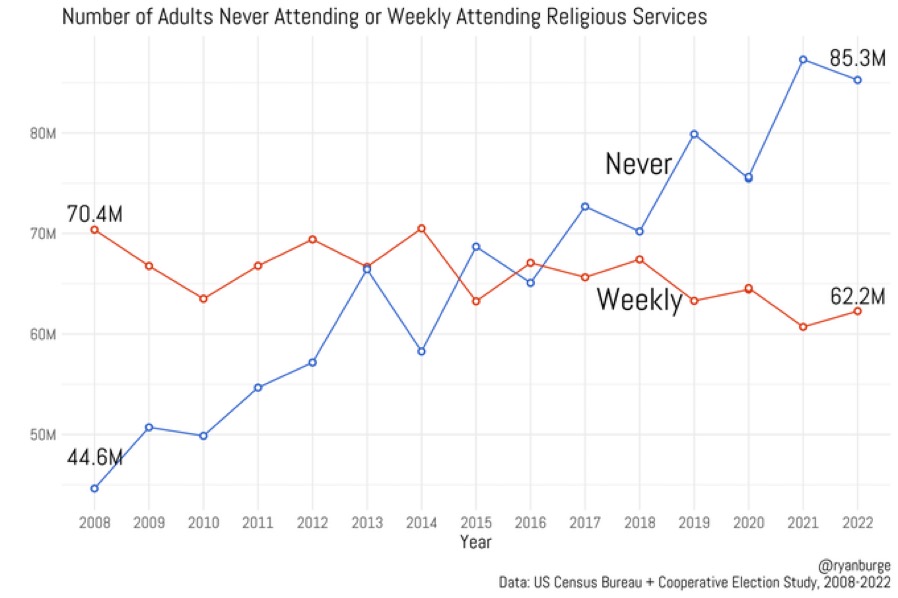
According to the US census bureau, the number of people who acknowledge attending a weekly religious service has gone down slow but steady since 2008. But those who disclosed that they never attend church has risen dramatically (see graph).

This explains the decline in attendance in most churches. The “regulars” are coming (although not quite as regularly); the “once-in-a-whiles” are not coming at all. 

Why did the “some-timers” become “no-timers”? Studies will show that there is not a single factor which has led to this decline in the de-churching of America. There are plenty of reasons. Some valid. Some not. 

Here’s the problem: If people have this life to determine their eternal accommodations, then there is no time for a detailed review of all the variants and subset reasons why the “some-timers” became “no timers.” Let the PhD candidates wrestle with those questions in their doctoral research projects. In the meantime, the situation is more like a building fire than a specimen to be examined. We are not afforded the time for analyzing the circumstances that led to the fire; it’s time to rescue the perishing (wasn’t there an old hymn by that name?). It’s time to go on the offensive. But how do we do that? How do people who have never come or don’t want to come or who have been hurt in the past by the church start coming or come back to church (and discovering Jesus)? 

The attractional method stopped working. “Build it and they will come” doesn’t work either. Christmas Cantatas, bus ministries, and cold calling on neighbor’s doors armed with the four spiritual laws might be met with someone armed with a Colt 45.  Most of the things that worked pre-2000s don’t work today, yet churches still want to play by the 1990’s rule book.

What works? Relationships work. Love works. Getting the church into the community, not asking the community to come into the church. That works. Blessing the community in as many ways as possible works.  Many in the world don’t think they need the church (or Jesus), it’s time for the church to show the world all the good and love the church (and Jesus) provides. When the church does that– it’s beautiful. It’s attractive. “No-Timers” become “One-timers,” then as they see authentic love within the pews, the “once-in-a-blue-moon-timers,” discover Jesus (or rediscover Jesus) and become, glory upon glory, “all-most-always timers.” 

Reversing the downward trend is as simple as Jesus instructions, “Love your neighbor as yourself.”  It’s living into Paul’s words in 2 Corinthians 5:7: “For Christ’s love compels us.” As we are compelled to bless our community with Real, Authentic, Love—they will see Christ and His Bride in their beauty and return once more.

Everything has changed. Nothing has changed.

We used books when I was a kid. Real books with paper and pages and everything. A phone book. The Yellow Pages The Wish-book from Sears and Roebuck. Encyclopedia Britannica. A Webster dictionary. A road atlas. All were staples of every house (we had everything but the encyclopedia). 

Cars didn’t have computer chips then. Only NASA had computers. Not houses. Not cars. Our cars had seat belts, but who used them? Car seats for babies? C’mon, I was in my mama’s arms. As I got a little older, I would curl up on the floorboard of the back seat and sleep. As a teenager, on several occasions, I was a passenger in the back of a pickup truck. Not the backseat (there were no backseats in pickup trucks), I rode in the cargo bed. Bumpy roads were both fun and scary. 

I owned a Walkman on which I played a cassette tape (the eight-track generation was before my time). I made a mixtape from my favorite songs off an AM radio station. Later I ordered cassettes and then CDs from Columbia House. I had a boombox too. My dad called my music choice “devil music.” I would tell him it was Christian music. Petra, Stryper and DeGarmo and Key were a few of my choices. I’m not sure my dad was convinced. His favorite words: “Turn it down!”

Cameras and phones were two completely separate things. Cameras used film, which we would take to Fotomat in the parking lot of K-Mart (my hometown had the distinction of the very first K-Mart). Several weeks after the picture-worthy event had happened, we would get the pictures back. Usually someone’s head was cut off or they weren’t looking at the camera. My brother Fred was never smiling. Sorry, no retakes. 

Our phone was a rotary variety and was located on the kitchen wall with a 12-foot (usually tangled-up) cord. We had a party line. That sounds fun (Party Line!  Yippee!!), but in fact it wasn’t fun. “Party Line” meant we shared the phone line with the Evans family who lived kiddy-corner from our back yard. We had to quietly lift the receiver to see if someone from the Evans’ household were already talking on the phone. Mrs. Evans was always on the phone. My brother Fred got in trouble for listening in on Chuckie Evans’ teenage conversations (maybe that’s why he wasn’t smiling in the family pictures). 

Life is different these days. Technology is different. Somethings are better (no party lines). Somethings are worse. I don’t pine for the “good old days,” but I do pray for better days ahead. Everything has changed, but the author of Hebrews reminded us that Jesus Christ is the same yesterday and today and forever (Hebrews 13:8). Jesus is the Constant. Here’s the profound truth: Jesus hasn’t changed, but Jesus changes everything, In the midst of a constantly changing world, Jesus is the Rock on which we stand. Our world needed Jesus then. Our world needs Jesus now. Jesus was the answer then. Jesus is the answer now. 

Everything has changed, but nothing has changed. We still need Jesus!

The Shocking Irony of Heaven: Your Next-Door Neighbor

If there are heavenly mansions (in the way we think of mansions); I hope Christians who can’t get along with other Christians here on earth are next door neighbors in Glory. A fundamentalist-leaning who loves Jesus living beside a progressive-leaning Christian who also loves Jesus— having to borrow cups of sugar when baking a dish-to-pass for the heavenly pot-luck banquet. Wouldn’t that be the shocking irony of heaven? FYI… words of wisdom from an antacid-popping-pot-luck survivor: if there are pot-lucks in eternity, it won’t be in heaven. But, presumably, there will be people who disagree on some pretty weighty issues here on earth residing in Beulah Land. 

If we are going to spend eternity together, it makes sense that we start the get-along process here on earth. According to Paul, since believers have been made new in Christ, they have a new ministry. Paul calls it “the ministry of reconciliation.” 

Therefore, if anyone is in Christ, the new creation has come: The old has gone, the new is here! All this is from God, who reconciled us to himself through Christ and gave us the ministry of reconciliation. 2 Corinthians 5:17-18. 

In other words, Christians “ghosting” other Christians or bashing fellow believers on social media does not compute in “the ministry of reconciliation.” Any misunderstandings, grievances and differences within the family of God should be a point of deep consternation for any true follower. 

The ministry of reconciliation is active. It doesn’t happen without effort. Those made new in Christ can’t assume the other won’t receive the reconciliation advances or worry that their attempts at reconciliation might be weaponized against them. A new creature reconciled in Christ becomes a reconciler. That means bridging the gaps, tearing down the walls, sending the extra texts, leaving the extra voicemails, going the extra mile and extending the arms of friendship. It’s taking a “whatever-it-takes” mentality into this “ministry of reconciliation.”

Eugene Peterson’s version puts it this way: We’re Christ’s representatives. God uses us to persuade men and women to drop their differences and enter into God’s work of making things right between them. (2 Corinthians 5:19. MSG). Can’t we drop our differences? Can’t we make things right? We better try. If the heavenly housing supervisor has a sense of humor, we might be neighbors on Golden Avenue. 

If the Hated Feel Hate, it’s Hate

Some Christians say: “Hate the sin, love the sinner.” (Note: it’s debatable whether they actually do this). Be that as it may, forget hating “sin” or “sinners,” maybe Christians should work on not hating each other. “We don’t hate the person,” we say. “We hate their teachings; hate what they are doing; hate the organization of which they are affiliated; and hate their attitude.” Who determines hate? The “hater” or the one the hate is directed toward? If the hated feel hate, it’s hate.

John was obsessed in his letter about hatred between brothers and sisters (FYI… He is not referring to biological families, but the family of God). Apparently, hatred within the church walls has existed even before the first church carpet committee convened, but (from John’s perspective) it is always (yes, ALWAYS) unjustified. 

Anyone who claims to be in the light but hates a brother or sister is still in the darkness. 1 John 2:9

Anyone who hates a brother or sister is a murderer, and you know that no murderer has eternal life residing in him. 1 John 3:15

Whoever claims to love God yet hates a brother or sister is a liar. 1 John 4:20

Those (even pastors) who harbor hatred toward those who claim Christ will be in for a rude awakening according to John. 

What does hatred toward fellow believers in the modern world look like?

  • Hatred is not attempting to make amends. Hatred is a social media lambast toward a fellow believer without following Jesus’ instructions of Matthew 18 of talking to the offender first. Hatred is passive aggressive posts with no conversation prior. Has there been discussion with the person before hitting “send”? Have a couple of believers spoke directly to the other to right the wrong before the airing of grievances? 
  • Hatred is refusing to acknowledge the other. It’s ignoring– then justifying the snubbing with an excuse of “they wouldn’t receive any attempts at reconciliation.” How does one determine that to be true? Sent one text? Maybe two? Is that going “the extra mile” that Jesus talked about?  Leaving one voicemail is going an extra foot, there are 5,279 more feet to go to get to an “extra” mile. 
  • Hatred is telling lies and weaponizing or “sanctifying” scripture to justify the lies (aka Satan’s tactics to Jesus in the wilderness). 
  • Hatred is speaking poorly about the offending brother or sister to others (aka gossip).
  • Hatred is referring to the other in derogatory terms. Wait a minute, some might say: “Jesus called the Pharisees “snakes,” “hypocrites” and “white washed tombs” among other things.”  I say, “Look in the mirror, friend, you ain’t Jesus.”

Why are young people leaving the church? Maybe they’ve seen too much mudslinging between so-called believers; too much hatred spewed toward those whom Christ loves; too much vitriol comments on social media; heard too many hate filled sermons; and seen a lack of love toward the least of these. They’ve seen it on all sides on just about every issue. They’ve seen too much and they’ve said, “Thanks but no thanks. I like Jesus. I don’t like His so-called followers.”

Before differentiating our hatred of sin and/or sinners, maybe we should try not hating our fellow believers. 

Confessions from a Pastor of 35 years.

Pastors aren’t always…

  • great preachers (I’ve preached my share of stinkeroos).
  • knowledgeable of every piece of Biblical minutia (They aren’t walking commentaries). 
  • in good mental health (People battle depression, loneliness, anxiety… pastors do too). 
  • mindful of social media (Have you posted stuff you regret? Pastors do too). 
  • care-free. (Some church stuff stinks. Sometimes comments sting and pastoring is hard.)
  • up-to-date on every political happening (They don’t watch Fox News or CNN all day. Neither should you).
  • perceptive of the character flaws in individuals (Pastors can be duped, just like you).
  • male (we have three great female pastors at Central church).
  • aware that Sister So and So had a birthday (Birthdays and anniversaries aren’t memorized).
  • the best pray-ers in the church (Have you heard Sister So and So pray? She touches heaven. I wish I had remembered her birthday and wish I prayed like her). 
  • healthy (sickness happens—through poor habits or poor genes or poor who-knows-what).
  • attentive to every financial decision in the church (Someone bought new communion trays? Cool!)
  • timely in returning phone calls, texts and emails (Sometimes they’re too busy. Sometimes they forget).
  • astute financially (Bible college doesn’t have a lot of high finance classes).
  • good judges of temperature in the sanctuary (Last Sunday in the foyer: “Pastor, it’s too hot” and “Pastor, it’s too cold”).
  • good judges of the noise level in the sanctuary (Last Sunday in the foyer: “Pastor, it’s too loud” and “Pastor, it could be louder”). 
  • mind readers (I didn’t know about that thing you never told me about. Sorry).
  • snappy dressers (GQ or Mademoiselle models we ain’t).
  • up on the latest cultural lingo (see above usage of the phrase “snappy dresser”).
  • grammarians. (see above usage of the word “ain’t”).
  • auto mechanics, HV/HC repair men or carpenters (Jesus was a carpenter, most pastors aren’t).
  • the best choice to drive the church van (Some pastors are bad drivers. Or so I’ve been told…). 
  • prepared to handle criticism (Silently count to ten before you respond… 1…2…3… BOOM! Oops.)
  • in the best place, spiritually (Shocking, but true. Sometimes like Elijah in 1 Kings 18, pastors are on top of the world. Sometimes like Elijah in 1 Kings 19, they are curled up in a fetal position).
  • perfect. (In fact, they are rarely perfect. Ok. Never. They make mistakes, just like you).
  • prayed over enough (Our enemy knows if the pastor gets messed up, the potential for many to be hurt is real. Pray for your pastor. Every day. Right now. Pray).

Pastors are called by God. That’s it. Pastoring is a calling. It’s not a job. It’s not a career. It’s a calling. Successful pastors know the challenging work of pastoring is a matter of knowing, trusting and keeping one’s eyes on Jesus and always remembering God’s call upon his/her life.

I desire to do your will, my God; your law is within my heart. Psalm 40:8

Who are you eating dinner with?

Who do you eat meals with? (Dear Grammar buffs…sorry about the dangling preposition). For me, it’s usually Karla. Sometimes I eat with church folks. Once in a while I eat alone. Often in the gospels we are told how Jesus ate with “the tax collectors and other sinners.” Occasionally the gospel writer will add “prostitutes” to the unsavory group. Tax collectors, as you probably know, were considered collaborators with the occupying Roman enemy. They were hated. The worst of the worst. And “other sinners” could be described as “even worse.” Then add the prostitutes… well, you know, where they stand. So, Jesus ate with “the worst of the worst and even worse and sometimes worse than that” people.

If we are to be like Jesus (and we are); if we are to act and think and love like Jesus (that’s the goal); then here’s a simple question: When was the last time you had dinner with “the worst of the worst and even worst and sometimes worse than that” people?

Maybe that’s too hard. In my mind “the worst of the worst and even worse and sometimes worse that that” people, are child molesters, serial killers or drug kingpins. I don’t know too many serial killers and drug kingpins. Let’s make the question a little easier: When was the last time you had dinner with “the not-so-bad, and even nice, just don’t know Jesus” people? 

For some it’s every night, I’ve described someone in your home. They are good people. Not so bad. Even nice. Just don’t know Jesus. Some of us eat with them a lot.

For others, you will have to think about it. It’s been a while since you shared a meal with “a not-so-bad, and even nice, just don’t know Jesus” person. Maybe it was last Christmas when your crazy cousin Willodeen was at the family gathering talking about was her seventeen cats. Think about it: When was the last time you had dinner with “the not-so-bad, and even nice, just don’t know Jesus” person?  You are probably a Christian. All of your friends are probably Christians too. You know a few “not-so-bad, even nice, just don’t know Jesus” people, but you’ve never had dinner with them. It’s your mail carrier; the check-out lady at the grocery store, maybe your next-door neighbor. 

Where did Jesus meet so many tax collectors, prostitutes and other sinners? Maybe they had a special club where they hung out. Or more likely, Jesus was intentional in making friendships with those people far from God. Jesus probably went out of his way; cleared his calendar; and prioritized their gatherings and made hanging out with “the worst of the worst and even worse and sometimes worse than that” crowd kind of fun. It seems like they wanted to be with Jesus too. 

If we truly want to be like Jesus, then maybe instead of sucking down a Coney dog (Detroit style for me, please) with our Christian friends, we should be thinking about who we know that doesn’t know Jesus; is far from God; but with whom we might share a meal. Try it. You’ll be more like Jesus if you do. Make the meal fun, and pass the mustard!

War, Evil and Our Trivial Disagreements 

The world is on pins and needles observing the war in Gaza. The suffering is incomprehensible sitting in our comfortable living rooms watching the events unfold. I’ve never been in a war-torn area. I’ve never heard bombs and gunfire outside my bedroom window. I’ve never had a loved one raped or murdered simply for being in the wrong place at the wrong time or who was of the “wrong” nationality or “wrong” religion. 

It is heartbreaking. So we in America pray, pray, pray. 

As we watch the evil atrocities of Hamas and the scarcity of the basic necessities of life in Gaza, it makes the petty things we, Christians in America, fight over seem all the pettier. 

A couple of weeks ago, a few people took acceptation to a blog post of mine. Folks from the right and left didn’t like it (usually a sign I was on target). They wrote and said mean things. Lies even. My skin is pretty thick when it comes to things written or said; but my skin is not thick enough if it were bullets being fired. Compared to the situation in the Middle East, my tribulations are extremely light and momentary. In fact, I don’t like using the word “tribulations” in comparison to the suffering occurring in our world. We need to put in perspective our trivial disagreements.

I get it. Theology matters. We want to be correct biblically, of course. People will not always agree with our nuanced look at scripture and theology. Fundamentalists, Calvinists and Wesleyans hold different beliefs about the Bible, women in ministry, the atonement and a host of other things. We all believe in Jesus. We might be neighbors in heaven. Can’t we turn down the rhetoric? 

John Wesley said, “Though we cannot think alike, may we not love alike?” It’s a good question. 

I get it. I’m a white, over sixty (boo hoo) male. I’m not excluded because of my gender or race. Maybe I shouldn’t be the one stating this, but our bickering over non-essentials is not worth the fight. In our ever-divided world, for many their “non-essential” list is shrinking, and their “essential” list grows. But should it? Our trivial differences seem so inconsequential as people’s lives are destroyed and so many are left wondering about their very survival in the Middle East. 

As the world watches in horror the events in Gaza, of course, our enemy is not the innocent Israeli or Palestinians. Neither is our enemy those Christians who might view scripture differently. There is evil in the world and it’s not the Methodists, Baptists or Catholics. Our Enemy is the roaring lion of whom Peter instructs: Be alert and of sober mind. Your enemy the devil prowls around like a roaring lion looking for someone to devour. (1 Peter 5:8). In such a time, we believers must stand as one and denounce evil in all of its forms (Reject every kind of evil. 1 Thessalonians 5:22). We must pray, weep and hope together. In the face of evil, Christian brothers and sisters must live into Romans 12:9: Love must be sincere. Hate what is evil; cling to what is good. In other words, know the Enemy. It’s not my Christian brother or sister who might differ with me on the nuances of Scripture or end times theology. It’s really not.

Live in harmony with one another. Do not be proud, but be willing to associate with people of low position. Do not be conceited. Do not repay anyone evil for evil. Be careful to do what is right in the eyes of everyone. If it is possible, as far as it depends on you, live at peace with everyone. Romans 12:16-18

Be Happy. Not Sad. 

Once upon a time there were twins, Humperdinck Bartholomew and Salvador Montgomery. To make things simple, their parents called Humperdinck Bartholomew, “Happy” and called Salvador Montgomery, “Sad.” Never wanting one boy to think the other was more favored, Happy and Sad’s parents made sure the boys always had the exact same things. Throughout their lives Happy and Sad had everything identical, except one thing– their attitudes.

Happy had a blue shirt, and loved every thread.
Sad had a blue shirt, but wished it were red.

Happy had a toy truck. “Wow! it rolls far!” 
Sad had a toy truck, but wanted a toy car

Happy had chocolate cake. “Yummy, it’s cake! Right?” 
Sad had chocolate cake. His favorite cake was white.

Happy had a Christmas list, and wanted something on it.
Sad had a Christmas list, and wanted everything on it.

Happy had holey jeans. He thought, “I’m wearing the latest style.”
Sad had holey jeans. He threw them in the big junk pile.

Happy got a B on a test, and said next time I’ll do better.
Sad got a B on a test—Jealous of those with a better letter.

Happy went to church. He enjoyed every song.
Sad went to church. The preacher preached too long.

Happy grew to be a man, and appreciated sunshine or rain. 
Sad grew to be a man, and found reasons to complain

Happy got married. They rarely had a fight. 
Sad got married. His wife could do no right.

Happy had kids. Even small things caused celebrations.
Sad had kids. They never met his expectations.

Happy when wronged, forgave those with whom he disagreed.
Sad when wronged, took to social media. Slander guaranteed.

Happy had a job, worked hard, excelled in all he did.
Sad had a job, worked little, behind his desk he hid. 

Happy was old and passed on all that he had learned.
Sad was old. Toward future generations– unconcerned.

Happy reach the end of his days, thankful and glad.
Sad reached the end of his days, grumpy and mad.

The moral of the story: 
Be happy. Not sad.
Count your blessings, don’t compare them.

Second moral of the story: 
Don’t name your kid, “Sad.” It’s a terrible nickname.

The end

The Big Fat Juicy Lie about Small Churches 

There is a lie floating around about small churches. A big fat juicy lie. The false narrative asserts that small churches are nothing but trouble. To those sensing a call into ministry, the Great Fib says, “Stay away! Don’t go there!” Sucked into the faulty story, many called into ministry believe it’s better to plant a church, or start a Christian coffee shop or do just about anything else than to go to an existing small church in a small town and deal with the stuck-in-their-ways, older congregation.  

Reality: Small churches can be a huge blessing to the community and pastor. I was called out of a small church (so was my brother and others). It’s a doctor’s office now. My wife’s small church had people called into ministry. It is closed too. Those two churches were not failures. The doors are shut, but the ministry of the Elmwood and Reading Churches of the Nazarene continues through those of us who are still serving the Lord.

Granted it’s been a while, but my first church was the Bad Axe Church of the Nazarene in the Thumb of Michigan. I joke about being a “Bad Axe Pastor.” Saying it fast without annunciation sounds a little funny. 

There were 40 people present on my first Sunday as a Bad Axe pastor. The church was located on a side street. Even people who lived in Bad Axe for years, didn’t know where the church was located. The parsonage and church were so close together, they were connected with a tunnel between the basements. The church fellowship hall was the parsonage basement. Eventually the living room became a Sunday school classroom. 

I was a solo preacher. Meaning I was also the lawn care provider, snow shovel-er, counselor, sometime special singer (big regrets over that), bulletin designer, director of VBS, bat exterminator (yikes), youth group leader, senior adult director and shortstop on the church softball team. You name it, I did it. 

I made mistakes in Bad Axe. Too numerous to count. But the good folks of Bad Axe loved me anyway. Folks would drop off vegetables from their gardens or homemade goodies. We lived below the poverty line and the district paid for half of our health insurance. Still, it was such a rewarding time for a young pastor and spouse. 

I loved Bad Axe (if you couldn’t tell). It was a good ministerial start and I’m a better pastor today because of my three years as a Bad Axe pastor. 

All this to say, small churches aren’t bad. They aren’t mean (there might be a meanie or two in some places). They aren’t pastor-assassinators and joy-killers. 

I recently wrote on the slow leak of young people leaving the church; but there are plenty of young people who want to stay. We need them to stay. Small churches need young pastors. They need the vitality that young pastors bring. They need new life, new energy, and a new hope for the future. A good small church will love to be pastored by a young adult!

Don’t believe the big fat juicy lie that small churches aren’t worth the trouble. Don’t believe the false narrative that small churches are mean, hard-hearted or void of potential. Small churches can be such a blessing to their community and their young pastor! 

(as part of “Pastor Appreciation Month,” I’m taking time to appreciate the wonderful church’s where I have been blessed to serve)

A Plumbing Problem in the Church of the Nazarene

When a pipe bursts, you know it. There is water everywhere. But when it’s a leak, a slow leak, it is easy to overlook the problem. If the leak persists, year after year, without being addressed, eventually the damage could be worse than the bursting pipe. Slow leaks unattended can destroy the whole structure.

We’ve got a plumbing problem in the Church of the Nazarene. It’s not a pipe bursting (see the United Methodist Church); it’s a slow leak. 

I used to think the Church of the Nazarene might split over (you name the issues): Drinking; Speaking in Tongues; or the Wesleyan view of Scripture to name a few. It doesn’t appear that the Nazarene’s are marching toward a massive split. The last major split (I believe) was the formation of the Bible Missionary Church back in the 1950’s over watching TV. (The Bible Missionary Church was against the “devil box” placed in everyone’s home). 

The Church of the Nazarene will continue to die in USA/Canada (not necessarily in the rest of the world) because of a slow but steady exodus of young people. Check out the average age of newly licensed ministers. It’s not men and women in the early 20’s (like when I received my first license); it’s people in their late 30’s. Why is the average age so high? Because young people are walking away. 

It’s a slow leak.

Denominational leaders will point to the year-over-year level number of credentials surrendered and say, “See, we aren’t doing so bad.”  The problem is that young people aren’t even going through the process of getting a district license. They are dropping out. 

It’s a slow leak.

They see the division in churches; the deception of church leaders; the battle lines drawn over opinions; the angst over human sexuality; the fundamentalists gaining ground; the limits on discussion; the heavy-handed restrictions on creativity; the overtly political agenda; rise of Christian nationalism and young ministers-in-training say, “It’s not worth it. There’s too much baggage. It would be easier to pastor a non-denominational church; plant a church or be a Christian “minister” in a coffee shop.” Then they walk away.

It’s a slow leak.

What can be done to stop the leak? There isn’t a quick answer. There’s no magic substance that can plug the hole. But maybe the beginning of the answer is through listening and conversation. It begins with a posture of humility in our leaders. Listening is not liberal, conservative, “woke,” fundamentalist, progressive or any other label. Listening can’t hurt, will probably help and at the very least bring all parties to a better understanding of the other. Before drawing conclusions, passing down injunctions, removing status or walking away, couldn’t we listen?

People leave when they feel their voices aren’t heard. Listening (on all sides) can only help end the slow leak.

I’m blessed– you can be too!

I’ve been on this planet exactly 21,916 days (if you are doing the math at home, I’ll save you the trouble: that’s 60 years plus one day). Me, Gwyneth Paltrow and Google had a birthday yesterday (many thanks to all who sent greetings my way). According to a study reported here, September 27 is the most common day for a person to be born. In other words, I’m not as special as my mother told me I was. 

I’ve been sucking in air for 21,916 days on our beloved revolving ball of dirt and water. Not all of those days have been great. There’s been a few clunkers. But, honestly, just a few. 

The day of my brain aneurism wasn’t a great day, but I really don’t remember much of that day. Kidney stones, a ruptured appendix and a few other assorted ailments make up a handful of bad days. The death of my parents and other close friends account for a few more bad days. There have been disappointments in people’s choices; a few church folks (not many, just a few), in the back pocket of the Enemy, made for some stinky days; and a car crash or two (who’s counting?) made for a less than perfect day. All this to say, of my 21,916 sunrises almost all have had sunsets that followed a pretty decent day. Many days were exceptional! I’ve been blessed.

If I had 150 bad days (and I think that number is high) then about 99.33% of my days have been good days. I can testify with Kind David from the favorite Psalm who wrote: “Surely your goodness and love will follow me all the days of my life” (Psalm 23:6). God’s goodness and love have followed me. I don’t deserve the blessings I’ve received. I’m overwhelmed by God’s graciousness!

Against, my mama’s opinion, I’m not unique. You have been blessed too. Maybe you’ve have a few more bad days than me. Maybe you’ve had a few less. But the reality is that God longs to bless His childrenPsalm 2:12 says, “Blessed are all who take refuge in him.” Not some. Not a few. ALL who take refuge in Him are blessed.

In Jesus list of those blessed in the Sermon on the Mount (the Beatitudes), some of those considered “blessed,” are questionable. Are they really “blessed” –the poor in spirit, those who mourn, the persecuted—to name a few? It would seem that they have more than their share of “bad” days. What gives?

James understood it this way: Blessed is the one who perseveres under trial because, having stood the test, that person will receive the crown of life that the Lord has promised to those who love him. (James 1:12). Peter agrees: But even if you should suffer for what is right, you are blessed. (1 Peter 3:14). In other words, the worst of days of our lives don’t have the final word. Jesus does. Keep your eye on the Prize not the problems.

Unless I am like Moses (he lived 120 years) I don’t have another 21,916 days left in me. Whether those remaining days are many or few; whether the days are mostly bad or mostly good—this I know: I long to experience the blessings that the Revelator foretold: “Blessed are those who wash their robes, that they may have the right to the tree of life and may go through the gates into the city” (Revelation 22:14). That glorious final blessing is my aim and goal—I hope it’s your too.

Revival Is Coming! I can’t wait!

Spiritual Renewal is something that every believer should want. The Lord’s mercies are new every morning (Lamentations 3:23), who wouldn’t want a new mercy every morning?  Who wouldn’t want to be renewed in his/her spirit each day? This isn’t a conservative or liberal thing. Who doesn’t want to be revived?  

Those who might say “revivals” or periods of spiritual renewal in a church are not effective these days. They aren’t like the “good old days” when folks didn’t have anything better to do, had three TV channels from which to choose; and came out to anything the church offered. It’s true there are more things to do and more things that (we feel) must be done. Look at social media. Walked through a high school. Noticed the direction of our country. Think of the defeat/discouragement within families.  Hear the angst and the lonely cries of people all around. We need revival. More than ever, we need spiritual renewal.

Who doesn’t need: More encouragement? More strength? More wisdom? More spirit infused courage? We all need more of Jesus these days not less. Those who say, “I don’t need spiritual renewal” or “I’m too busy for revival” or offer some other excuse—are more than likely the ones most in need of spiritual renewal.  We all need it (pastors included).

Everyone can grow stale. No one is immune. Spiritual renewal is the antidote.

To combat the prevailing forces and pressures in our ever-compromising culture, we must slow down, focus on Jesus and plead to grow deeper in our walk. It might involve openness, honesty, confession, vulnerability and stepping out of one’s comfort zone. It might cost us something. Growth usually does.

Clearing calendars is inconvenient. Of course, there are commitments that have to be kept (revival week or not). There are some things a person can’t get out of doing—but there are plenty of things that we can get off our plate for a four-day immersion in soul renewing. It might involve asking to re-arrange a work schedule; cancelling a regular appointment; or asking to be excused from a class. If we claim that our soul care is the most important thing in our lives (and it should be), then, for this four-day period, we need to act like it. 

Once a year (generally the first week or two of October), Central Church sets aside four days, Sunday through Wednesday to intentionally focus on our soul reviving. This year, October 8-11, Dr. Tim Green, dean of the Millard Reed School of Theology & Christian Ministry at Trevecca Nazarene University in Nashville, Tennessee will be our speaker. We make every effort to eliminate excuses. A free dinner is served Monday through Wednesday. Our Discovery Area (nurseries and pre-school) are fully staffed. Our children’s ministry (grade 1-5) also have special speakers and workers. We prioritize this week in our budget and in our efforts. 

We put forth the energy because we believe God wants to revive our souls, improve our outlook; strengthen our families; refocus our attention and ready us for whatever the future might bring. We’ve got a couple of weeks to shuffle our duties and clear our responsibilities to enable full participation. Spiritual renewal is worth it. Revival is coming! I can’t wait!

Headline reads: “Rapture Tomorrow” (My Tip: Make your car payment)

According the picture that was on my social media time line, the rapture is happening tomorrow. Apparently, whoever made this “theological calculation” forgot Jesus’ words, “But about that day or hour no one knows, not even the angels in heaven, nor the Son, but only the Father” (Matthew 24:36). In other words, make your car payment.

For argument’s sake, let’s say it was true. 

In 24 hours, the world is about to change… 


What would you do? 
Who would you call?  
What would you tell them? 
What if they didn’t believe you?
Would you take their “you’re crazy,” comment and drop the whole conversation?
Would you be persistent?

Are there people to whom you would need to make apologies?
Are there wrongs that need to be righted?
Are there people you’d want to thank?
Would you cancel your Saturday plans?
Would you be sad that you won’t be able to watch football this weekend?
(I’d be happy to be entering the sweet by-and-by in my fifties, not in my 60’s like a certain wife of a preacher that I know. I’d have all eternity to rub in that lil’ fact… snicker snicker).

Paul wrote this nearly 2000 years ago: 
Understanding the present time: The hour has already come for you to wake up from your slumber, because our salvation is nearer now than when we first believed. The night is nearly over; the day is almost here. So let us put aside the deeds of darkness and put on the armor of light. Romans 13:11-12

If the Apostle Paul said, “the night is nearly over; the day is almost here,” doesn’t it make sense that two millennia later, we are a whole lot closer to that Day (yes, I capitalized it on purpose) than ever?  Are we slumbering on this news? Have we put on the “armor of light”? (Read: Are we shining for Jesus?).  Jesus indicated we need to be prepare today for all eternity when He said, “And what do you benefit if you gain the whole world but lose your own soul?” (Mark 8:36). We are going to spend a whole lot more time in the next life than we are in this old life, so we need to be ready. For the procrastinators in the crowd remember the words of Proverbs 27:1: Do not boast about tomorrow, for you do not know what a day may bring.

I’m not suggesting that the rapture is happening tomorrow. I am saying, I could get in a car wreck tomorrow. You too (sorry for the Debby Downer wakeup call). Fact is, there are no guarantees in this life. If you’ve been in a car with me, you know that, statistically, there is a much greater likelihood of me blowing through a stop sign than Gabriel blowing his trumpet. Reality Check: Am I prepared to see Jesus, whatever my tomorrow may bring?

With apologies to the know-it-all, social media post, “the End” might not come tomorrow, so pay your mortgage and your tithe (hee hee)! Even more important, pay attention to the wellness of your soul.

Proof that the Old Preacher is Old

Proof #128 that I am old: I constantly find myself saying, “it was much easier pastoring in “the good old days.” I feel like a curmudgeon to say it, but it’s true. 

Pastoring is hard. 
Harder now than ever.
People are angrier. 
Social media is brutal. 
Less people go to church, and 
those that are church go-ers, “comparison shop” more than ever.
An old preacher once told me, “once the sheep start to wander, they never stop.” We’ve got a generation of sheep wanderers, drifters and dropper-outers. That’s Baaaaa-d! (Terrible puns? Proof #129 that I am old.)

Regular attenders are less “regular.”
I’m told that there are more reasons to miss church now (I don’t really think there are more reasons to miss. There have always been plenty of reasons to miss church. It’s just these days people are more apt to miss). 
It is easier to miss church (thank you live streaming). 
The only “live streaming” in the old days was if the water fountain in the church foyer got stuck (Church foyer jokes: Proof #130 that I am old).

Growing up, we went to church. If the doors were open, we, Princes, were there. A little tummy trouble wasn’t a good enough reason to miss church. You had to have a foot in the grave and the other foot on spilled communion juice to miss. (Bad Communion jokes: Proof #131). Not so these days. 

People are less forgiving.
They draw conclusions much quicker.
Authority, respect and kindness have seemed to take a backseat to personal liberties where every behavior under the sun is validated and if you think otherwise, the “Kibosh!” will be on you!! (Use of the word, “Kibosh”: Proof #132)

Often in a vacuum (thanks again social media); non-Christians only hear the voices of like-minded people, and (not shockingly) those in the world are not favorable to the things of Christ. Proof #133: Every fiber in me, wants to make a joke how Hoovers’ aren’t the only vacuums that suck, but I’m not.

Moreover, there are “believers” who likewise are critical of the Church, pile on at any bits of trouble and regurgitate all of the Church’s flaws. Knowing the actual facts seems to be optional. Of course, accountability is needed. Errors and sins should be exposed. Flawed, sinful leaders should be expelled. I’m not talking about that. I’m referring to the ad nauseam criticism and vitriol speech from those who claim Christ. They have no problem slinging mud on the Bride of Christ’s gown. Heaven forbid, if a pastor-type should tell the aforementioned “believer” that their negativity is not helping the cause of Christ. An avalanche condemnation and denigration will fall upon the poor preacher. 

Did I say pastoring is harder now? It is.

What’s my answer to this current state of church life and pastoring? I’m going to try even harder. I am going to work to get others to join me. I’m going to preach and pray and call and visit and love and work some more until Jesus comes. I’m also going to pray for young leaders who are strong, courageous, faithful, loving, truthful, and kind. God is calling them. I’m praying these young leaders will be listening and not get discouraged. The closer I get to the finish line, the more I long to hear, “Well done my good and faithful servant.” A grumpy generation is not going to stop me.

Now, get off my lawn.

(The previous comment is Proof #134 reason that I am old).

Hey Nazarenes, We Need More Good News!

I like good news. Who doesn’t?  The Gospel of Jesus Christ, of course, is the ultimate Good News. We always want to share it–as often as possible. But I also like hearing the good things that are happening in my tribe, the Church of the Nazarene. I especially want to know what’s happening in the USA/Canada region where I live and work. It seems Captain was right in Cool Hand Luke: “We have a failure to communicate.” 

There is news coming from various Nazarene entities. Nazarene Compassionate Ministries post on social media from time to time how Nazarene are helping to alleviate the world’s suffering. That’s good news. The NCM Magazine likewise provides good stories from around the world. Nazarene Missions sends an emailed prayer reminder on Wednesdays about different countries in the world. That’s good too. Nazarene News on Friday’s sends an email about what is happening here and there throughout the world. There is an obituary section (mostly USA/Canada clergy) and a once-a-month notice of the moving ministers (also mostly in USA/Canada). Nazarene News has a slight social media presence (emphasis on “slight”). Holiness Today offers good articles, but isn’t really a disseminator of news from around USA/Canada. There are probably a few other outlets of which I am unaware. Those sources are fine in what they do, but I need more good news. 

Just like the traditional news outlets, where ‘bad news sells,” social media seems to swirl around the negative. There’s bickering on all sides ad nauseam. Paul said our struggle isn’t against flesh and blood, but it sure seems like we are making it out to be. Our Enemy is the same since Eden. So why are we making it so personal against one another? (Cue: the comments about “standing for truth” or the need to “love unconditionally”). 

I’m not a Pollyanna. Bad things happen. When they do, those bad things need to be exposed. Confession, repentance, sorrow, lament and grief are legitimate responses to those bad things. They should never be swept under the rug or the bad things will keep happening. I get all of that. Still Paul said, “Rejoice in the Lord always, again I say, rejoice!” We act (and post on social media) like Paul wrote “Keep hounding on the terrible things, again I say puke it out more and more.” Can’t we rejoice a little more than we currently seem to be? Do we have to be so negative? Our brothers and sisters might differ on some issues, but they are still our brothers and sisters. There need not be a feud in the family of God.

The truth is: Good things are happening. They are happening in my corner of the world (probably in yours too). Lots of good things. A lake-full of people getting baptized last month; the grand opening of Central Park; plenty of new folks at Pastor’s Chat and a great youth fall kickoff yesterday; and a medical team leaving for Panama on Saturday (our third team to Panama this year)—good things are happening at Flint Central Church. But I want to hear about God’s working across the country too.  

Listen in an age of angst and anger, we need to hear about the power of God at work among us. We need to be encouraged. We need reports of the good things of God. I’m not a “world’s going to H-E (well, you know the rest) in a handbasket” guy. I’m convinced that God is still at work in America. I just want to hear about it more and more.

All Alone in a Crowd of 76,416 (and sin has nothing to do with it)

My sons and I will be at the Kansas City Chiefs vs. Detroit Lions football game tomorrow at Arrowhead Stadium in Kansas City. Alex and Ben will be wearing Chiefs’ shirts. I will be wearing the Honolulu Blue and Silver of the Detroit Lions (I have failed as a father. Two sons. Zero Lions’ fans. But I digress.). We will be at the game along with 76,416 others in the stadium. Probably 76,415 will be cheering for the Chiefs. Hopefully, there will be two or three other Lions’ fans representing the Motor City Kitties.  

If you are not a football aficionado, I will remind you that that Chiefs won the Super Bowl last year. In fact, the Chiefs have been in the AFC championship game for the last five years, and have won two Super Bowls. The Detroit Lions, on the other hand, have never been to a Super Bowl; have won exactly one playoff game in my lifetime (you read that correctly. ONE!); and despite greater expectations for upcoming season, the Lions are not predicted to win this game.

If watching the game on TV, in a sea of red jerseys, look for a guy in the nosebleed section in the north end zone wearing blue with his hands over his ears. Arrowhead Stadium has the Guinness World record for the loudest stadium, when Chiefs’ fans’ screaming one time hit 142.2 decibels. I tend to get migraines with a little extra noise in the sanctuary. It could be a long night. If ever I felt all alone in a big crowd, Thursday might be my night. 

Sometimes one can feel like you’re wearing blue in a stadium filled with red.

Recently, a church leader wrote the following on social media: “Loneliness and isolation is (sic) the result of solitude without Jesus.” I get what he was trying to say– “you are never alone with Jesus.” It’s the “Just Jesus and me on the Jericho road” theme of the old hymn. He’s not wrong about Jesus always being with us. Jesus said, “Lo, I am with you always.” Jesus meant it. Moreover, personal sin can lead us to a lonely place as we isolate ourselves from God. My problem is with the mistaken notion that loneliness is always the result of a lack of connection to Jesus. Loneliness might have nothing to do with one’s standing with Jesus. 

Biblical heroes like David, Jeremiah and Paul all had bouts of loneliness and it wasn’t the result of a lack of faith in God almighty. Feelings of loneliness can be the result of grief, friendship changes, mental health issues, singleness, chronic pain, even the lonely servant of the Lord. None of those examples are necessarily a lack of faith and to suggest otherwise, only heaps needless guilt onto the lonely sufferer.

A remedy for loneliness is rarely a simple answer. It involves some or all of the following: acknowledging one’s situation; allowing God’s word to penetrate the soul; being proactive in cultivating Christian friendships; having fellow Christians perceptive to one’s circumstance; and ultimately allowing God to be one’s provision. 

Paul words to the Corinthian church are the beginning of the remedy: 

Blessed be the God and Father of our Lord Jesus Christ, the Father of mercies and God of all comfort, who comforts us in all our affliction, so that we may be able to comfort those who are in any affliction, with the comfort with which we ourselves are comforted by God. 2 Corinthians 1:3-4

In other words, the remedy for loneliness is not “just Jesus and me on the Jericho road.” It’s Jesus and me and you and other believers too on every road of life. Rueben Welch said, “It isn’t Jesus and me, it’s Jesus and we.”* It’s being comforted by God, then passing that blessed comfort onto others. When loneliness attacks, in its finest hour, the family of God moves into action. When God’s people circle the wagons of love around an individual, loneliness’ grip begins to lessen. 

Hopefully, there will be some kind-hearted Chief’s fans sitting nearby that will have compassion on this lonely Lions’ fan too. 

*Welch, We really do need each other, p. 73. 

Ready

Last Sunday, in my sermon I spoke of how we have this life to determine our eternal accommodations. Like I often say in funerals, there are no make-up exams, no do-overs and (if you are a golfer) no mulligans.  My friend, John Faulconbridge, was in the service.

Less than 24 hours later, John had a massive heart attack; shortly after John was, like the Salvation Army would say, “promoted to Glory.” That euphemism for our passing is appropriate for my friend, John. He was a West Point graduate, a very proud veteran, and most importantly a follower of Jesus.

John’s funeral service is tomorrow at the church. His burial will be at a later time at the Oklahoma Veteran’s Cemetery. John just recently took the buy-out General Motors offered their salaried employees. He and Becky had plenty of plans for these years. He was 67 years old.

When I was younger, 67 years old seemed very far away and very old. It doesn’t now. It seems young(ish). I want to put the adverb “only” in front of the number “67.” People are supposed to live a lot longer than 67 years these days. My brother-in-law ran a marathon for his 70th birthday. 70 is the new 50. 

Whenever someone passes away suddenly, I am shocked once more into the reality of our need to be ready. No one is guaranteed any days. We all have an expiration date, but unlike milk jugs we don’t know when that date is. My point: Be ready. This week was a familiar, yet stark reminder. 

Part of my job as pastor (or as my friend Steve Hack refers to me, “shepherd”) is to do all I can to make sure that the flock is ready for the greener pastures in Glory. It’s remembering that all who call upon the name of the Lord will be saved (Romans 10:13). We still need to accept that invitation. It’s free. It’s available to all. But we need to accept and then live into this calling of following Jesus. This sounds a little too transactional: Say a prayer; Get your fire insurance; and bingo, you’re good to go. I don’t mean it that way. Being ready is about encountering Jesus, then formed by Jesus to be a part of the mission of Jesus in the world. John lived into that Jesus calling. There may not be a West Point to be in the Lord’s Army, but John answered the call and wholeheartedly served Jesus.  

As a Shepherd/pastor, I hope to always have the same confidence about the departed loved one as I will have tomorrow when I step behind the pulpit to officiate John’s funeral. He loved Jesus and wanted to serve Him. John was ready for his unknown and unexpected expiration date. I hope you are too.

Central Park: You “gotta” Play With Them

40 years ago (has it been 40 years? Yikes!), when I was a summer intern from Olivet Nazarene University at the Alanson Church of the Nazarene in Northern Michigan, Pastor John Carr, told me, “You’ve got to play with them to pray with them.” He meant that a pastor (or any believer) has to earn the right (via showing that one cares) before people will trust you to talk to them about spiritual matters.

He was right, of course. He’s more right now. (Can one be “more right”?). There may have been a time when cold calling on people by knocking on their front door; spewing out the Four Spiritual Laws or the Romans Road or some other evangelism plan; led to people trusting in Jesus. It might have worked then, not now. Knock on a stranger’s door these days, and you might be greeted with a Glock 44 instead of a crock of honey and crackers. 

These days you need to “play” with them first.

This was proven last Friday as we opened Central Park. Our neighbors nearly outnumbered Central folks with the arrival of the first official day of the park. Kids were sliding on the slides; swinging on the swings; and seeing how fast the merry-go-round could move. Several of the parents talked to me about our church; thanked us for building the park and talked about their intention to “try the church out.” 

You’ve got to play with them (literally). I told one neighbor one of our key commitments at Central Church is “to be the best neighbor.” His response, “You are!” Of course, that’s what we want to hear. 

It’s not 1990. In 2023, people want to know you care. They are more suspicious than ever. Many have been hurt before in their religious experiences. They have seen and heard of too many faith based organizations that have broken the trust of those they were so-called serving. The news of Christians is not always positive. 

The way to combat such thinking is to show folks a deeply religious experience can be different. Caring for the spirit, soul and body seems like a positively wonderful Christian thing to do. Paul wrote (in the verse all good Nazarene’s have memorized): May God himself, the God of peace, sanctify you through and through. May your whole spirit, soul and body be kept blameless at the coming of our Lord Jesus Christ. (1 Thessalonians 5:23). 

That’s exactly what Central Park is hoping to accomplish! Through our efforts to care for the spirit, soul and bodies of our neighbors, we will have opportunity to share with them the sanctifying and peace infusing work of God!

Preaching isn’t always Easy

Every year, since my Bad Axe preaching early years, I get away for four or five days for reading, research and prayer as I plan out the following year’s sermon calendar. I have found that I need a map for my upcoming preaching calendar to be balanced and well thought; and I need to seek the Lord and study to accomplish that goal.

I take this responsibility extremely serious. I believe Paul was writing to me (along with Timothy) when he wrote: Preach the word; be prepared in season and out of season; correct, rebuke and encourage—with great patience and careful instruction. (2 Timothy 4:2). Paul’s instruction to Titus applies to my pastoral responsibility too: Our people must learn to devote themselves to doing what is good, in order to provide for urgent needs and not live unproductive lives (Titus 3:14). Moreover, I hope to accomplish what Solomon spoke of in Proverbs 9: Instruct the wise and they will be wiser still; teach the righteous and they will add to their learning (Proverbs 9:9). 

Here’s your pastoring 101 lesson: Preaching isn’t easy in the 20th century. I suppose that’s why so many pastors are throwing in the towel, and why young women and men aren’t heeding the call as eagerly as they once were. It’s hard. People are more fearful, angry and can be downright mean. The divisiveness in our country is rampant (election years are the worst, by the way). Sometimes it seeps into the church. People often want their way, their message, and their agenda preached. Paul’s stand in Galatians 1:10 is mine too. He wrote: Am I now trying to win the approval of human beings, or of God? Or am I trying to please people? If I were still trying to please people, I would not be a servant of Christ. In the end, the preacher is responsible for what is proclaimed from the platform. Andy Stanley correctly stated, “The cross is our invitation to live for the approval of One, not everyone.” Jesus must be preached and He is to whom preachers must answer. 

I’m thankful for the time to get away and listen to the Lord. I’m looking forward to a great year of preaching in 2024!

The 21st Century Needs Discipleaders (yes, that’s a new term)

Everything rises and falls with discipleship,” I wrote in response to John Maxwell’s old teaching that “Everything rises and falls with leadership.” Making disciples is what Jesus calls us to do (See Matthew 28:20) — not build churches, platforms, big budgets or ministries. Make Disciples. Period. But that doesn’t mean, John Maxwell was totally wrong. Leadership does matter. We need disciple making leaders. To that end, I have created a new term “Discipleaders.” The word placement is important. It’s not leaders making disciples, but disciple-makers with leadership qualities is the need for the 21st century. 

What does a Discipleader look like?

Discipleader is a person first committed to growing spiritually themselves. You can’t teach what you “ain’t” got. Discipleaders are seeking God for themselves, then teach from the overflow. As such, a Discipleader is prayerful, in the Word, a seeker holiness in heart and life and generous. 

Discipleader is on the lookout for those who also want to grow in the Lord. Young Christians need to be invited to be mentored and discipled. Not all are ready, not all have the desire. Discipleaders are looking for those longing to be taught the ways of Jesus.

Discipleader is patient. By definition new believers are not immersed in the ways of Christ. They potentially make mistakes, fail, and sin. A discipleader doesn’t quit on people very easily. Discipleaders are persistent.

Discipleader is humble. It’s learning from the initial, rookie discipleaders, as Jesus reminded them, “Anyone who wants to be first must be the very last, and the servant of all” (Mark 9:35).

Discipleader is relevant. They are moldable. They are not static but look for new ways to teach age old truths. Not always will the disciples-in-training be younger than the discipleader, but frequently they will be. A discipleleader must stay somewhat current (admittedly, I am a fuddy-duddy, and my use of the word “fuddy-duddy” proves it). 

Discipleader can communicate truth in love. It’s the “John 1:14 Model.” Jesus was full of grace and full of truth. Truth means I’m going to be honest no matter what. Grace means I’m going to love you no matter what

Discipleader duplicates her/himself. A church with one discipleader may grow a little. A church full of discipleleaders will grow exponentially. 

Discipleader cares about one number and it has nothing to do with attendance and budgets (Jesus didn’t tell us to get hung up on those things). Its baptisms. Discipleaders are baptizing folks and then following up with a discipleship path that leads to more discipleaders.

Are you a Discipleader?

Have American Christians Missed the Boat?

Forgive my nautical lingo (I just returned from an Alaskan Cruise), but have Christians in America missed the boat?  Not “missed the boat” regarding heretical tangents (although a case could be made that in some corners of “evangelicalism” – even the name itself—has turned heretical). Have we blown off-course (again the nautical language) regarding our main emphasis?  

It was John Maxwell, the leadership guru of the 80’s and 90’s, who famously said, “Everything rises and falls on leadership.”  Maxwell made the point to thousands of pastors and church leaders (and made himself wealthy) by touting this message in multiple books and even more conferences. But was he right? Is leadership the determining factor for the rise or fall of the church and in effect Christianity in USA/Canada?

From the title of this blog, you can probably guess my response. The rise and fall of the church in the last century was determined not by leadership, but by another “ship”: Disciple-ship. Sadly, that “ship” hit the icebergs of consumerism, church growth strategies and, not a little bit of pride and arrogance. 

Jesus gave us our sailing orders. He commissioned the church (see Matthew 28:20) to make disciples. Not make leaders. Not build churches. Not even to “make” Christians (that’s His territory). Our mission is to make disciples. We are to teach people to obey all the things of Christ and to baptized them in the name of the Father, Son, and Holy Spirit. That’s it. 

Name your pet peeve about the modern church: Too Materialistic? Too Nationalistic? Too Political? Too Misogynistic? Too Racist? Not Biblical enough? Not committed. Not loyal. Not caring or compassionate? Bottom line: Not Christ-like.

All of those ills are remedied not by leadership alone, but by discipleship. We haven’t taught people how to be disciples of Jesus Christ. We have (you guessed it) missed the boat.

The big question: Is it too late to get on board the disciple-ship? With Christ as the Commander-in-Chief (see what I did there), it’s never too late. The church must take an inventory and recognize its current reality. We have done an extremely poor job in discipling people. If nothing else, Covid exposed this. The massive decline in church attendance; lukewarm churches; those feeling the need to “deconstruct” their faith; the disconnect many experience in the church; young adults leaving and not returning to church; pastors quitting at a record pace; the politicization of the church (and many other ills) are not the result of poor leadership (although admittedly we’ve had poor leadership too), but the result of leaders not emphasizing discipleship.

Years ago, Willow Creek church did a study of their people and determined that their church was a mile wide and a millimeter deep. Seeker sensitive worship experience built a crowd, but not many disciples. (Reminder: Jesus didn’t commission us to build a crowd). The church in America has the same malaise—seeker sensitive or not. The ship is sinking because we didn’t follow the orders. We built crowds, churches, programs and platforms—just not many disciples.

What’s needed? A return to the basics. Emphasis on the age old Christian practices: Prayer, Bible reading/teaching, fasting, and the fellowship of the believers (see Acts 2:42). It’s confessing we’ve blown it (not a difficult assessment given our current reality) and praying that the ship hasn’t already sailed– leaving us high and dry. 

The Christian fleet needs Leader-ship, Fellow-ship, Partner-ship, Friend-ship, Steward-ship and Wor-ship but without the flagship of Disciple-ship, we’re sunk. 

The Order of the Perpetually Pessimistic, Pickle-sucking, Poo-poo-ers of anything Praiseworthy and Positive

Following the hail storm in Davison last week, apparently, there was a roof leak unbeknownst to Dr. Steve and Marilyn Anthony (former District Superintendent on the Eastern Michigan District). They woke up Saturday morning to a laundry room full of a caved-in ceiling. The repair/restoration crew took out more ceiling yesterday. 

File this under: What a bummer. Thankfully, son-in-law, Ryan and other friends helped them and the mess was cleaned up. A roofing company has already patched the holes and inside repairs will be forthcoming. 

Why share the Anthony’s woes?

There are plenty of Christians who think the sky is falling too and I’m not talking about storm damage. They watch their news channel choice and doom and gloom follow. I’m not a marketing guy, but if the TV networks are the indicator, bad news sells. Convince the audience that trouble is coming, viewership rises. During Covid it was the nightly count of deaths and hospitalizations. If a storm is a remote possibility, it’s nonstop coverage. As the heatwave continues in the southwest, we are led to believe the earth will self-destruct in five seconds. With election season coming, more mud will be slung in 30-second advertisements than at a tractor pull competition. Ugh!

We Christians are not ignorant of troubled times. We need not put our heads in the sand, but neither should we think the sky is falling. Christians know the score: Jesus wins. The gospel is the GOOD NEWS. We need to be GOOD NEWS people. The Bible tells us 365 times (a curious number) to not fear. Which may have led the Apostle Paul to write from a Roman prison (arguably a very fearful place) Romans 15:13: May the God of hope fill you with all joy and peace as you trust in him, so that you may overflow with hope by the power of the Holy Spirit.

Can one be filled with joy and peace and overflow with a hope powered by the Holy Spirit AND think the sky is falling every time they watch the news or listen to their favorite talk show host?  I don’t know how. Christians, we are to be ambassadors of the Good News of Jesus Christ not be of the Order of the Perpetually Pessimistic, Pickle-sucking, Poo-poo-ers of anything Praiseworthy and Positive (I just made up that “order” but I’ve known several people who are over-qualified be president of the group).

Are there problems in the world? Sure. Should we work to solve them? Of course. Can we join in the many voices from all political spectrums and stations of life bemoaning everything in the world?  Why would we want to do that?  

You might clean up a mess every now and then (aka… Pastor Steve and Marilyn’s laundry room) but even that should not rob us of our joy. In another letter from prison Paul wrote:  Rejoice in the Lord always; again I will say, Rejoice. (Philippians 4:4) The sky isn’t falling when the Son (see what I did there?) has risen! Rejoice, my brothers and sisters, REJOICE!