
Ryan Burge released a survey recently about people who attend religious services multiple times a week (see graph). In other words, who attends church “whenever the doors are opened.” According to Burge, the number of white evangelicals who attend “whenever the doors are open” is only 18% (non-white evangelical was slightly higher at 21%). This is a telling factor in church life today.
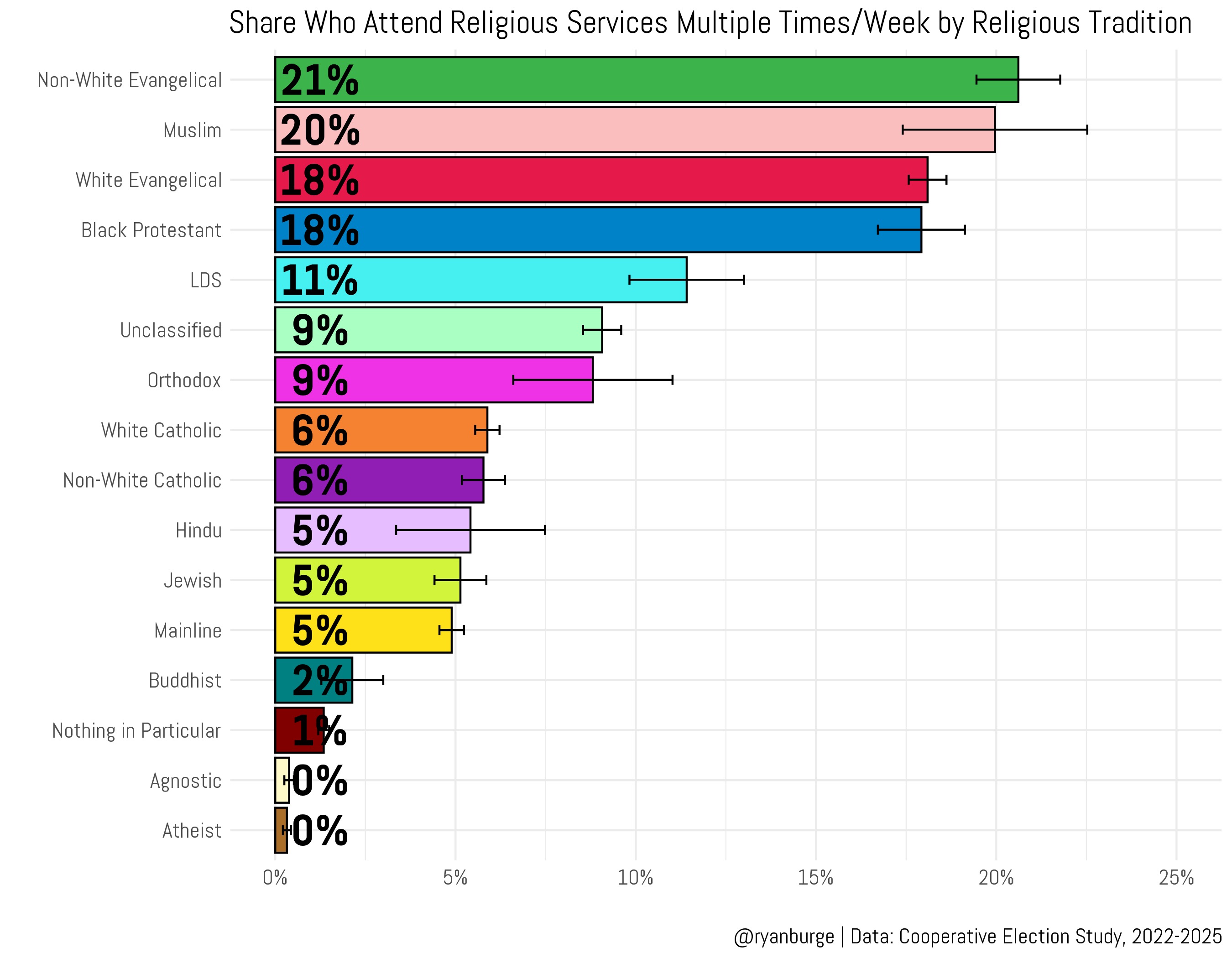
Not only is Sunday morning attendance down in many churches, but less people are attending as frequently as members once did. I’ve told the old joke that “I had a “drug problem” when I was a kid. My parents’ “drug” me church Sunday morning, Sunday night and Wednesday night too.” It’s not happening as much these days. In part, many churches no longer have Sunday night services. While many churches still offer Wednesday activities and separate youth group gatherings, participation is still down (apparently).
No doubt, there are several factors have led to lessening of participation in religious activities. Competing elements for one’s time (both for the adults and minors); homes where both parents are working or single parent homes that leave less time for religious or extracurricular activities; and as stated the cessation of services offered by churches.
The obvious effect of these numbers (no matter how legitimate the reason) is a lessening of discipleship. Less face time in religious services and around fellow believers leads to less discipleship, less engagement and less connectivity to the church and the things of God.
Much like the old argument, “which came first—the chicken or the egg?” one can debate the question– has a lack of discipleship led to less participation in religious services or has a lack of religious services led to a discipleship lapse? The answer most likely is “Yes.” It’s both. We have a discipleship problem that has led to many not feeling the necessity to be present as frequently within the church community. People see little value in attendance in the other gatherings. Additionally, less frequent participation has created a less discipled membership. The greatest service in the world can happen, but if one isn’t there, an individual can’t learn, grow, or be blessed.
If the goal is to make “Christ-like disciples in the nations,” does 18% participation in multiple services indicate that we are failing in that endeavor? Can a person become Christ-like if only attending one service a week? The answer might be in what constitutes or qualifies as a “religions service”? Does Burge’s survey include a small group that meets during the week? What if one meets regularly with a religious mentor or is independently motivated to biblical and devotional reading and prayer?
Obviously, one can grow in the Lord through those means and become a devout follower of Jesus without attending multiple services in a week. It’s possible. But is that happening on a regular basis? It seems not likely. Generally, for most people, community is what fosters growth. People thrive on peer-to-peer learning. Intentional discipleship is needed. There are soul-strengthening benefits of coming together on multiple occasions throughout the week. Conclusion: Maybe more than 18% of believers are actively being discipled, but whatever the number, it is not nearly enough. Former Point Loma professor Rueban Welch said it best years ago, “We really do need each other.”

