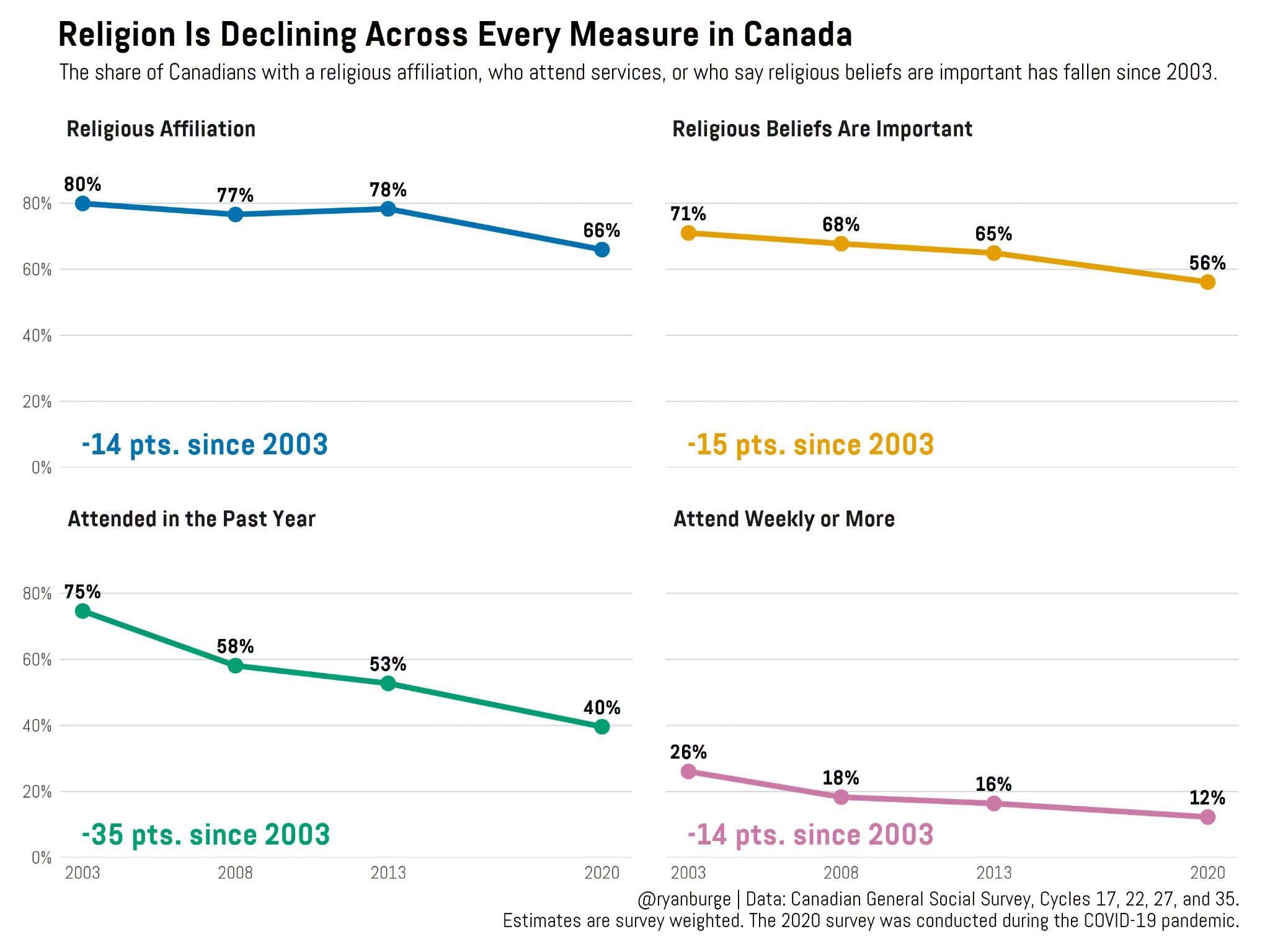
Ryan Burge recently released a series of graphs examining religious life in Canada (see graphs). Although the data only extends through 2020, the trends are troubling. They point to a decline in religious affiliation and practice. Logically, it seems those numbers have worsened rather than improved by 2026.
The Church of the Nazarene groups Canada and the United States together in the USA/Canada Region. Yet any geography buff knows that Canada is an enormous country, spanning a vast landmass and home to approximately 41.8 million people. The Church of the Nazarene divides this expansive nation into five districts. Under the leadership of Canada National Director Mark Collins, the denomination has 365 licensed and ordained ministers, 148 churches, and 12,215 members across the country.
The Church of the Nazarene has a long and meaningful history in Canada. The first Nazarene church in the country, located in Oxford, Nova Scotia, predates the formal establishment of the Church of the Nazarene denomination, having begun in 1902. Remarkably, it continues to meet in its original building.
Canada is also home to Ambrose University in Calgary, the denomination’s affiliated educational institution. Over the years, Canada has produced many outstanding leaders. Perhaps the most notable is Edward Lawlor, who served as a general superintendent from 1968 to 1976. Raised in Canada, Lawlor also served as district superintendent in both Alberta and Canada West. More recently, Stan Reeder, a Canadian native, served as the USA/Canada regional director.
Like New England in the United States—where Vermont and New Hampshire rank among the least religious states—Canada presents significant challenges for those seeking to make Christlike disciples. The work is difficult, but it is not impossible. The spiritual challenges facing Canada should not lead us to despair; rather, they should deepen our commitment to prayer, mission, and faithful witness.
What Can We Do? We can pray.
- Pray for Mark Collins as he provides leadership and direction for the Church of the Nazarene in Canada.
- Pray for the five district superintendents: David Skidmore, Steven Ottley, Gordan McCann, Randy Barrington, and Rose Brower-Young.
- Pray for workers to enter the harvest fields, remembering Jesus’ words in Luke 10:2: “The harvest is plentiful, but the workers are few.”
- Pray that God will open doors for the gospel, strengthen local churches, and raise up new leaders.
- Pray for a spiritual awakening across Canada—a revival that renews the Church, draws people to Christ, and inspires a new generation of disciples.
- Pray that the Nazarene Bible College and Shepherds Circle (shameless plug) might assist encourage and equip pastors for the days ahead!
The USA/Canada Region is vast, diverse, and filled with both challenges and opportunities. Canada must not be overlooked, and its spiritual future must not be written off. The mission field is too important, the gospel is too powerful, and the call of Christ is too compelling for us to surrender hope.
Canada is not beyond the reach of the gospel. Let us pray, work, give and believe God for a revival. This land must not be lost to the Kingdom of God or to the mission of the Church of the Nazarene.